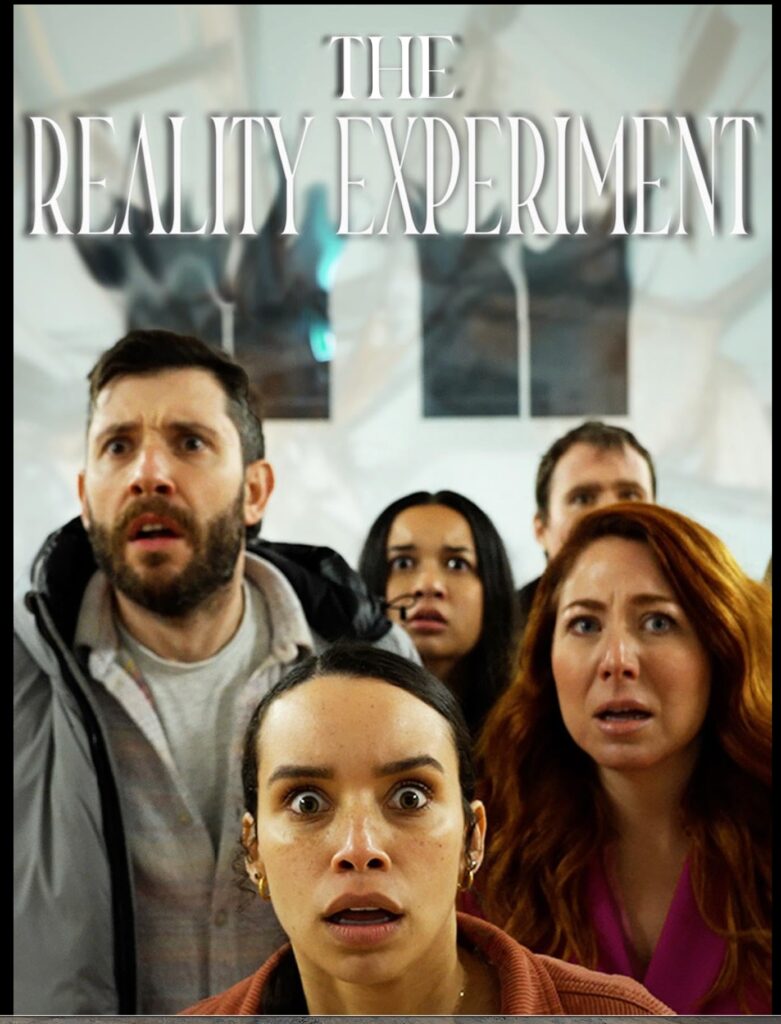
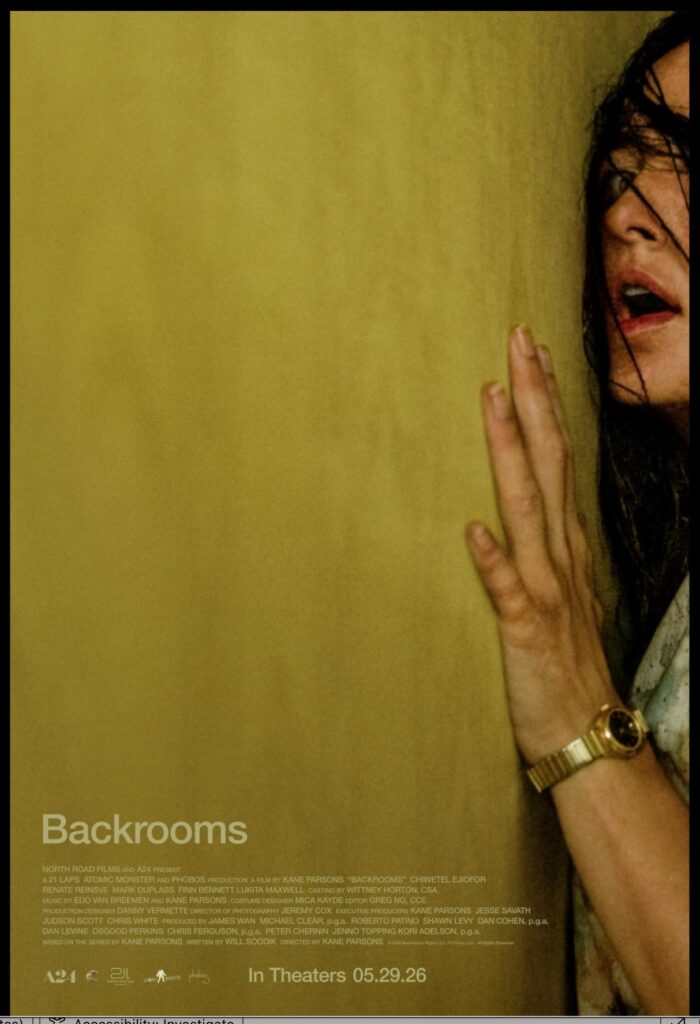
So I think at this point we’ve accepted that technology is going to kill us all one way or another. It’s like we’re playing an elaborate mind-game about which exact glitch will lead to our demise. After the much-deserved success of Backrooms (2026) along comes The Reality Experiment (2026), cut from the same techno-cloth. Plot setup: A kooky-haired British “researcher” named Jeremy hires a group of college students to be his guinea pigs for his eponymous project. They meet in a nondescript office park of some sort, sit in a circle, and each of them has a small white ball with a buzzer atop it: At Jeremy’s command they will all push the buzzer at the same time, receive a small electrical shock, and all of their “realities” will be altered or transformed into . . . what, exactly, is unclear.
The Reality Experiment
No spoiler alert here: I won’t give it all away. Jeremy—a research psychologist I guess you could call him—is rather feckless and scatter-brained. Seaton Kay-Smith plays Jeremy and does a good job of investing him with personality, even when he seems a bit cliché as the somewhat-ridiculous academic with extremely messy hair. The students are a mix of male and female, with the young woman Kelly (Livia Hendricks) emerging eventually as the Main Character. They push their buzzers simultaneously and voila, the world is not the same as it was before. One woman has a new iphone (yay). Another doesn’t recognize the people in her Facebook page. The worst is Paul—a rather hangdog chap—who seems to have lost his wife and kids in this new reality. From that initial setup the rest of the film unfolds, and answers, various mysteries and subplots. It’s all a bit like Backrooms.
Backrooms
As in Backrooms, the altered reality of their experiment takes a sinister turn. Once they change realities they can’t get back to their original selves. They keep fiddling with the buzzer device (powered somewhat comically by two AA batteries) and rewarping reality to disastrous effect. Although it’s as highly improbable as Backrooms it does hold together well: After being skeptical of the film’s quality in the first five minutes or so, I kept watching and was hooked by the mystery. Roughly three-quarters into it the story starts to weaken. When a giant duck appears and seems to eat one of the characters, it most resembles Backrooms. But, as they say, “All is not what it seems.” Is it a good movie? Kinda. I was hooked. The ending didn’t quite make it for me, but there’s a sly nod to what the power of consciousness can achieve.
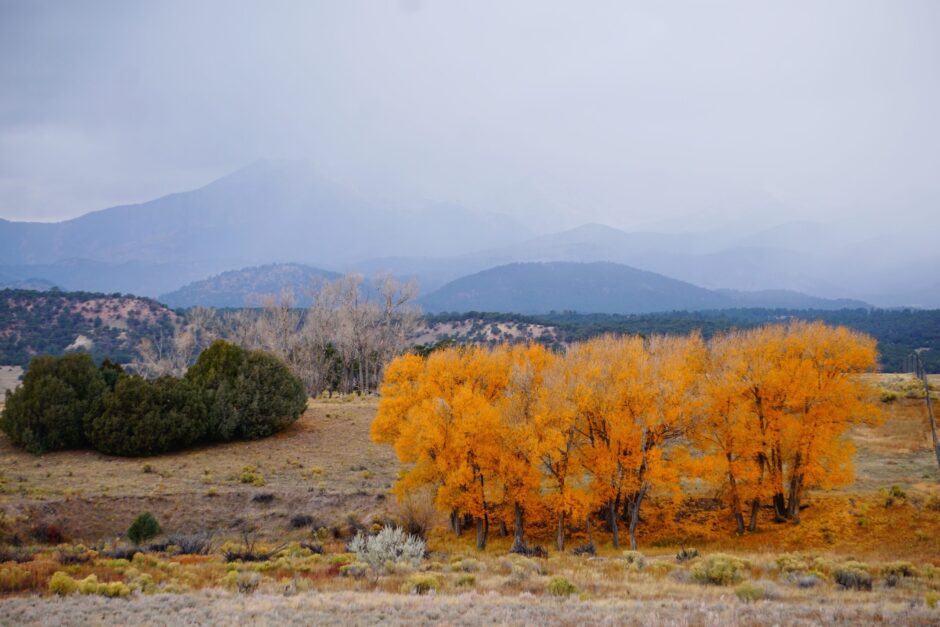
So I haven’t posted anything lately because I’m too busy enjoying the Fall color, with friends and family visiting. My home in the Sangre de Cristo mountains of southern Colorado has been gorgeous of late. It only comes once a year so you have to enjoy it while it lasts.
Those are the hillsides just north of several 14,000-foot peaks, such as Crestone Needle, Crestone Peak, Kit Carson and Humboldt Peak.
That’s Horn Peak in the very center of the photo, to the right of the aspen.
The aspens are especially lovely this time of year.
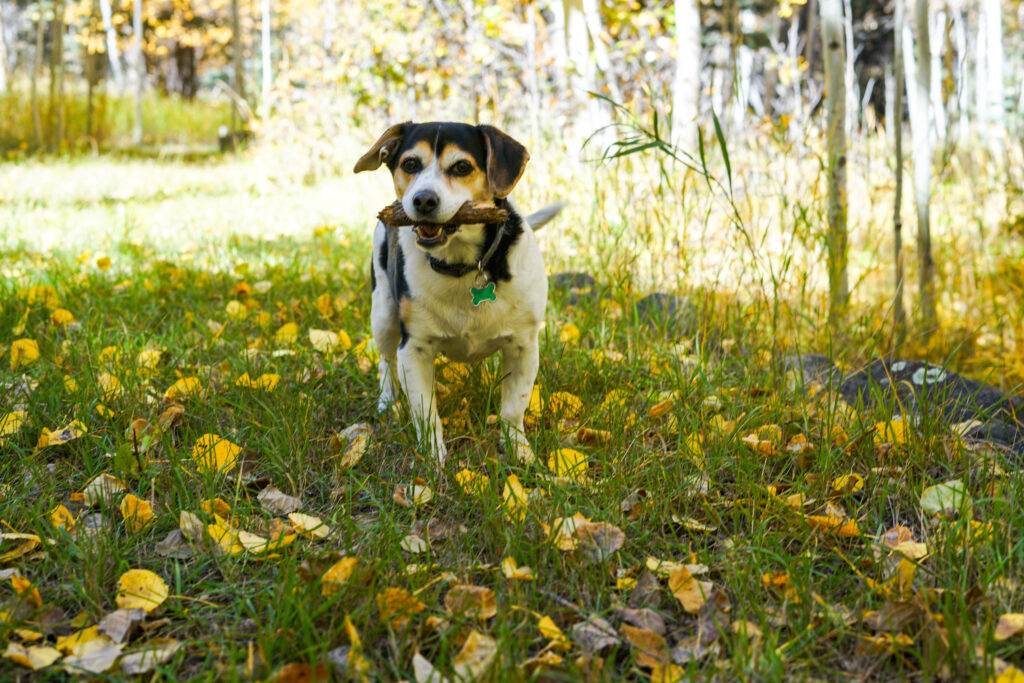
And even my dog Swishy is enjoying the leaves, and a stick.
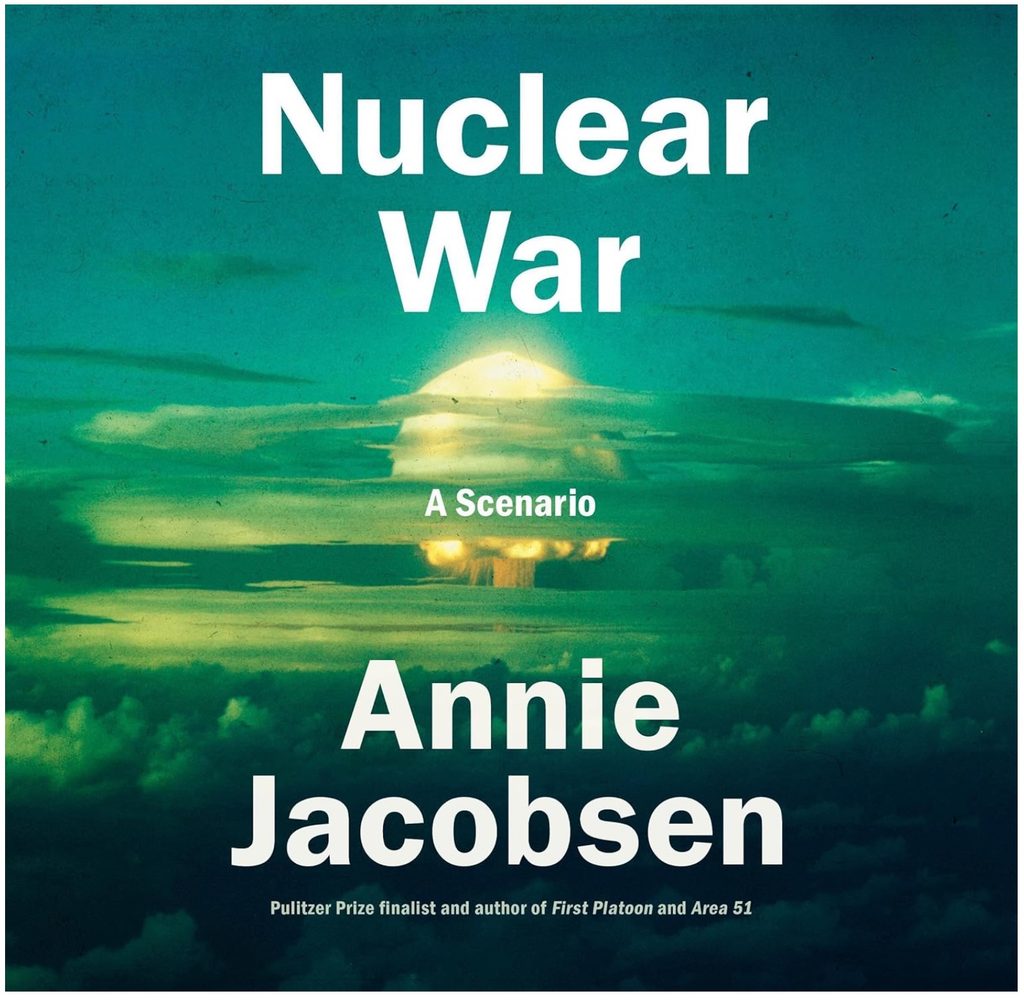
So like most people (I assume), I don’t dwell on the threat of nuclear war too much. Yes, it’s a Sword of Damocles hanging over our head. But it has been for some 81 years, right? Surely it will continue this stasis that preserves . . . gulp . . . our shared civilization and very existence? Well after reading Annie Jacobsen’s Nuclear War: A Scenario (2025) I’m not so sure. This may be the scariest book I’ve ever read. Perhaps more accurately: This is a lucid book about the frightening and fragile reality in which we all live.
I’m not thrilled with this book jacket. The nuclear mushroom cloud could be more dramatic.
First off, the obvious: There’s no shortage of doomsday scenarios floating and bubbling in our culture and news at the moment. A.I. could kill us all! (Maybe but nobody knows.) Bioterror attacks engineered by A.I. could kill us all! (One of the scarier possibilities.) Nanotechnology will kill us all! (See the doomsday-danger speech in Season Three of Silo.) Climate change will doom our planet! (Data driven warning.) But climate change is slow and inexorable, and more a matter of adverse climatological consequences over time than an immediate menace.
So let’s talk speed: Nuclear war would be ungodly fast. As Jacobsen notes, President Reagan in the Eighties famously lamented that any American president would have approximately six minutes to respond to the threat of an incoming nuclear missile. Six minutes. And that only reflects how long he/she would have to access the famous “Nuclear football.” Then the missiles start flying. As more than one quote in Jacobsen’s book warns, “The world could be over in two hours.”
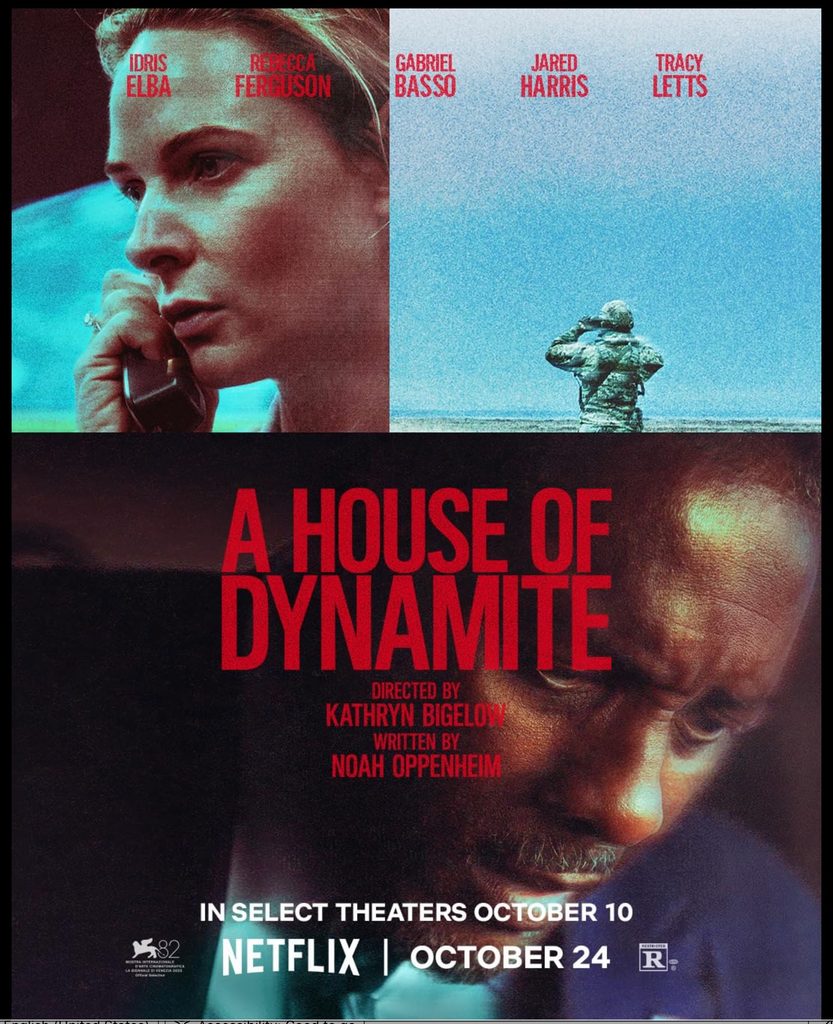
Nuclear War: A Scenario has essentially two parts: The scariest part, in my opinion, is the careful description of the various technological systems in place to enable, facilitate and control the danger of nuclear war. The recent Netflix film A House of Dynamite (2025) also highlights the absurdity of this danger. It stars Rebecca Ferguson, who also stars in the Apple TV series Silo, as the main character Juliette Nichols. She’s a doomsday bookend of sorts: House of Dynamite builds up to a nuclear Armageddon and Silo imagines a post-apocalyptic world in which survivors live in fifty large silos underground, and have been doing so for four centuries. (Ferguson is excellent in both roles.) And the scariest part is how fast of all it would happen. In her scenario, we have about a half-hour from the moment the first missiles are launched before they start landing and other missiles launch in retaliation—all over the world.
The second part of the book is the “scenario.” It’s fictional, and for that reason I find it less terrifying. It involves the North Koreans, Russians, and Americans making decisions to launch many nuclear-warhead missiles (and bombers), totally destroying the world as we know it—at least the northern hemisphere. She doesn’t mention Africa or South America. Or China for that matter. I can quibble with whether the North Koreans would start such a futile war, whether the Russians would then exacerbate it, and whether the U.S. would launch a massive strike in retaliation. One of Jacobsen’s rhetorical arguments is MAD (Mutually Assured Destruction) does not work as a peace policy. All it takes is one bad actor to violate it, and we’re in a world full of falling nuclear missiles. (As this scenario goes, at least.)
The unnerving speed to ultimate disaster: The book is framed by time, beginning with a quick history of the buildup of the world’s nuclear arsenal from 1945 to the present. Jacobsen then relates the SIOP (Single Integrated Operational Plan for General Nuclear War), which details how the U.S. would respond to potential nuclear scenarios, including a First Strike. Then Part II unfolds the nuclear scenario: the first chapter in that Part has the subhead Four-Tenths of a Second After Launch, which is referring to the first launch of a North Korean nuclear missile toward the continental United States. The rest of the chapters follow that pattern, followed by 1 to 3 Seconds After Launch followed by 4 Seconds etc. All of the events described in her scenario happen way too fast. One thing that strains credibility is how quickly Jacobsen imagines our forces respond. If the POTUS has only six minutes to respond to an attack, what makes us think he’ll be available in those six minutes? What if he’s too busy posting angry screeds on his own Truth Social media platform?
Brief aside: The “scenario” involving the U.S. President is the only thing that approaches humor in Nuclear War. I think it’s inadvertent: The fictional POTUS doesn’t even seem to know what his role in a nuclear war is. The generals get frustrated when he won’t supply the attack codes. But it’s clear from Jacobsen’s description of our nuclear systems: The U.S. President has the ultimate—and only—power to launch. Now that’s beyond scary. In such an apocalyptic scenario, do we really trust Trump to do the right thing?
Rebecca Ferguson should win an Oscar for Apocalypse Queen
To be clear, Jacobsen doesn’t imagine the POTUS as being Trump, or any other recognizable politician. He doesn’t come across as a fool, either. He doesn’t want to retaliate, or even make the decision of whether to launch nuclear missiles or not. (He also ends up dead.) House of Dynamite stars Idris Elba as the fictional POTUS, as well as a terrific Jared Harris as the Secretary of State. This fictional POTUS is not unlike his counterpart in Nuclear War: A Scenario. Neither of them wants the decision. Jacobsen notes that many past presidents have been woefully naïve about their role, and that some of them seem not to want to know. I don’t blame them. But if push comes to shove (nuclearly speaking), it might affect the history of our world if our POTUS doesn’t do the right thing. What would that be? Who knows. But launching hundreds if not thousands of thermonuclear-armed missiles never seems it would be the “right thing” to do. Unless you want to kill us all.
Nuclear War: A Scenario is quite rhetorical. And Jacobsen convinced me. Of what, exactly? We shouldn’t even have nuclear weapons. It’s madness. Fueled in part by an irrational belief we can point civilization-ending weapons at each other indefinitely and not expect a dire outcome. Lastly, I suppose I should address this question: Is it a good book? Yes, absolutely. It was a bestseller when it (originally) came out two years ago. I read the 2025 update with its updated Afterword. It’s addictive. Although I didn’t find the fictional “scenario” scary, due to its being fictional, it’s still riveting. You rush through it to the end, which is really The End.
After that we enter the post-apocalyptic reality, which Jacobsen only imagines in a quick summation, but thanks to the folks at Apple TV, we have the series Silo to do that. I confess to joining the Silo fandom rather late, as I didn’t start Season One until Season Three was being advertised. But now I’ve seen all three seasons, and expect a fourth. Spoiler alert: If you don’t want to hear some observations from the Season Three finale, don’t continue.
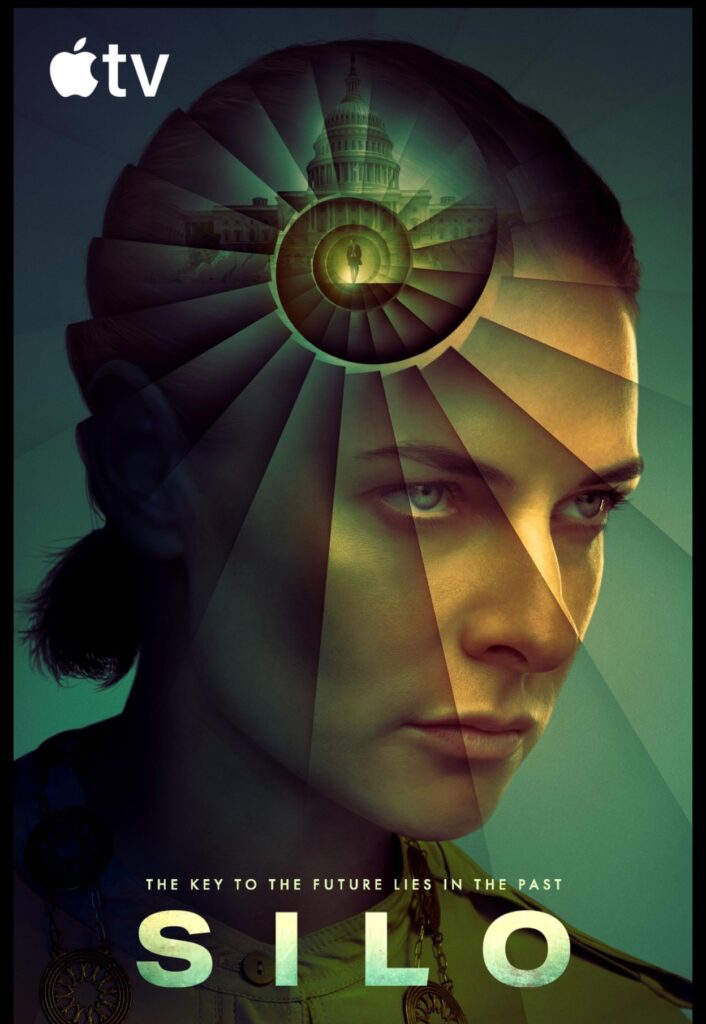
Now that’s a classy design
In the first two seasons of Silo the actual cause of whatever apocalyptic catastrophe occurred (which seems to have been four hundred years earlier, more or less) is obscure. It’s hinted at and flirted with, fairly obliquely. This viewer had actually ruled out nuclear apocalypse because there was no mention of radiation. I was wrong: In the finale of Season Three a nuclear weapon explodes (on the horizon somewhere in the distance, beyond the fifty silos). All these silos are the brainchild of a techworld billionaire named Per Stenson, who most resembles an Elon-Musk stand-in. He’s convinced the apocalypse will happen, and has undertaken the gargantuan (and expensive) task of constructing fifty silos (each of which holds around 10,000 people) and populating them, with the intention to save humankind. That all sounds nice and dandy. Except from several clues I suspect Per Stenson actually knew of and maybe even engineered the apocalypse to begin. (The character of Per Stenson is played by Colin Hanks, Tom Hanks’ son, who is quite good in the role.)
What to think of all this nuclear threat? We have to sleep at night, don’t we?
I don’t have any answers for that.
It’s not like we live in a world where we all get along. As of the first of October 2026, a headline in CNN this week: “Putin warns Russia is prepared to use ‘all weapons,’ including nuclear, to protect Kaliningrad.” Or this quote from the NY Times: “Foreign Minister Abbas Araghchi told “Meet the Press” that Iran was fully prepared for a new round of fighting, ‘even if it comes to a doomsday war.’”
These are only a few ominous rumblings from some so-called “leaders.” Trump has threatened to “wipe Iran off the map.” Good god. Tone it down, people. Those threats feed into one of the biggest rational fears to emerge from Nuclear War: A Scenario: Our main hope for stability and safety resides in the people in charge doing the right thing. Lord help us.
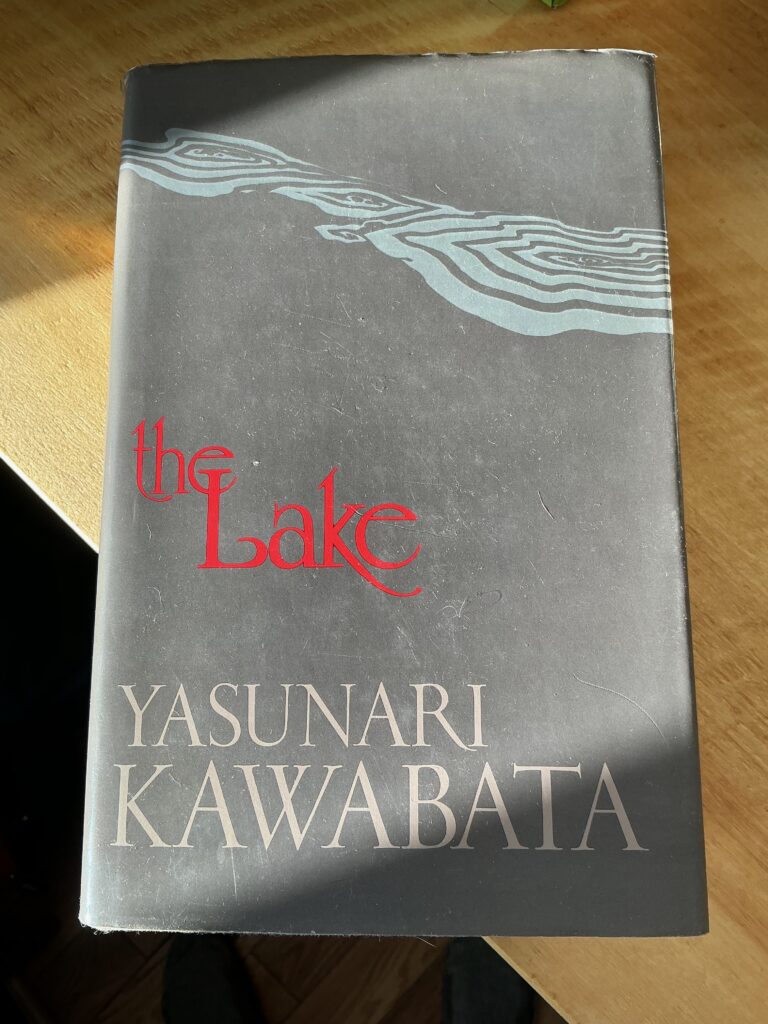
So to understand my appreciation for Mike Bezemek’s nonfiction book Mysteries of the National Parks (2025), you need to realize I’m a sucker for so-bad-it’s-good B-movies and books that don’t quite fit any category but are a joy to read. One that comes to mind is Yasunari Kawabata’s elegant short novel The Lake (1954). In Kawabata’s case, it’s a story about an extremely nerdy teacher guy who gets into trouble for romance with a student . . . if you can call it that. (It’s oblique and understated: They appear to have met secretly a few times, which caused a scandal.) But it’s one of my favorite novels. It violates many principles often taught in creative-writing classes: The main character is not likable. He’s kind of a mumbling, bumbling anti-hero. Nothing really happens. He visits a lake resort and attends an outdoor festival. That’s about it. (And nothing is resolved about his quasi-romance, if it is even that, with the student. She doesn’t even seem to particularly like him, either.)
Hardback of original American edition
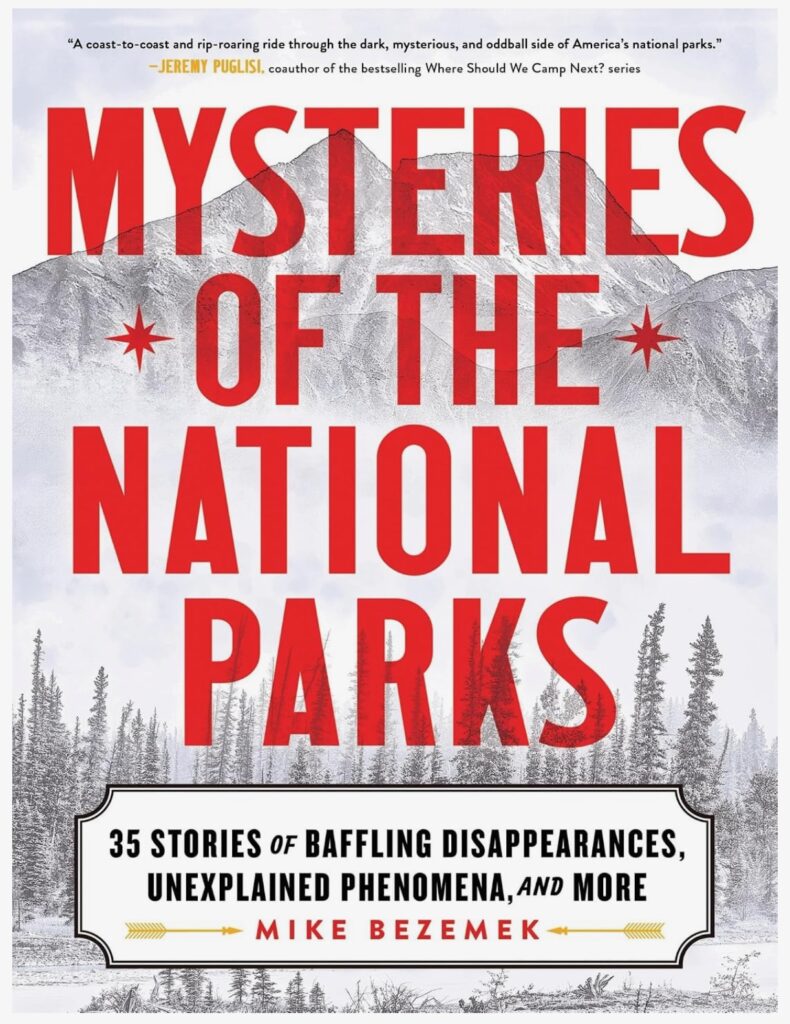
Which is all to provide context for my praise of Mike Bezemek’s Mysteries of the National Parks (2025). First off, it’s a kooky book. Its subtitle is “35 Stories of Baffling Disappearances, Unexplained Phenomena, and More.” But it’s really more like, “Here are some kooky things I decided to write about that connect very loosely to some national park, somewhere.”
It’s not the parks that are mysterious
Consider Chapter 11, one of my favorites: “How Was Heaven’s Gate Named One of the Worst and Best Films of All Time?” What exactly does the infamous Michael Cimino bomb of 1980 end up as a National Park mystery? Well, apparently some of the movie scenes were shot in and near Glacier National Park. Or what about Chapter 1: “Did Kenneth Arnold Spot the First Flying Saucer?” That took place somewhat close to Mount Ranier in Washington State. I do take issue with the “Yellowstone” story, which is Chapter 10: “Is Murder Legal in the Zone of Death?” There’s no actual murder, and no actual death zone. Perhaps a better title/subject might be, “Why do tourists taunt the bison and get thrown in the air?” Or perhaps the historically accurate: “Why did the tourist parents pour honey on their baby’s face and hold it out the car window for the cute black bear to lick off?” Answer: So they could get an awesome photo.
I have to hand it to Mike Bezemek, whoever he is. (Full disclosure: I know nothing about the guy.) It’s not so much about the mysteries of national parks as more of a humorous glimpse into one man’s odd obsessions that somehow, often tangentially at best, relate to national parks. Seen from that angle, you nailed it, Bezemek! I’m reading the whole book. Even if some of the chapters are pretty sketchy, such as Chapter 16: “Who Left Behind the Forgotten Winchester?” Someone forgot their rifle, leaning against a tree. End of story.
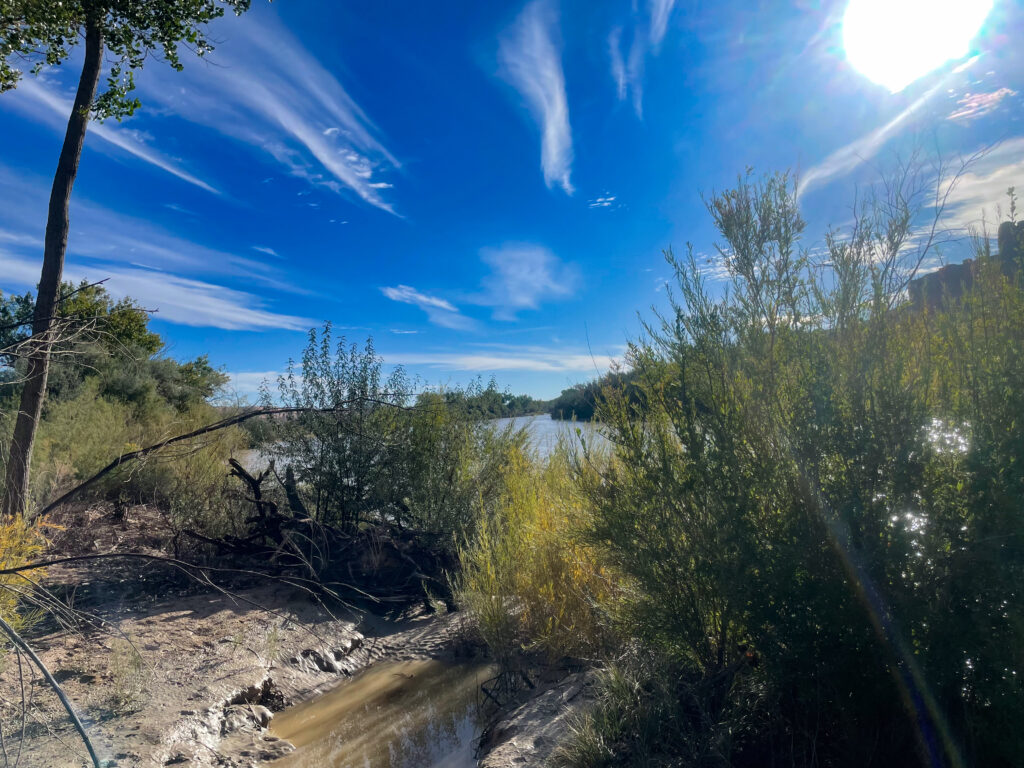
So last weekend my wife and I drove to Utah to spend a week kayaking the San Juan River. It’s a beautiful, relatively easy float—typically a calm river with many rare Native American petroglyph sites. It rises in the San Juan mountains of southern Colorado, winds its way west/southwest until it crosses into Utah, south of Blanding, near the tiny town of Bluff. We stayed at a great, quirky hotel called the Recapture Lodge. But the El Nino we’re now experiencing seems to have thrown a monkey wrench in the weather gears. The San Juan usually flows at around 500 cfs (cubic feet per second). When we arrived on Saturday (for a Monday launch) it was at 8,000! The river was many feet higher than usual, filled with brown silt. By Sunday it was 8,300 cfs. The banks were flooded into willow trees. We were lost in the Great Utah Flood of 2026! It looked like this:
Flooded San Juan River bank near Bluff, Utah
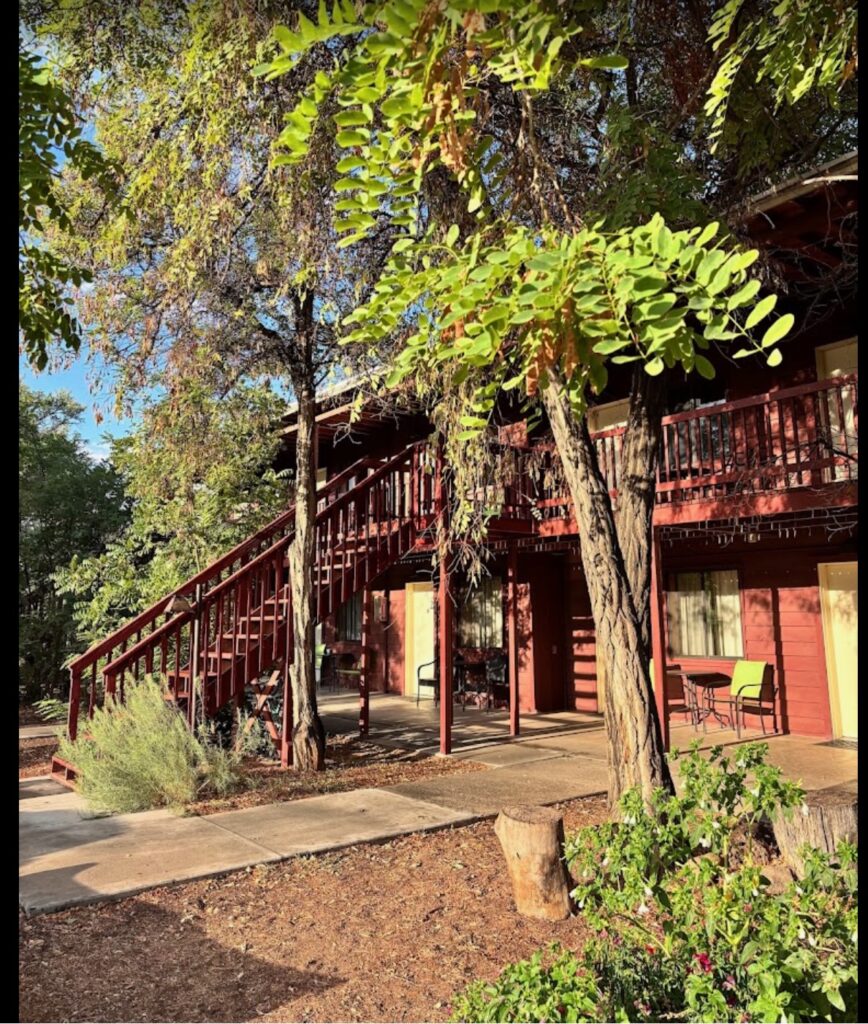
Kayaking a flooded river is certainly not impossible but rather foolish. It was full of silt, mud, and debris—mainly tree branches and whatever loose stuff could be swept away from the banks. Like drowned cows floating down the river. (I did not see any but a guest at our hotel reported a sighting of one.) And if you’re ever in the area, I heartily recommend the Recapture Lodge. It has a great location for the popular outdoor sports of southern Utah: rafting, kayaking, rock climbing, and mountain biking. Good breakfast and great proprietor, Jim. I’ve stayed there several times, and have read an essay but the terrific writer Joy Williams in which she says she always stays there when passing through southern Utah.
Our room was on ground floor behind those stairs. Very cozy and Zen-like.
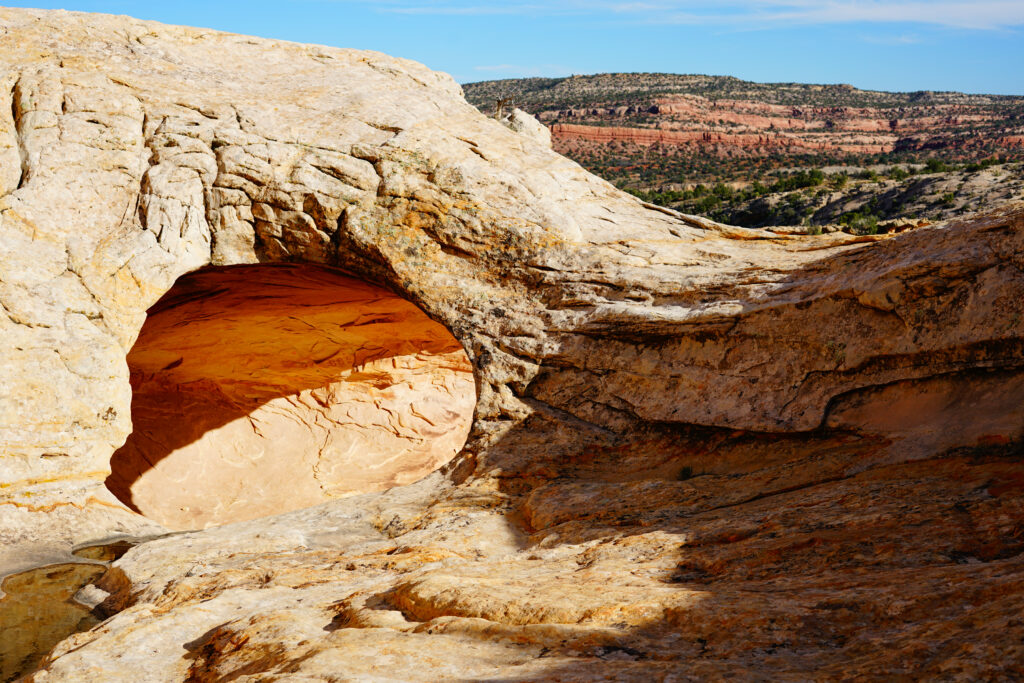
We planned five days on the river. (Our own self-guided trip, not a commercial thing.) Canceling the trip was disappointing of course but we’d be slip-sliding in the mud along the banks at every place we wanted to land, then scraping mud off our boats (and probably each other) after we did. So we bailed. Plus there was more rain on the way. Instead we did some awesome early-autumn hiking in the canyon lands of Utah. Here’s a gorgeous vista from the Butler Wash archaeological site. (It features cliff dwellings similar to the Cliff Palace at Mesa Verde National Park.)
Arch at Butler Wash archaeological site.
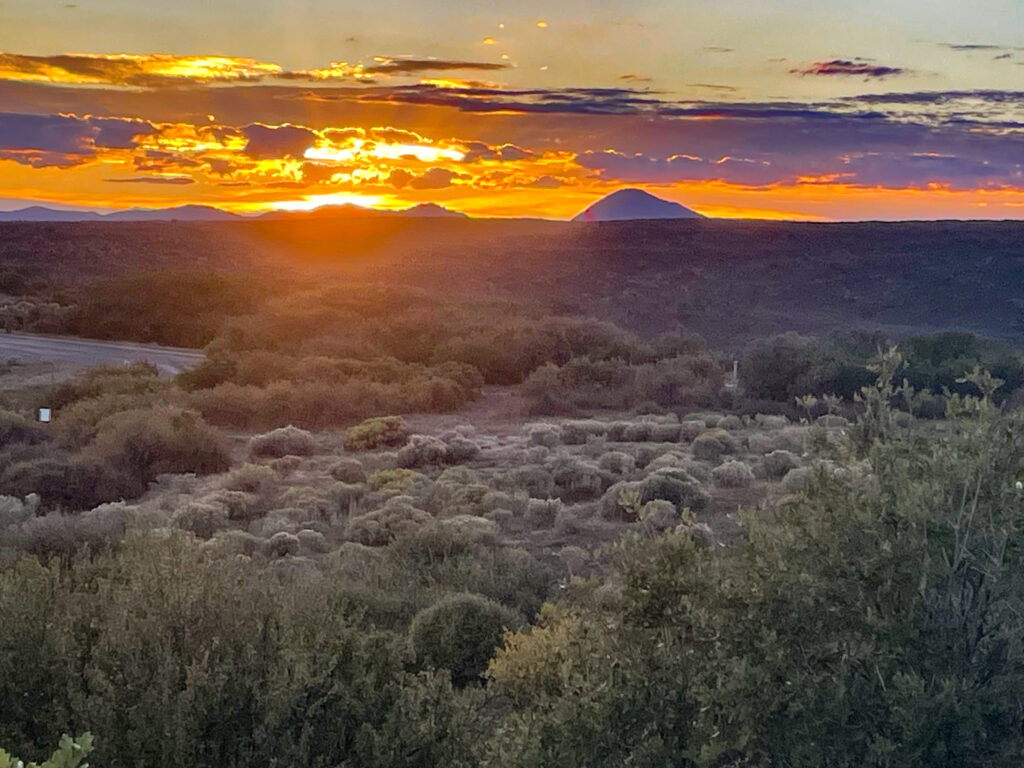
After hiking to sites in Utah we pivoted east to Mesa Verde National Park, one of my favorite places in the world. There’s a zen spiritual mystery to the mesa and the canyons. We stayed at the Far View Lodge, and had good views of the sunset.
View of Ute Mountain (center silhouette) near Cortez, Colorado, from Far View Lodge in Mesa Verde National Park
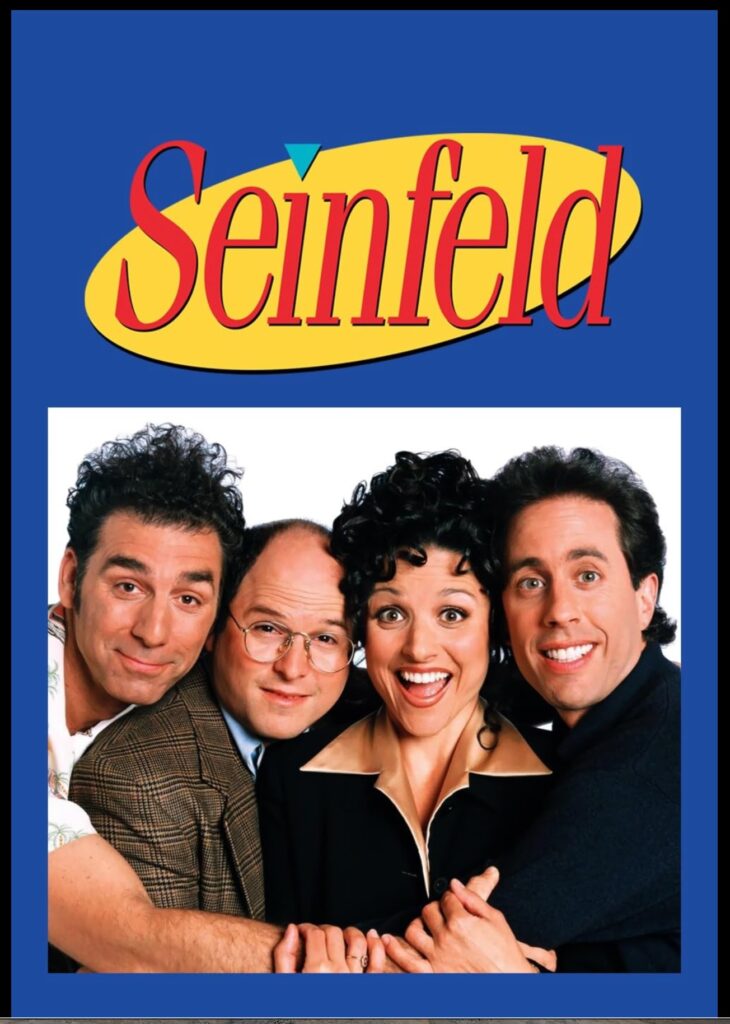
So I can’t post about the genius of Richard Yates fiction without recognizing that he is immortalized in a Seinfeld episode: “The Jacket,” Season 2, Episode 3. I stumbled upon this in a Wikipedia post no less. The story goes that Seinfeld co-creator and writer Larry David once dated Richard Yates’ daughter Monica and had a similar dinner experience as the one in “The Jacket,” in which infamous tough-guy actor Lawrence Tierney played Elaine Benes’ father.
Seinfeld stars look so young
Why was Richard Yates so grouchy? He was a terrific writer but his books did not sell. (It happens to the best of us.) There’s a figure quoted that none of his books sold more than 12,000 copies. And what’s worse, his novels were out of print late in his career! That’s adding insult to injury. While the two other writers I compare him to—J.D. Salinger and John Cheever—each had their bestsellers and popular acclaim, Yates languished in the publishing doldrums. I’d be pissed too. It makes Larry David seem a bit like a Forrest Gump character, the naif who stumbles his way through history.
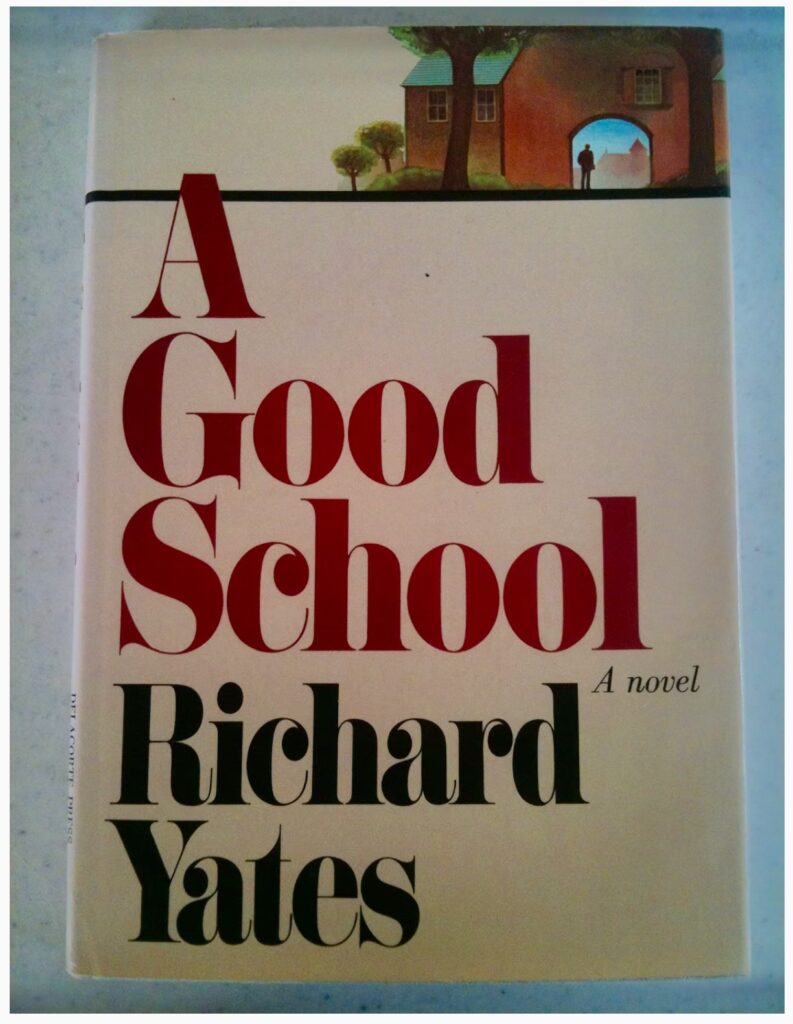
So I’ve just finished reading my third Richard Yates novel—in this case, A Good School (1978), about a dying prep school in Connecticut, in the 1940s. It’s touching, raunchy, and slightly weird in its gritty depiction of an all-boys school during WWII. Cut to 2026: In this bizarro-world era in which we live most fiction/film concerns the fantastic, unlikely, or impossible. Witness the many stupid-hero movies and books featuring ghosts, demons, vampires, and wizards. To some extent, that’s fine. People like fantasy. I’m all for imagination. But at times it seems to seep into the culture at large. People believe in lies and liars and factual accuracy doesn’t seem to matter anymore. It’s a symptom of the death of Realism.
Hardcover book jacket
I’m sure there are some excellent realistic fiction writers out there in the world writing at this point in time, but generally no one seems to be paying much attention to them. For instance, a writer I greatly admire, George Saunders, has a new novel out: Vigil. Some of its main characters are angels. Funny angels, kind of. Slapstick, even. It’s satire/fantasy. But if we go back in time a few decades, we come upon a neglected writer who is a master of Realism, Richard Yates. He’s like J.D. Salinger who has grown a pair. Or the flip side of John Cheever. All three are among the finest writers of the post WWII era.
It’s all about time and place
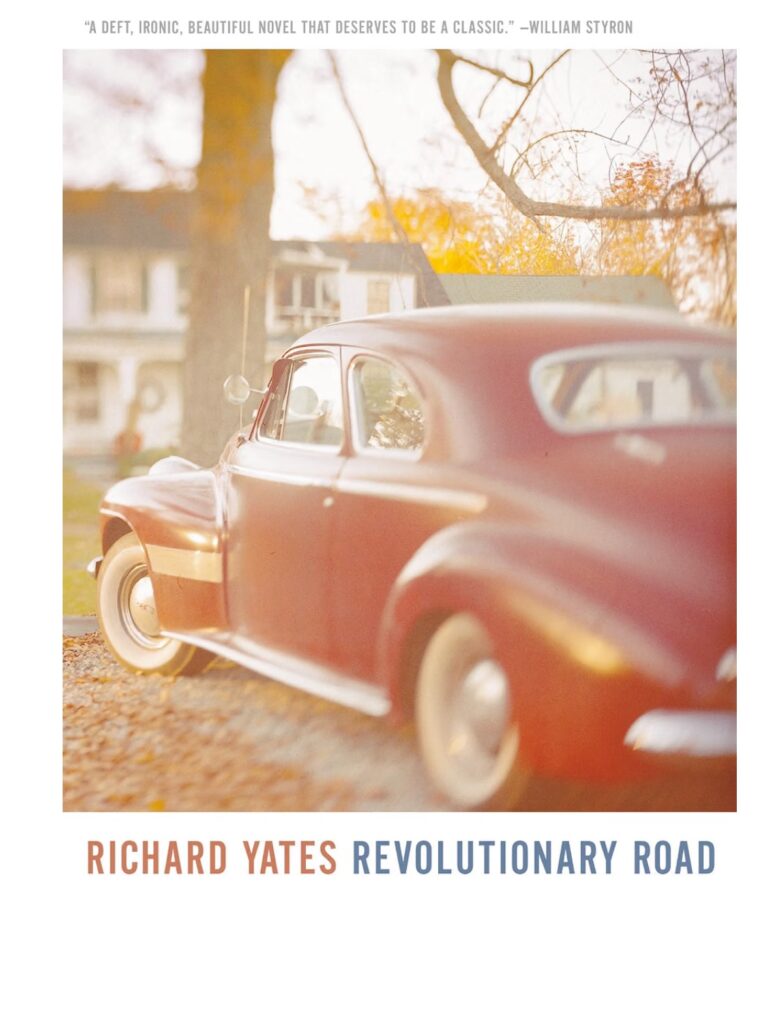
Revolutionary Road (1961) is a good place to start, as it was Yates’ first novel and a Finalist for the National Book Award in 1962. For whatever reason, Yates was a writer greatly admired by other writers and critics, but who never achieved popular success and readership (join the club). Supposedly no book of his ever sold more than 12,000 copies—which is meager, for a major writer at least. His reputation was revived in the late 1990s and throughout the 21st century. As an example, in 2008 Revolutionary Road was made into movie starring Leo DiCaprio and Kate Winslet. That was actually my first taste of a Richard Yates story. It’s bleak. But both DiCaprio and Winslet do a great job and make it heartbreaking, and with an early-career performance by David Harbour as a smitten neighbor.
That image looks anachronistic for the 1950s-60s
My favorite so far is The Easter Parade (1976), which is a kind of novel that we don’t seem to produce anymore: Emily Grimes, the main character, stands for something, exemplifies a certain kind of person in a particular time and place. (Sure, many novels feature characters like that to some extent, but here Yates nails it.) So does the actual parade in the novel, a lost era, time gone by. Emily is a career-minded young woman, something of a sexual free-spirit, and all her hard work in Manhattan and love affairs dry up as she approaches middle-age, when she feels washed-up and spent.
Yates is considered a master of The Age of Anxiety. Perhaps he was never quite popular because he portrays life with a healthy dose of failure and disappointment. Consider the Tolstoyan tone to this opening to The Easter Parade: “Neither of the Grimes sisters would have a happy life, and looking back it always seemed that the trouble began with their parents’ divorce” (1).
I don’t know why he didn’t achieve popular acclaim. It’s the real world. I love it. It’s not like I’m some purist, above-it-all kind of writer. I’ve often imagined the fantastic in my fiction: In my story “My Wife, the Unicorn” I described a world in which the U.S. is in a low-level Civil War and people are transforming into animals. His wife morphs into a unicorn for comic effect. It echoes Carol Emshwiller’s great little novel, Carmen Dog (1990) or William Kotzwinkle’s Dr. Rat (1976). My recent story “Camp America” features an A.I.-assisted law enforcement division. So, sure, dream away. Imagine away. But sometimes we need a depiction of the real world that hits home, that makes us sit up and take notice. Richard Yates is a master at that. If you haven’t read him, you should.
[Note: This personal essay was originally published in the Superstition Review, Spring 2016 issue. It was a terrific online lit magazine published by Arizona State University. Unfortunately the Superstition Review is no longer with us, so I’m reclaiming the essay, a decade later, and giving it a new life here, by popular request.]
My daughter cohabits with approximately 427 stuffed animals. If this were like the early days of The Book of Genesis and the skies were to open and deluge us with forty days and forty nights of rain, we could repopulate the Earth with our own Noah’s ark of stuffies. Only they wouldn’t be alive, technically.
That’s actually a moot point. For my daughter, these animals are alive. She has an elaborate Invisible World that is populated with stuffed and make-believe beings, friends, and furniture. In this Invisible World, the animals rule. If a Great Flood were to come, she’d be ready, with her entire troupe. I can imagine her drawing up the plans for her animal boat, although she’d want to know exactly what a “cubit” is.
It would be called Lili’s Ark, in honor of its namesake. Names are important. My daughter knows this. She has named each and every one of her stuffies.
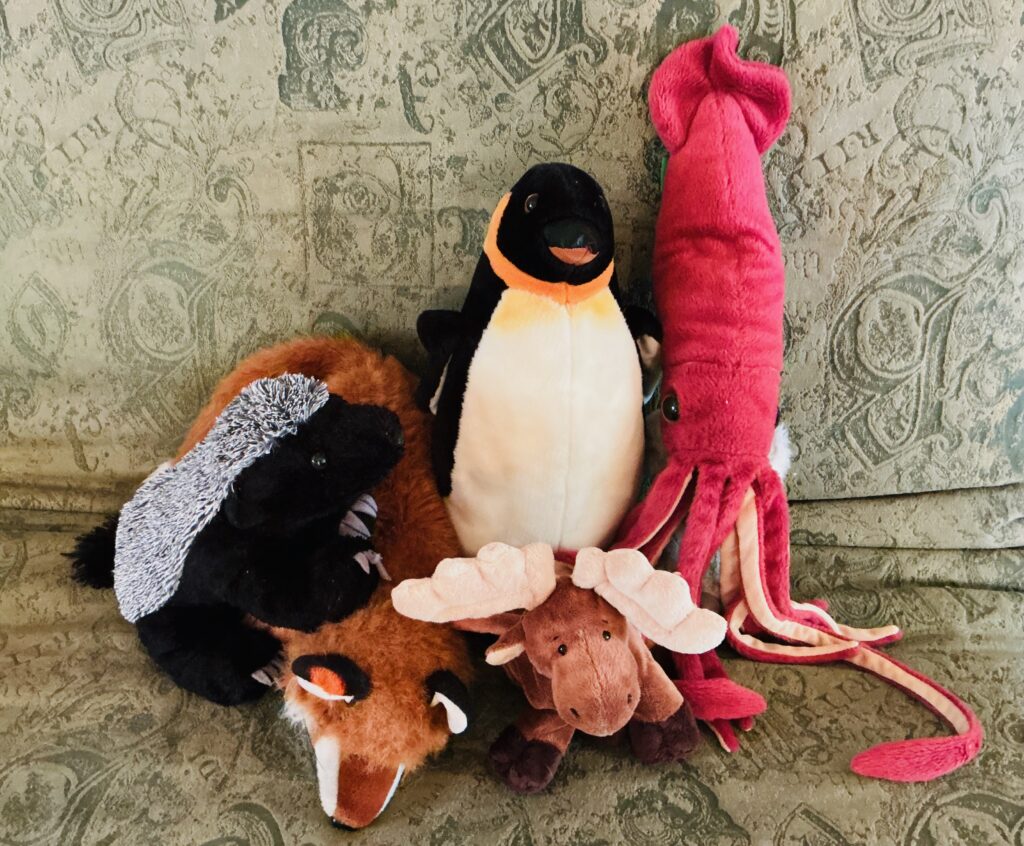
Our most recent adoptions include a kangaroo mother with her joey—Rosa Parks and Little Baby Washington. These were rescued from a gift shop at the Smithsonian Natural History Museum in Washington, D.C. We also adopted a Giant Squid (James Earl Faster) and a Honey Badger (Hamilton), who was my choice. One of her dragons (we have several) is Jo-Jo SillyBilly, who makes a strange gargling growl if you squeeze his paw.
I confess my favorite of all is a rather large penguin named Aquatica Mortimer. He’s the handsome fellow in the center of the photo below:
Aquatica Mortimer and Friends
He was adopted into the family at a SeaWorld amusement park in San Antonio, Texas. On the day we visited, as far as I could tell SeaWorld was merely a rather elaborate, land-locked, water-themed, gigantic gift shop. The killer whales—one of the main draws, like lions at a safari park—were on break. We couldn’t see them, but I imagined them in a back room, smoking cigarettes and doing tequila shots. Talking about which trainers they’d like to hold under the water just a little too long.
Lili loved it. Her idea of vacation is an endless stream of gift shops. As long as they are well stocked with stuffed animals. We have visited Yellowstone National Park many times in her eight years of existence (the first time before she was two). She has backpacked there several times, including more than once hiking six miles on her rather short, little-girl legs, doing a good job of keeping up with the grown-ups.
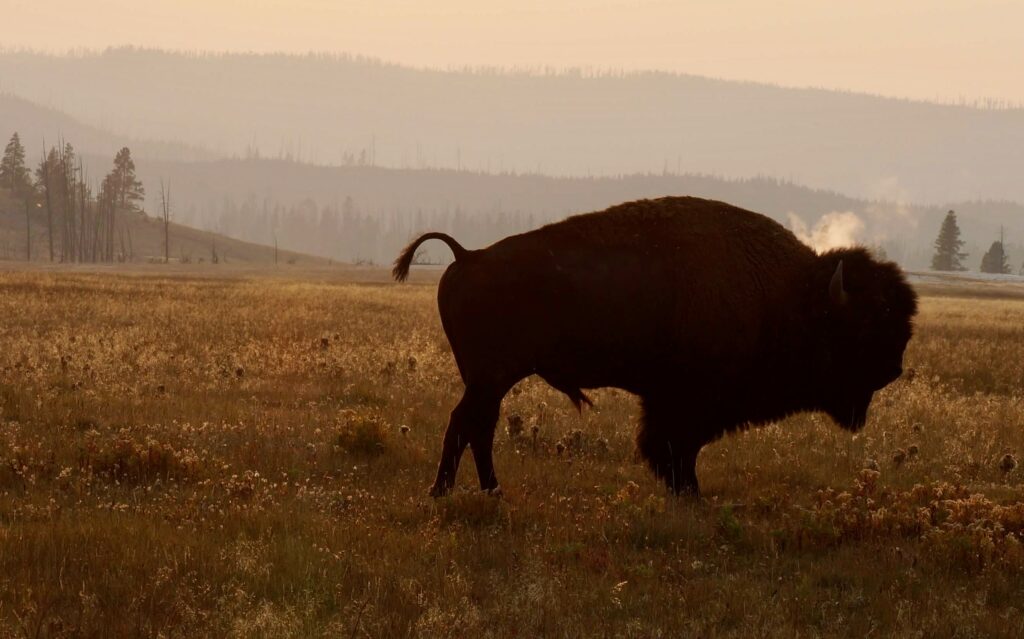
One of her most memorable moments: While we were making dinner around the campfire in the Imperial Geyser Basin, not far from the famous Firehole River, a large Buffalo (or American Bison, okay?) walked right through our camp. It was almost close enough to touch. We didn’t know what to do. We didn’t even see it coming until it was there, upon us. We looked into its eyes and froze. It kept walking.
After it was fifty paces from our camp, it lay on its back and squirmed, scratching its back, like dogs do. Lili was thrilled, and still talks about it to this day. She keeps trying to tell the story the right way, again and again, in various journal entries. Most of them involve some form of the sentence: “A buffalo walked through our camp!” She calls an exclamation point a “gusto mark,” and uses them liberally.
Our bison friend
All these gifts shops and stuffed-animal buying come with an emotional cost. Once, in Glacier National Park, at the Two Medicine Lodge (we loved the name) gift shop, Lili clamored for a little stuffed-animal Lynx, which I didn’t want to buy for her. We’d already bought her a number of stuffies on that trip and at the moment I thought it was one too many. She pouted and sulked. It wasn’t expensive—five or eight dollars, I believe—and I gave in. Then I became angry with her for not saying, “Thank you.” On the return to our camp, I pouted and sulked.
I still feel bad about that. Yes, I should not spoil her, in principle. I don’t want her to become another Veruca Salt, that pretty brat from Roald Dahl’s Charlie and the Chocolate Factory—who is, by the way, one of Lili’s favorite characters. But she’s not. She can pout and sulk and get over it within minutes. I can too. But I realize I shouldn’t let anger get the best of me, shouldn’t pout or sulk like an eight-year-old. It’s my role to be mature.
When I’m angry I feel like William Hurt in Altered States (1980)—that Eighties cult film, an adaptation of a Paddy Chayefsky novel (1978). In Altered States Hurt starts as an anthropology professor who messes around with sensory-deprivation tanks and does hallucinogenic drugs (a kind of handsome Carlos Castaneda, as it were), so much that he undergoes a kind of reverse evolution. Eventually he becomes an apelike creature, a Homo erectus perhaps, terrorizing the zoo and one comely graduate assistant in his bed (well, he doesn’t actually terrorize her). He just grunts. That’s what I feel like when I lose my cool, with its commiserate guilt/remorse.
The animals help when I reach this stage of devolution. I confess that I sometimes buy forgiveness with the purchase of stuffed animals. I know this is wrong. But still, I think, it’s not that wrong. If it’s a sin, it’s pretty minor. A venal one at best. I feel remorse for letting anger get the best of me, but seriously (as Lili is wont to say), remorse for buying her another stuffed animal? Not much.
It’s been a constant chore, teaching her to be polite, good manners and all. To say her please and thank yous. Friends and even strangers will remark to us how polite she is, and my wife and I are like, “You don’t know the half of it.” Discipline for us has been an on-going task, fraught with turmoil and guilt and general success. I wish I could say I’ve never raised my voice. I wish.
We don’t spank her, thank god. I can’t even imagine the guilt that would haunt me if I did. Once I asked married-with-children friends of ours if they ever spanked their children and the mother replied, rather haughtily, “We never hitour children.” Touché! And persuasive: Who wants to be the parent who proclaims, “When my child doesn’t do what I ask, I hit her!” So we don’t. Instead we reprimand. We nag. We repeat ourselves. A lot.
Lili is an only child. I don’t really like that term, but it’s accurate, I guess. There’s an implication of being spoiled (probably, in a way), but also of somehow pampered, unrealistic. What is realistic? There are lots of “only children” in the world now. Many if not most of Lili’s friends are also “only children.” Back in the day (say, Kansas during the Dust Bowl years, living in a sod house, covering the faces of the fifteen children with gauze masks to keep out the dust) this was a rarity, when maybe tuberculosis was a common cause of death.
But seeing as she doesn’t have other siblings to spend time with, she’s gravitated to the Animal World. She crawls around the floor daily, impersonating one animal after another. Yesterday she was a wolf pup. “They’re so cute!” she exclaimed. Variously she has assumed the personalities of honey badgers, duck-billed platypuses, and black-footed ferrets. She believes it is wrong to hunt or to kill animals in any way. (We are, after all, animals ourselves, as she likes to point out.) Perhaps she does take this to an extreme degree: She hides flyswatters, won’t even let me use ant powder. Given her druthers, she prefers animals alive, up close and personal.
As she pointed out during our recent trip, the Smithsonian’s Museum of Natural History is really a dead zoo. The Louvre of Lost Animals. That’s where we adopted Rosa Parks and Little Baby Washington, two fine members of our 672 stuffed animals (we’ve purchased some new ones since I started this paragraph).
Thankfully, most of our stuffed animal encounters do not involve reprimanding, feeling guilty, or forgiveness. Mostly they involved cuddling. And sometimes minor heroics. Quests, no less.
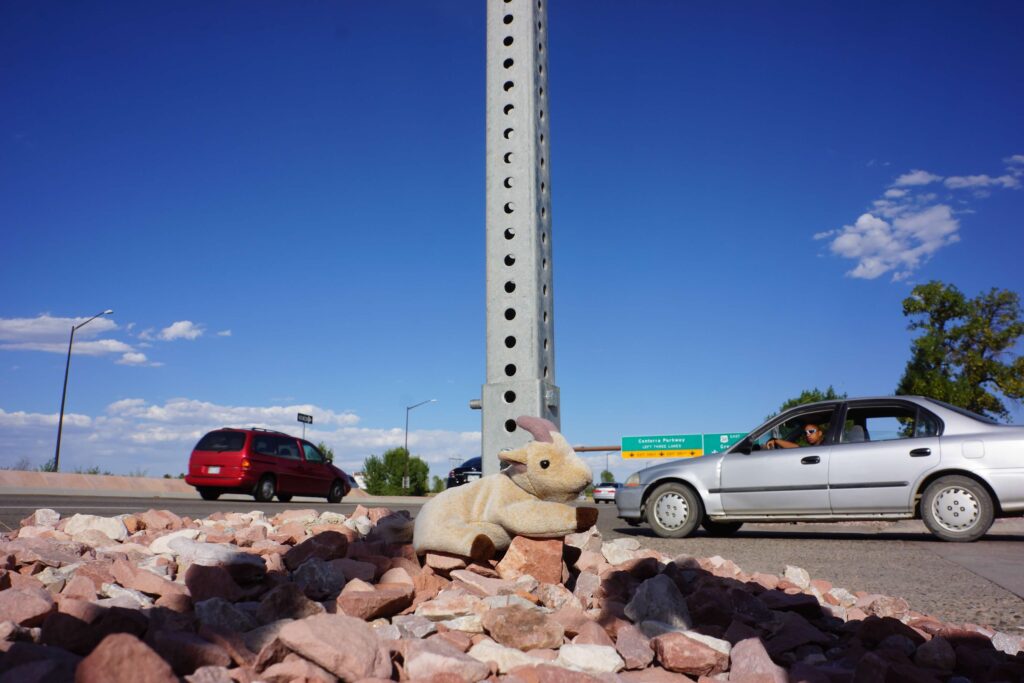
Like the time we drove ninety miles to rescue the lost Billy NannyGoat. We were on a road trip, where many of our mishaps occur—passing through Colorado Springs, en route to Wyoming. After visiting an AutoZone, we had a picnic lunch on the grassy knoll beside a busy avenue, under some trees. Is this crazy or what? A picnic lunch beside a busy avenue? Well, the timing was right: We’d already been driving over an hour to get there, and the avenue wasn’t that busy. The sky was blue, the air fresh. We enjoyed ourselves. Lili sat against a tree and at the outset of the picnic, Billy NannyGoat was in her lap. Life was sublime.
An hour later, approaching the outskirts of Denver, Lili burst into tears. What’s wrong? Billy NannyGoat! He’s gone. “I left him on the ground. He’s all alone! He doesn’t know anyone there!”
I’m driving: Interstate 25/speed limit 75. I’m doing 80 no doubt. It’s the Law West of Wherever: Always add five miles an hour to whatever the speed limit, and you’re cool. Lili is weeping inconsolably in the backseat, beside her aunt (my sister), who had given her the stuffy—that day. A brand-new stuffy, left on the roadside, for any thug to come along and steal. An exit appeared. At that speed, I have microseconds to react. “Are you sure he’s there?” I asked. Lili nodded. “I put him behind my back, to keep him warm. Right against the tree.”
Note the particularity—the specificity, if you will—of her memory. I try to teach my writing students this mantra: Be specific. Lili’s specific memory was convincing. I flicked the turn signal. “You’re not doing what I think you’re doing,” said my wife.
The atmosphere in the car was tense. Each of us locked in our own imaginary scenarios. What if we drove all the way back and no Billy NannyGoat? What if someone had stolen him? True, he was a handsome little goat. But kidnappers? Really?
Maybe she had not left him there at all. Maybe we would make it back to the AutoZone and no Billy NannyGoat. His disappearance would become a Mystery. Like Sasquatch or a Chupacabra.
Nobody said a word. Lili quit crying, but she didn’t smile. She sniffled a little, looked worried. “He’s all alone,” she whispered, more than once.
And he was. All alone.
By the time we neared the AutoZone (rhymes with all alone), I was steeling myself to move on, counsel Lili about what we lose in life, how it wasn’t her fault, and so on. It was an hour out of the way on a day of driving that was already close to five hundred miles distance even without this stuffed-animal-rescue detour, but oh well. Traffic was brisk. The AutoZone parking lot was mostly empty. And there, beneath the tree, in clear view out our windows, sat a small stuffed animal, Billy NannyGoat, waiting patiently for the family who had driven off without him. Lili smiled. “There he is. Just like I said.”
Billy NannyGoat, waiting patiently on the Avenue of Lost Stuffies
That was the first day of a two-week vacation to Yellowstone and Glacier National Parks—a trip in which almost everything seemed to go well. I like to think we were blessed by Billy’s rescue. That if we had not returned, we would have been cursed. Logically, perhaps, there’s no connection. But what is logic to do about a little girl with fat tears in the backseat, weeping for the goat she left behind?
So as Season 3 of Silo hurtles towards its finale mysteries are being revealed. I’ll try to avoid spoilers but anyone watching this season knows by now that A.I. is part of the equation. The emergence of no less than Tom Hanks’ son (Colin Hanks) as Per Stenson, the billionaire creator of the silos, illustrates how we’ve now reached the Ur-moment: Back in the misty past of, say, 2027-8 (near future, anyone?), the U.S. is at war with Iran and things are going badly. (Sound familiar?) Along comes the White Knight in the form of a billionaire dude who designs self-sufficient silos that will house a half-million people and save humankind from extinction.
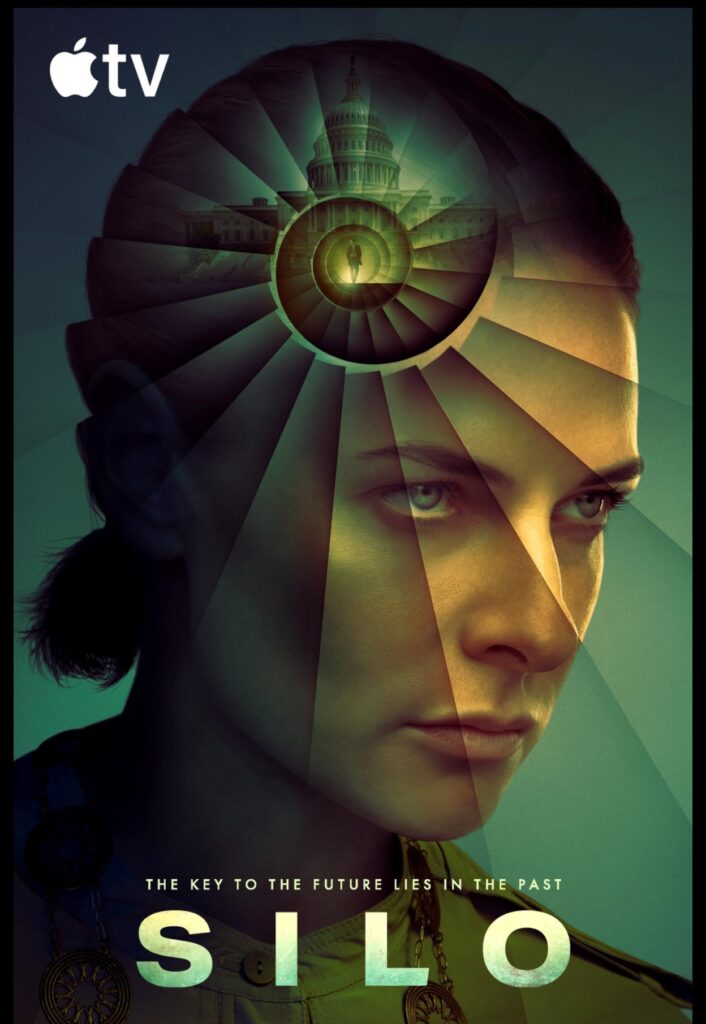
Silo poster
Here’s where the A.I. (named Legacy) comes in: Legacy is apparently in charge of maintaining the silos and will do anything—including killing all the citizens of a silo—to preserve order. This is clever in its own way: Although assigned with preserving humankind the A.I. entity enforces a rigid order that ensures misery and, possibly, catastrophic destruction.
I’m glad to see the dangers of A.I. cropping up in pop fiction and film. I’ve used it myself, in such stories as my most recent, “Camp America” (available here). We need to be aware of these dangers. I’ve blogged about some A.I. books I’ve read. One of the most disturbing details about A.I.: The experts and originators of it admit they don’t exactly know how it works. That fuels imaginary scenarios as in the terrific film Backrooms. It’s not explicitly about A.I. but works on a metaphorical level. Back to Silo: And then of course there’s the Vitamin D+ drug that causes mass amnesia. But that’s another story.
So I’m a late convert to the Apple TV series Silo. There are so many post-apocalyptic movies/shows that they’re a bit overwhelming and, let’s face it, somewhat cliché. Yet the series is streaming Season 3 so I gave it a try. Now I’m hooked. Silo portrays a neo-Medieval world in which survivors of some yet-to-be identified apocalypse live in a gargantuan “silo” that has over a hundred levels, scavenging and recycling lost technologies and materials, ruled by a bureaucratic overlord known as Judicial. It has a great sense of mystery about the creation of the silo—or silos, plural, because apparently there are 51 of them, each housing some 10,000 people, although by start of Season 3 we know of only two of them, Silos 17 and 18.
Silo promo poster
Rebecca Ferguson (of Mission Impossible fame) stars as Juliette Nichols, an engineer of sorts, who is determined to reveal the lies of the Silo overlords. But one reason the series is so watchable is its atmosphere of stubborn decline. The Silo world has very little color. Almost all the visuals are of muted tones, grays and browns and hybrid earth colors. It recreates a Medieval world vibe. Everything seems a bit run-down and moth-eaten.
One thing to note about Medieval cultures/eras: They usually follow periods of progress and learning that culminate in some destructive war, usually a fight over territory: the Bronze Age collapse followed the warfare of the Trojan War era, and the Fall of the Roman Empire ushered in the European Medieval era. There’s often a religious element, a sense of blindly following some belief system. In the Middle Ages the Catholic church in Europe followed such a pattern, including devolving into corrupt forms of “worship” or religious behavior, such as the infamous “indulgences” of the Medieval Catholic church (which paved the way for the Reformation).
In Silo their “bible” is The Pact, supposedly written/created by the Founders, four centuries before the start of the series action. But in Season 3 there’s a new wrinkle: an A.I. Superintelligence that controls the silo and appears to be both protecting and threatening what’s left of mankind. It’s also become quite relevant/timely: While the plotlines involving the present-day Silo people are taking place roughly four centuries in the future, there’s now a plotline that appears to be set in roughly present-day contemporary times: In the series we are at war with Iran, as we are now—though the way TV series are made this was written and filmed much before the present war started. To make matters worse, Iran has detonated a “dirty bomb” in Washington D.C. We then retaliated and encountered strange technology or bio-warfare. This is probably the opening salvos in some WWIII imagined scenario that ends in nuclear destruction. Lord help us!