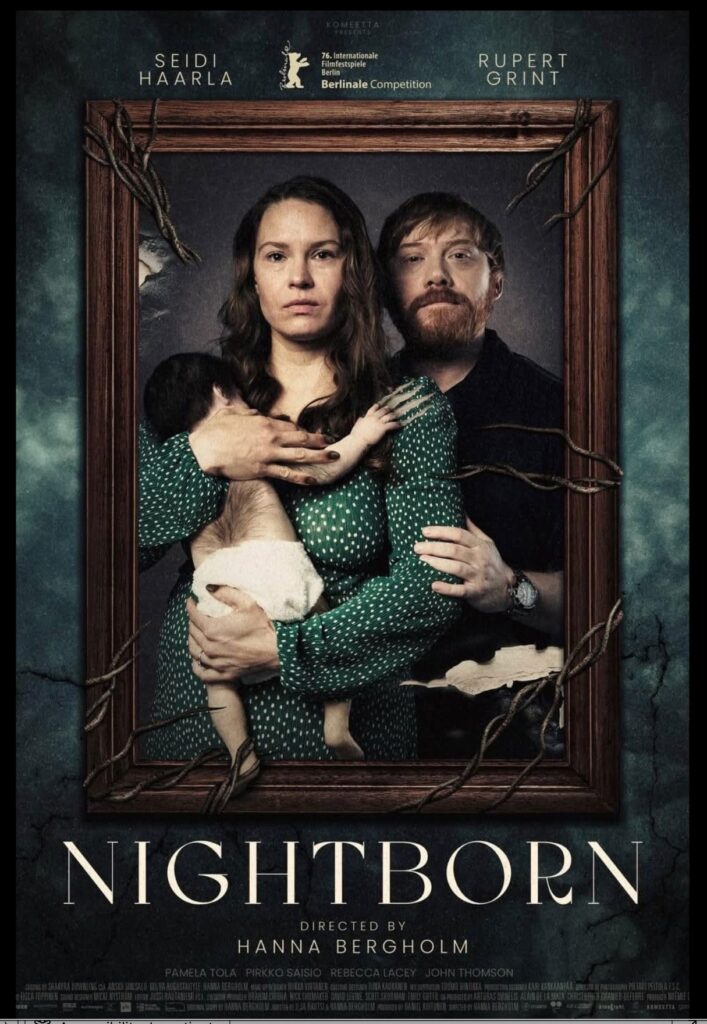
So I’m a sucker for Scandinavian horror films, having spent an idyllic month in Norway many years ago, falling in love with the fjords and the people. Although cult classics like Midsommer (2003) and The Ritual (2017) have come and gone yet bask in streaming glory, we now have a new entry into the genre: Nightborn, from Finland with love. It stars Rupert Grint of Harry Potter fame as Jon, the clueless (and fussy) British Dad, with Seidi Haarla (love the name) as Saga, his wife, soon a new mother. And last but not least, there’s a very hairy baby who is pretty much the center of attention and plot. He/it’s a charmer. I’ll just note that once he starts crying, you want him to stop. (“Please. Now I’m begging. Make that baby stop!”)
Movie poster
Nightborn begins with a drive into the Finnish countryside, down a narrow dirt road into a forest. In the car sits a happy couple, smiling and joking as they arrive at their new/old house, which was apparently inherited by Saga, as it’s the country house at which she would spend her childhood summers. These appear to have been quite some time ago. A Finnish fixer-upper, it’s a mishmash of rotten boards, cobwebs, and abandoned, mossy squalor. A tree grows from the floor of one room—Saga’s old playroom..
In this world, trees are quite important. And persistent. Jon cuts down the tree in the playroom and later it reappears, growing through a hole in the floor. One of their first acts in their new home is making love against a gnarly, venerable tree of some sort (looked vaguely oak), with Saga inviting Jon to “make me a mother.” And wouldn’t you know it, lickety-splitly a month later she’s pregnant, and before long the baby—um, er, “it”—is born.
Any couples curious about childcare should probably avoid this movie. Mom calls the baby “it.” She’s certain there’s something wrong with it. Dad and the doctors all seem rather blithe about the baby’s . . . peculiarities. These include a) it bites off the tip of its cousin’s finger; b) it smashes its grandfather in the head with a jar; and c) most importantly, it has rather bizarre feeding habits. For instance, it chews Saga’s nipples bloody when it tries to nurse. Not a fan of mother’s milk, instead it prefers bloody meat. While Saga recognizes “That boy ain’t right” Dad and the others insist just give him some time/it’s all perfectly normal. As if commanded to by the forest, Saga names the baby “Kuura,” which means “frost” or “hoarfrost” in Finnish. Cold iron burns like fire when it touches Kuura’s skin. (Perhaps because iron axes fell trees?)
By the end the audience agrees with Saga: Kuura is not perfectly normal. The final scene is deliciously over-the-top, both gruesome and funny. Although at times Saga struggles to accept her son, by the movie’s end she’s developed quite an outlandish coping mechanism. Essentially she gives in and becomes attuned to the forest world while Jon remains clueless. When they first arrive at the house he wonders about all the rusted vehicles and machinery that line the property. Later Saga discovers this is purposeful. Her grandmother is said to have explained it’s to keep the evil forest spirits at bay, a protective wall of rusted stuff. Urban-fussy Jon has it removed and the property “cleaned up,” with disastrous consequences.
Nightborn appears to be based in part on a Finnish folktale. As a writer who has used folktales in his contemporary fiction, I’ll note it’s harder than it looks. One of the tricks is making the folklore/supernatural elements seamlessly jibe with the contemporary, “realistic” elements of the story. For the most part, Nightborn succeeds: At times we the audience can question the seemingly supernatural elements of the story and wonder if they’re all just figments of Saga’s post-partum imagination. But by the end, the film crystallizes its mayhem. It’s not fuzzy. And not just “metaphorical.” Something dark and sinister lurks in the Finnish forests. Perhaps conceiving a child against the rough bark of an oak tree is just asking for trouble.
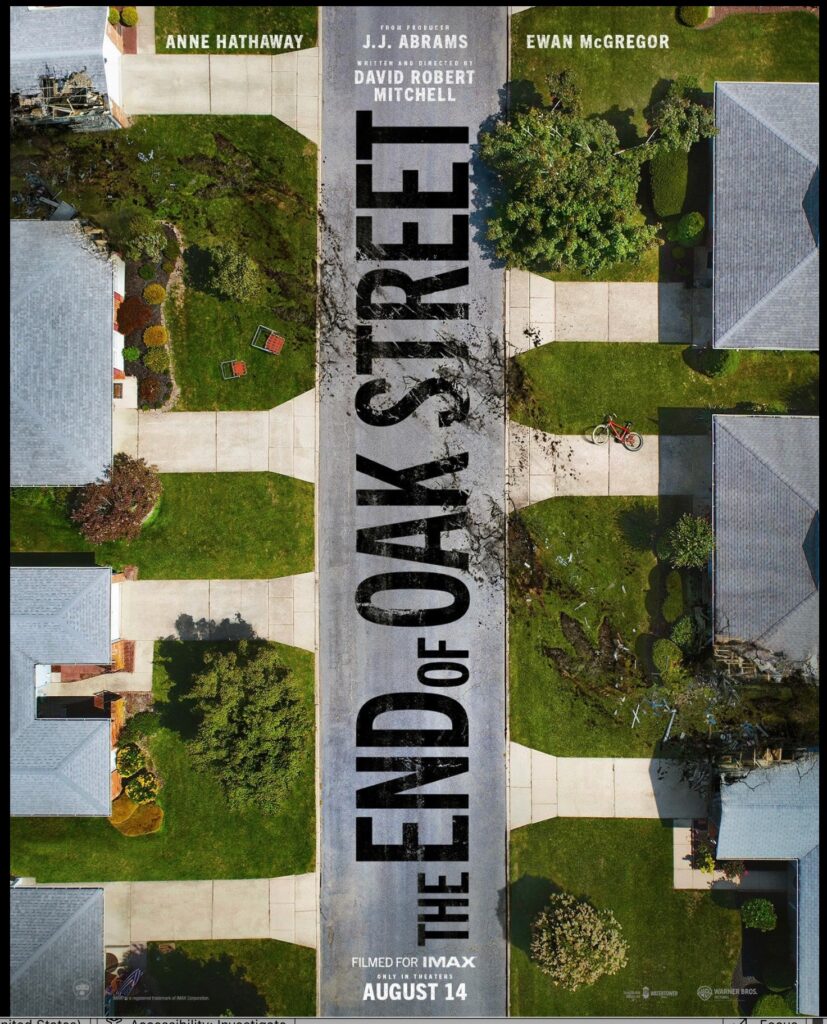
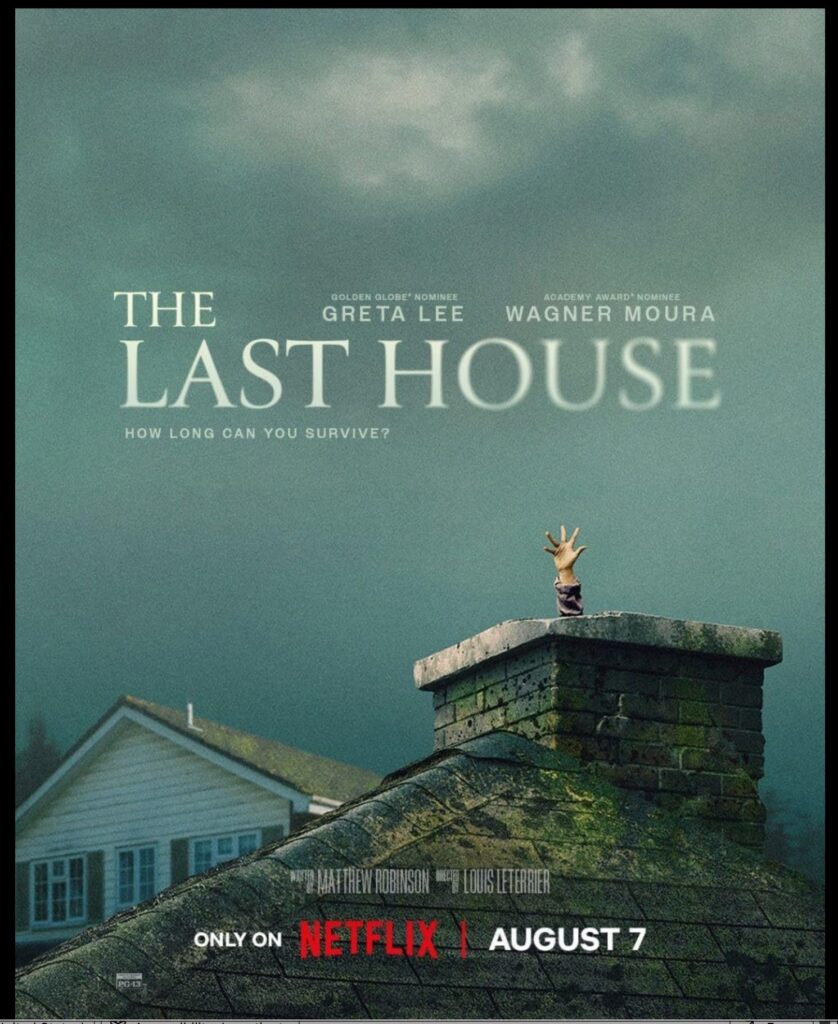
So I caught the new “fantasy-disaster” movie The End of Oak Street, the second one in a week. It echoes Netflix’s The Last House. Both feature cutesy nuclear families with well-behaved kids and put-upon parents. Both feature impossible scenarios involving some very unlikely natural or unnatural disasters happening to said “average” American family. Oak Street trumps Last House in star billing: It features Ewan McGregor and Anne Hathaway as the parents, an A-list cast if there ever was one. For my money Oak Street is quite a bit better, even if it’s high implausible, to say the least.
Movie poster
My thumbnail summation: It’s like JurassicPark meets Poltergeist. Set in a middle-class suburb circa 1982, it features a family that resembles the cast of Poltergeist, except there’s no youngster who gets spirited into the TV to hang out with the “TV people” who happen to be ghosts. JurassicPark because, well, unlikely as it may seem for 1982, there are dinosaurs. At times it seems a homage to the iconic suburban-set horror films of the 1980s like Poltergeist and Goonies, but once the dinos show up, it’s Action-Adventure time. Ewan McGregor plays the Dad well, being a bit down-on-his-luck and desperate, and Anne Hathaway plays his wife, a wannabe writer, who ends up playing the most important role in the drama. At some point one of the kids asks, “Is this the end of the world?” Answer is No. Not that complete. It’s just the end of Oak Street.
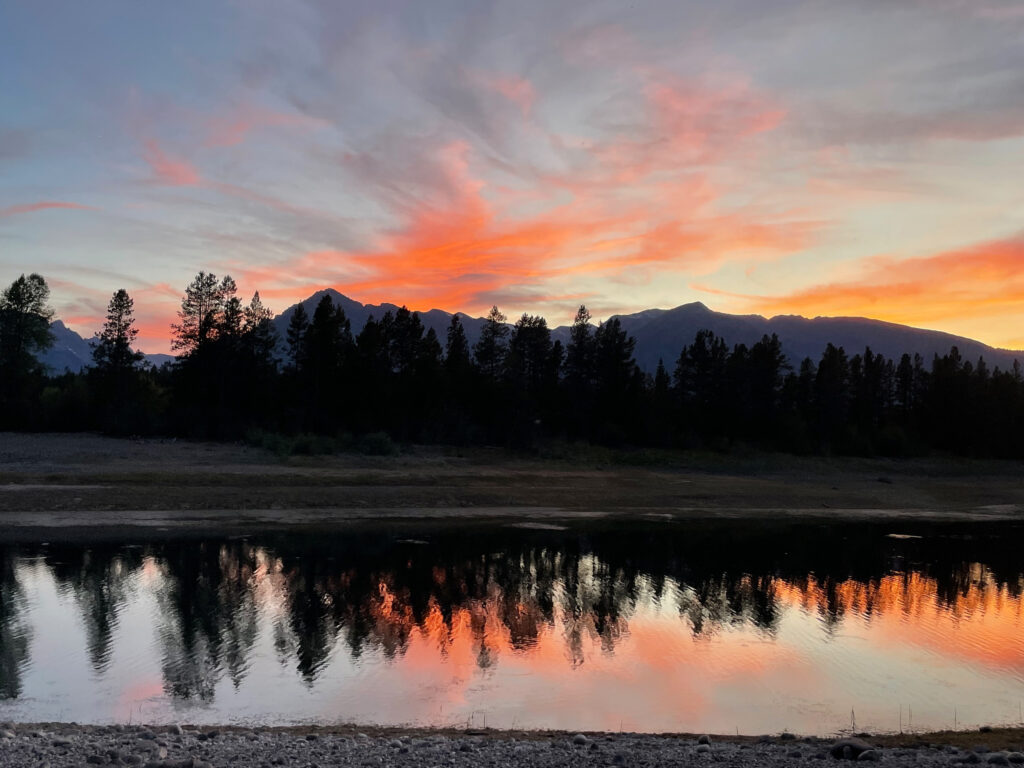
So for the third year in a row we traveled to Yellowstone near the summer’s end for a back-country trip: In 2024 we kayaked Yellowstone Lake and in 2025 Shoshone Lake. For 2026 we backpacked to Heart Lake. This year was extra special: our 25th wedding anniversary. As should be obvious, we love Yellowstone backpacking. Don’t believe all those media stories about how overcrowded it is. If you get into the backcountry you often find yourself alone. Oddly enough, all our Yellowstone adventures begin and end in the Grand Tetons, just to the south, in the Colter Bay cabins. The cabins have charm and glorious views of the mountains, exemplified by this sunset photo taken at the marina.
Grand Tetons from Colter Bay
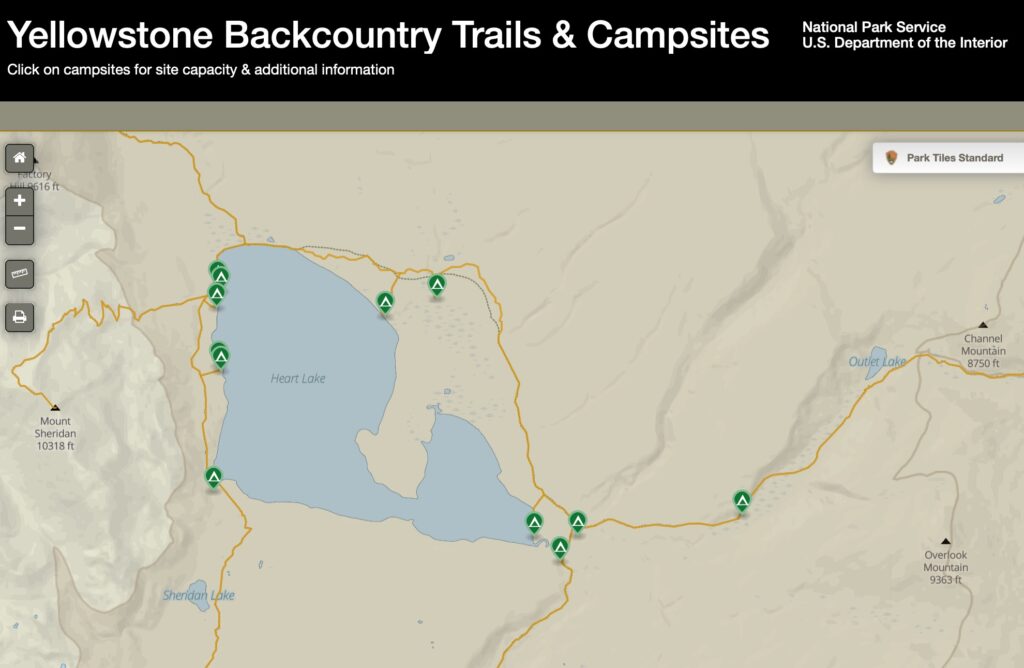
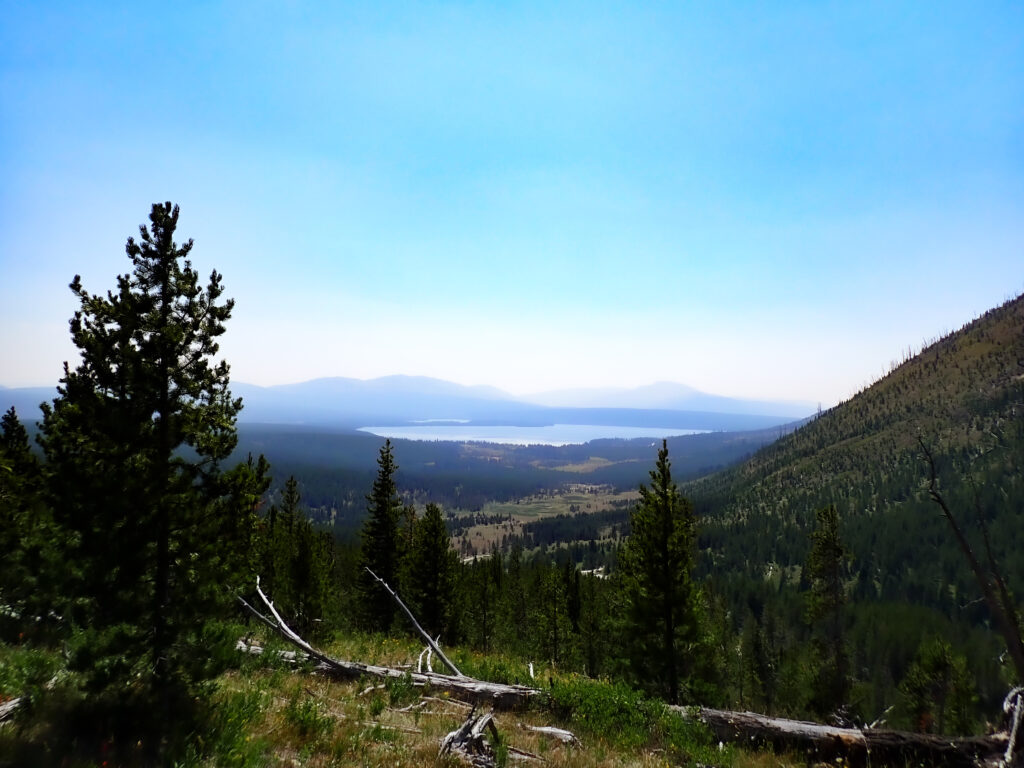
Our destination for this five-day backpacking trip was Heart Lake, a few miles south of Yellowstone Lake. As per its name, it’s heart-shaped, kind of. It looks more like a heart from the mountain pass a few miles north of it, when you see it in the distance.
We were there in 2017, got snowed on in July, and loved it so much we tried to get back several times. One thing or another always foiled the trip. It almost happened again: We tried to switch our final night campsite several times and visited the backcountry office to speak with the rangers, to no avail. But on our last unsuccessful try another ranger gal showed up and both she and the ranger guy we’d been dealing with were all up in arms about the firesmoke from Utah. They warned of air-quality alerts, that you shouldn’t be “exercising” outside: I think carrying a 35-pound pack 10 miles counts as exercise. They kept fiddling around with forecasts on their fancy computer screen and trying to dissuade us. I wasn’t having it. I’m not dying to hike in choking smoke conditions but then again it wasn’t that bad and we had planned the trip for months. I wasn’t about to cancel it on a whim. (Now that all is said and done, that would have been a foolish decision.) Here’s what the lake looked like on the first day, soon after we passed over the saddle:
Heart Lake from main trail
Turns out the smoke wasn’t . . . horrible. It was bad enough. A few times I was coughing. Our mouths were really dry and parched on the trail and we had to keep sipping water. Which leads to the most memorable and difficult moment on the hike . . . .The last few miles of our 9.5-mile hike to the Beaver Creek campsite on Heart Lake were the hardest.
To reach the Beaver Creek site, which is on the East side of Heart Lake, you have to hike along the sandy/gravelly shore of Heart Lake the first half mile. It’s like walking or running on a beach with soft sand. Then when we reached the end of the lake shore the trail headed uphill on a series of ridges until curving around to the Beaver Creek site, situated nicely on a rise above the lake, with a great view. (I think the total elevation gain for the day was around 1,400 feet.) Here’s our view:
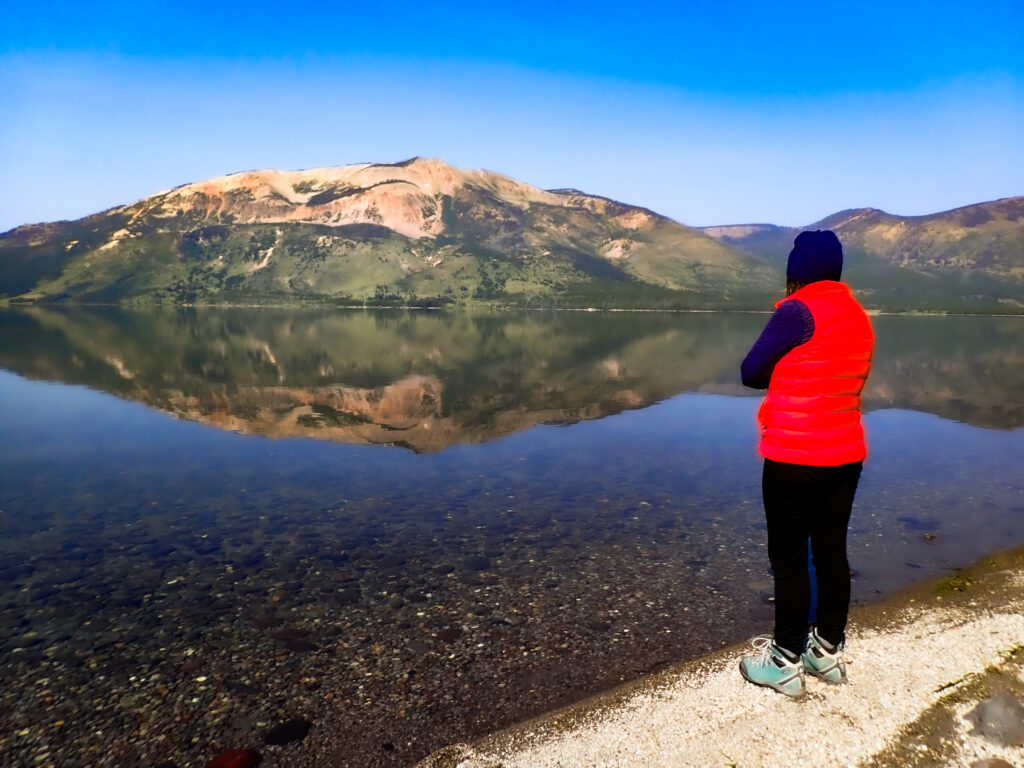
Heart Lake with Mt Sheridan
That’s Mt. Sheridan across the lake, at 10,308 feet the tallest mountain in the area. As you can see it’s clear early, haze comes later. We were there by 4:30 and immediately set about getting camp in order. We were out of water and I discovered my filter was clogged. Backup plan was a one-liter Katadyn BeFree squeeze filter and a JetBoil. Both worked okay but the boiled water was hot and the squeeze filter (hereafter known as the Squeezer) was hard to force the water through the filter. (It got better as time went on.)
Then strangers showed up: Around dusk I’m outside the tent putting everything in order for bear policy and in case of rain or wind. I hear voices. Our camp is a half-mile off the main trail so that’s odd. Suddenly a group of about six people, teenagers led by a thirtysomething tattoeed guy, walk into our camp, calming to be “exploring.” They seemed to want to camp there. It was the strangest encounter I’ve ever had in a national park: Usually people are respectful of the campsite protocol, the permits and policies. “In full disclosure” said the leader, implying he had not been honest with us to begin with, that they were looking for some place to camp. I advised them to head back down the trail, find a flat spot, and camp there. It was almost dark, the sensible thing to do. They did. The next morning we found their campsite about 50 yards away. But they had been quiet and did not disturb us, so all’s well that ends well. Still . . . it was weird.
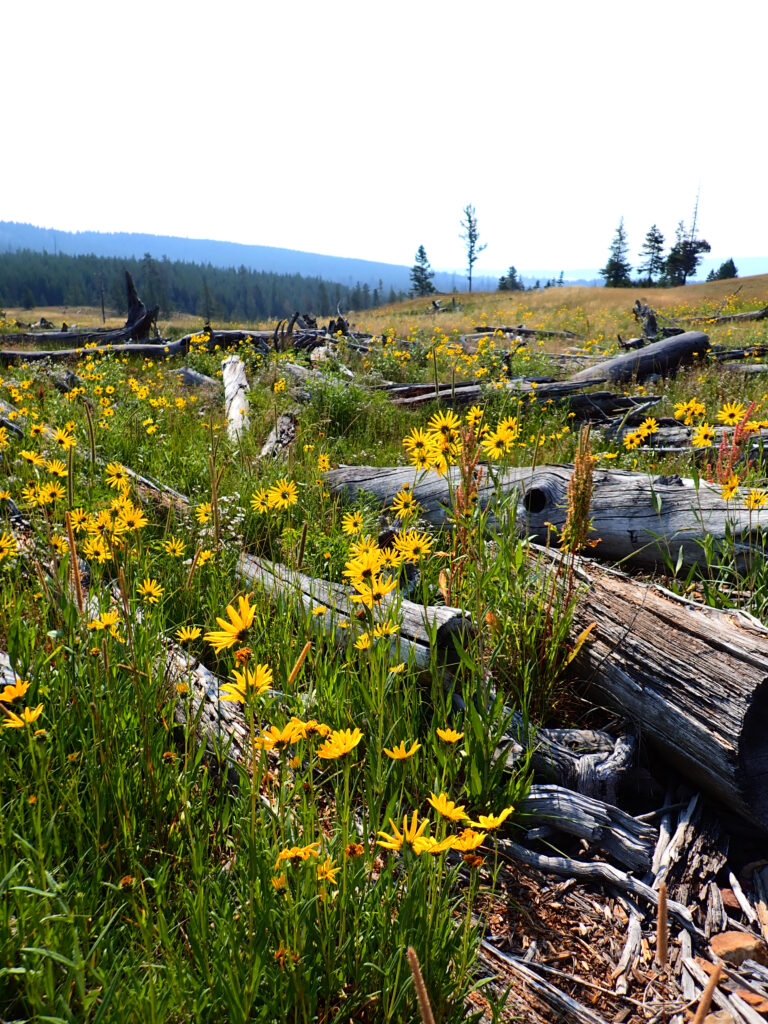
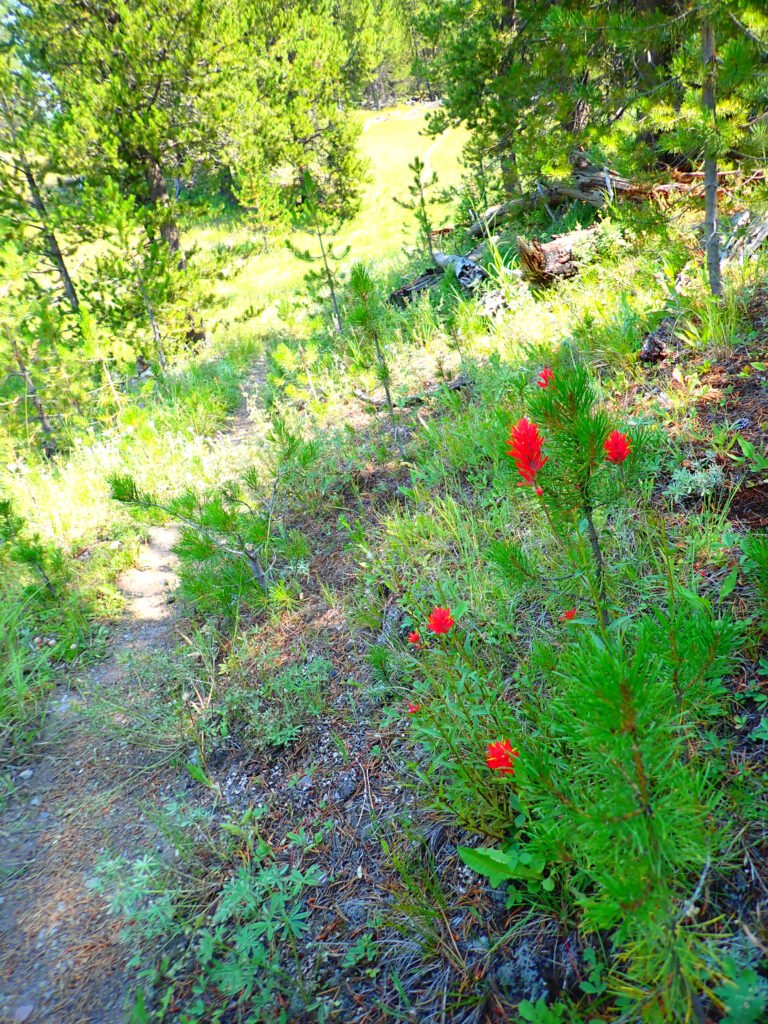
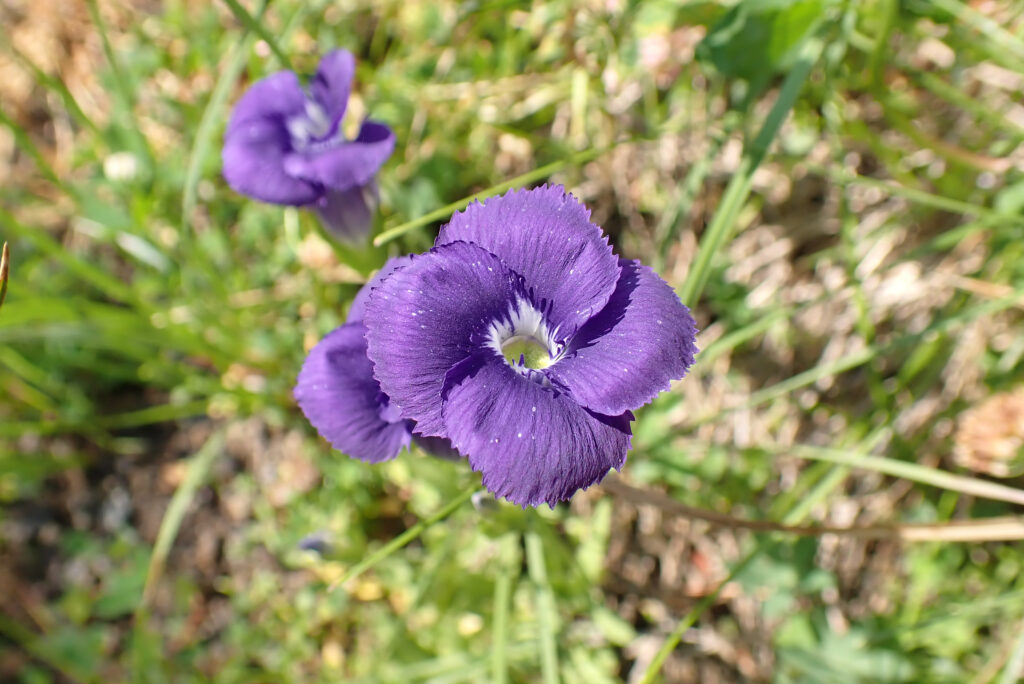
Day 2 we hiked to the Heart River campsite, about 4.5 miles. Despite the warm temperatures and no rain while we were there, the wildflowers were gorgeous.
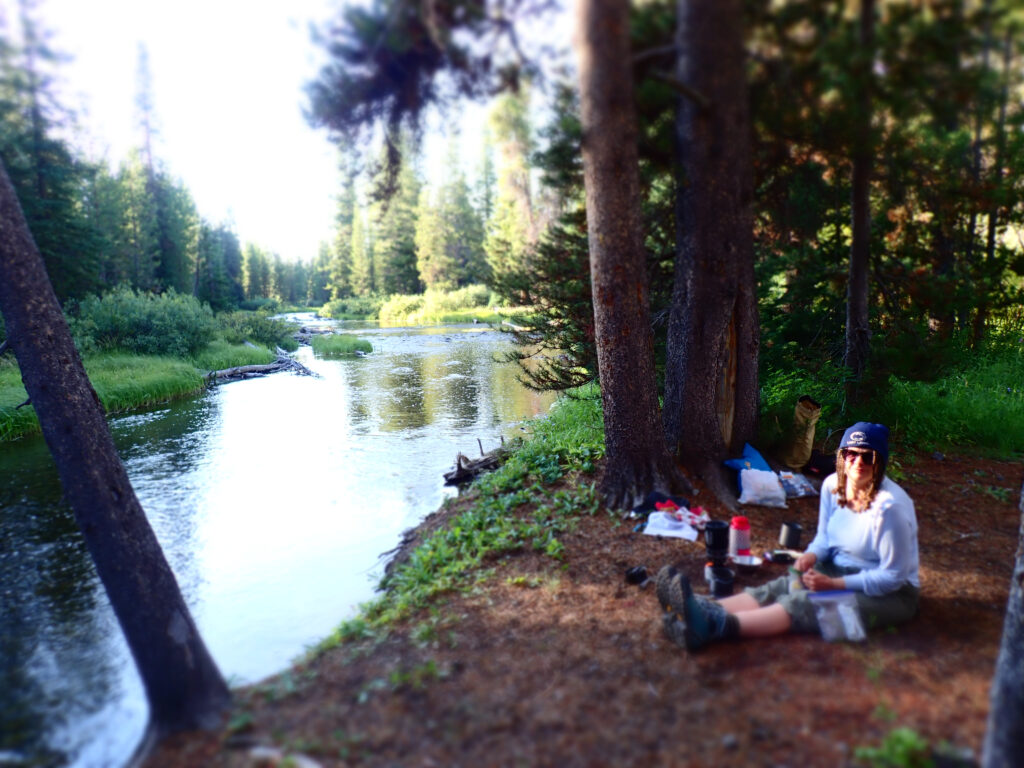
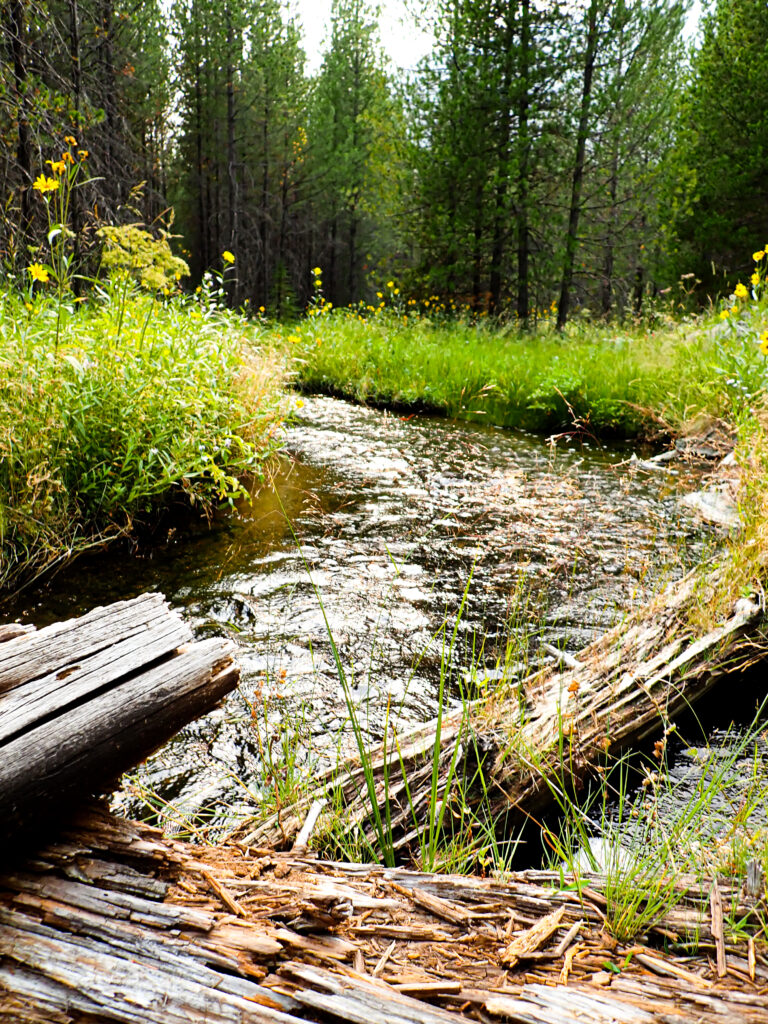
The Heart River is a mild, shallow river with its headwaters on the southeastern side of Heart Lake. It feeds into the Snake River a few miles southwest of the lake. We set up our kitchen in the trees beneath the bear pole and found it lovely and cozy, here:
“Kitchen”
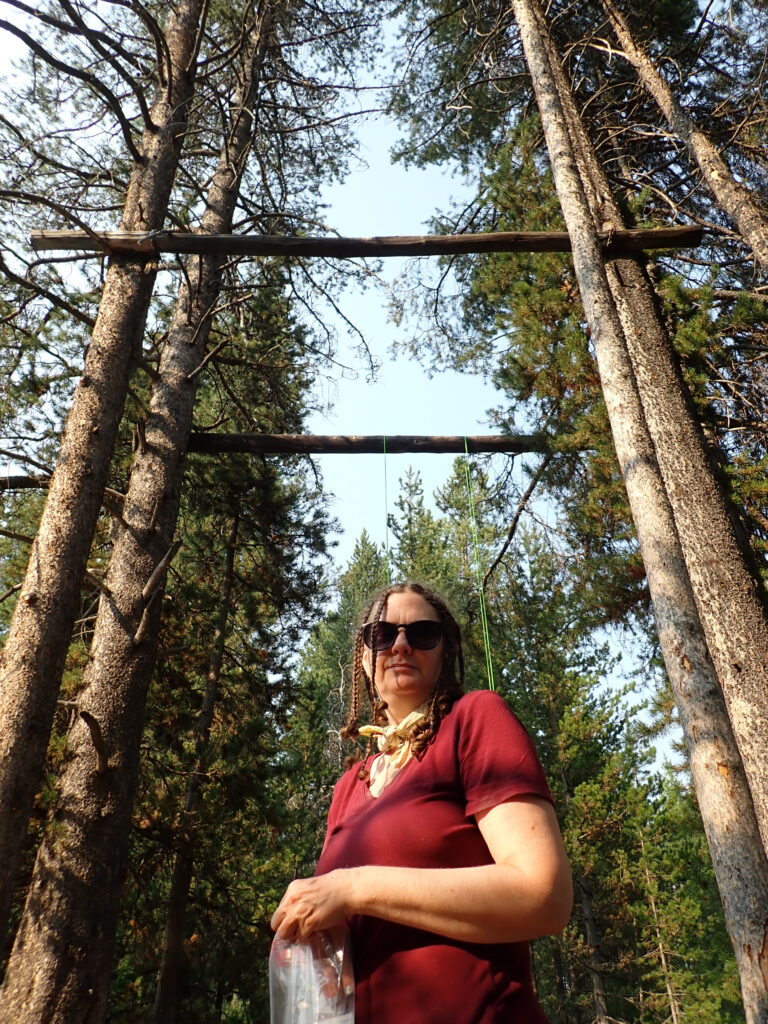
One of the odd things at this site was the location and height of the bear poles. There were two: I used the lower pole, which was still quite high, but on which my bear-bag ropes reached, each of them being about 35 feet. But in the trees there was an older and even higher bear pole, maybe 5-10 feet higher it seemed. My rope wouldn’t have reached! Here’s a pic:
Bear poles
Heart River turned out to be my favorite campsite. The river was pretty and shallow, with good birding. Ospreys and bald eagles flew by. Mergansers and grebes were in the lake. Kingfishers kept swooping over the river, and bright red dragonflies buzzed the marshy banks. One of the best aspects of the site was the kitchen, beneath the bear pole. The water was right there. The area was flat, shaded, good for cooking and hanging out: We put our packs against the trees and then our seatpads on the ground to make comfy backwoods chaise lounges.
We tried hiking south along the Heart River trail. Then gave up: After coming upon the second river crossing in a span of minutes we decided not to bother. We’d already decided we didn’t want to hike all the way to the hot springs marked on the map because it would be another 6 mile hike and we’d already done 4.5 at least.
Throughout the hike and nights spent in our cozy tent we were listening for Great Gray Owls and never heard one. Or any other owl for that matter. E said she heard coyotes.
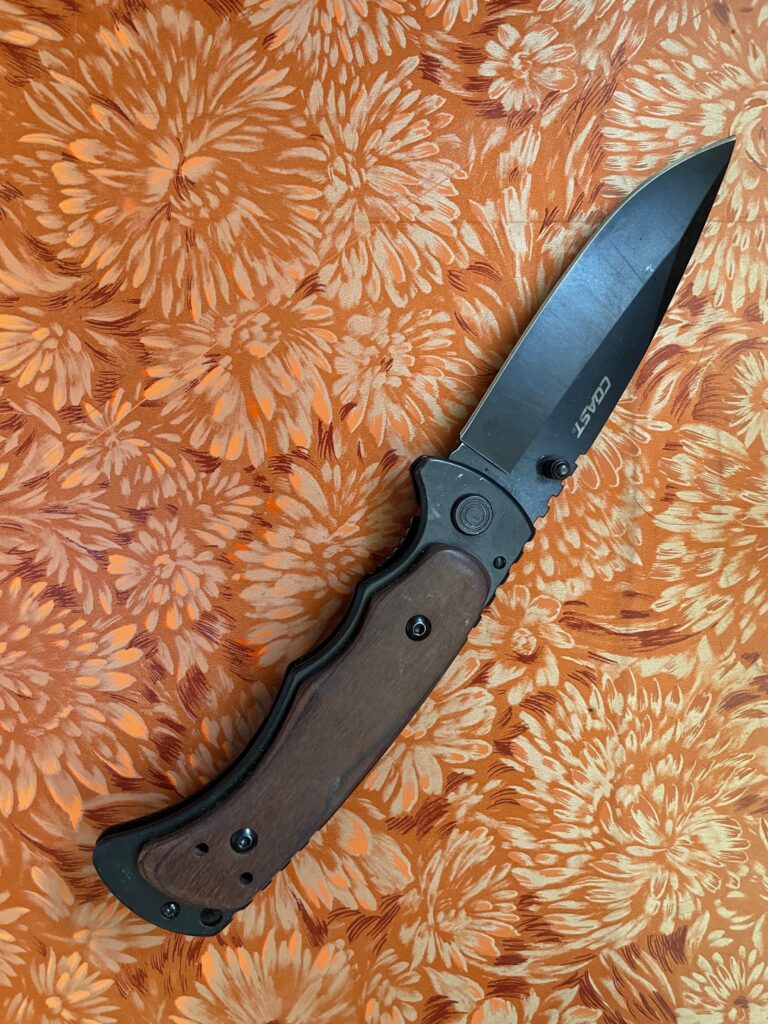
Day 3 was our Layover Day. We had aches and pains in knees and legs and wanted to rest and recuperate. But that didn’t stop us from having fun. After lunch we hiked northeast from camp and came upon the East Shore campsite (8J6). It’s a gorgeous site right off the lake shore. E found a knife.
I set up the MSR water filter and was happy to discover that it worked again. We had boiled water the night before and that morning but if we kept that up we might have run out of fuel for our JetBoil. It felt empty by the time we were finished using it Saturday morning but the scale says it still has 20%.
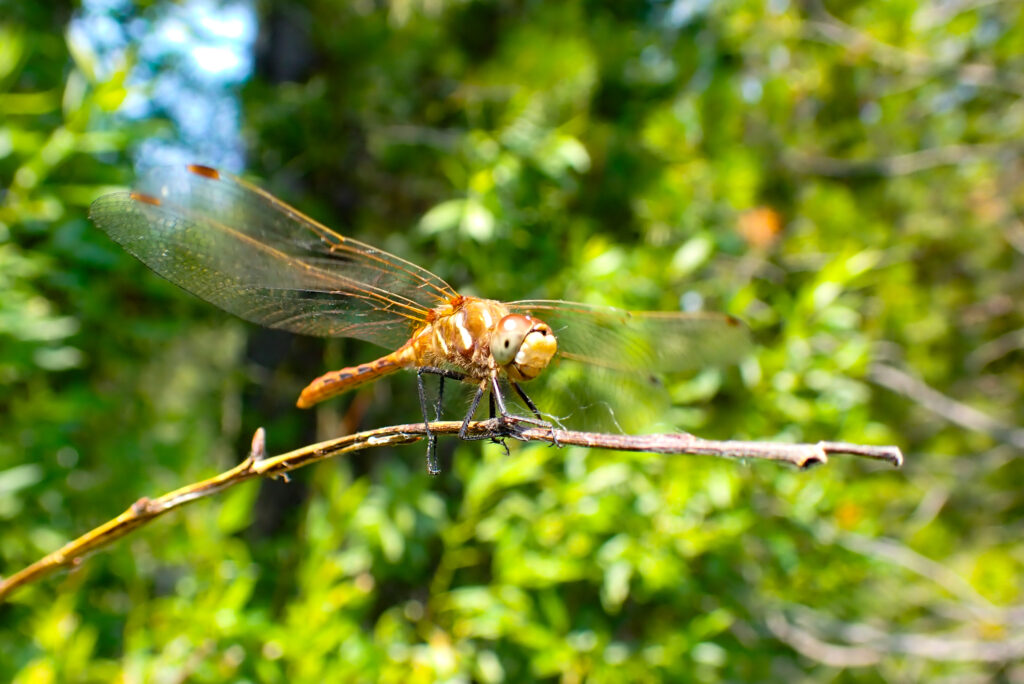
Keeping us supplied with purified water was a chore, as was charging our multiple electronic devices. I had bought a new (smaller) solar charger and it worked like a charm . . . as long as the sun was high in the sky. I charged my watch, E’s phone, the camera, the power bank, and the NightBuddy with it. But the sun keeps moving across the sky and it’s a bother to keep repositioning the charger and devices to make sure they keep getting power. I kept trying to get a good photo of the red dragonflies. Here’s my best:
Red Dragonfly
While Yellowstone is famous for being “overcrowded” we had the Heart River all to ourselves, went swimming. It felt great to be relaxing in the middle of a wilderness known for grizzly bears, bison, elk, and moose. The water was relatively warm for Yellowstone, which even during this hot, smoky period got down into the 30s in the morning. We had to bundle up with all our warm clothes to get out of the tent of a morning. But by afternoon the temps would be in the 80s and the sky would turn hazy from firesmoke, like the image below from the East Shore site.
Day 4 we hiked about six miles to the Witch Creek area when we noticed a trail splitting off the main trail and heading into the forest nearby. I did a quick recon hike and discovered we had struck gold.
At the end of the trail we found Witch Creek, in cool forest shadows.
Witch Creek
Day 5 began with an ankle injury: Before breakfast when I went to get our food cache and hopped off a log, sprained my ankle when I landed badly. It hurt but I walked it off, made breakfast and saddled up to hike out. At first I didn’t notice it much but by the time we reached the saddle that marks the divide between Heart Lake and the approach trail it was starting to get stiff and painful whenever I stopped, even for a few minutes. We kept hiking. We made it to the car before 2:30. No sooner had I dropped my pack and opened the car than the ankle went from achy to severely painful/can’t walk on it.
The funniest moment was at the Colter Bay cabin rental office: I could barely walk, even with the help of a trekking pole. I open the office door and a clerk (Allie) is all eager and polite there to help me, but it takes a few minutes for me to shuffle and hop on one leg over to the counter. She was patient. E got a bag full of ice. We made it to the cabin and I iced my ankle, settled down to rest. E was planning to order takeout but after icing the ankle for a while I said No, I didn’t want to stay in the room. Instead we went to the John Colter Ranch House, had margaritas and good burgers, and finished the day on a high note.
Now that’s the way you celebrate a 25th Anniversary.
So I’m back from backpacking to Heart Lake in Yellowstone National Park—had a great trip, thank you very much. Made it home late Monday night and have been struggling to get caught up with everything. As far as my viewing-pleasure goes, I did catch up on episodes of Alone and Silo that were worthy viewing. But first thing I want to write about since returning is a new flick titled The Last House. I rarely want to dis any book or movie because I know people work hard on these things and why something doesn’t turn out to be stellar is not always any one person’s fault. But in this case, I have to speak up.
The latest kooky-fantasy world movie released on Netflix is a both a doozy and a snoozer—The Last House. I’ll try to avoid spoilers here but will add that when we finished watching it, we both said, “Wow. I’m surprised we finished that movie.” As in: I’m surprised we didn’t stop watching and go do something more entertaining, like poking each other with a sharp stick. In a nutshell: It features a cutesy youngish family, husband/wife in their 30s, preteen son and even younger daughter, all lovable and nice to each other until . . . some mysterious force arrives when seals them in their house: Doors/windows won’t open, no way to get out. Same story for all other people in the neighborhood as well. And—at least it’s strongly implied—the rest of the world. Who’s doing this? Alien invasion, perchance?
I won’t give it away, but water is involved. It rains and rains. (What a shocker! They’re in a suburb of Seattle.) The rain aids and abets the mysterious entities who are keeping our ordinary cast of suburbanites sealed inside their homes. (What if you were driving around when all this “sealing” unfolded? Or walking through a field, minding your own business? Details imply this would not be good.)
Cut to five years later: Somehow this plucky family has managed to survive never leaving their own home by trapping critters in their driveway with this trap/contraption Dad made, which works like a charm even though it appears as if it would have no chance in hell of being functional. They’ve learned to hide and evade the mysterious entities who come out in the rain. (Most people are dead by now. Like, in the whole world. Except this plucky family!)
The ending really makes no sense but imparts an important moral: Be kind to mysterious water-creature alien-things and maybe they won’t kill you. Let that be a lesson for us all.
For my own modest version of Proust’s Remembrance of Things Past, I’ll post a Trip Report. It covers kayaking on Yellowstone Lake in 2024 and is perhaps shorter than Proust’s famously long novel.
Two years later, we (my wife Elizabeth and I) are about to backpack to Heart Lake in Yellowstone. Additionally, it is essentially just south of Yellowstone Lake and marks our third backcountry adventure in as many years.
The seeds of an interest in paddling Yellowstone Lake were planted many years ago. Our daughter, Liliana, was a toddler then, and we stayed at the big yellow Lake Yellowstone Hotel.
That visit we heard loons at night and saw people canoeing. That made me think paddling the awesome lake might be a great adventure trip.
Yellowstone Lake is the largest high-elevation lake in the lower 48. It is bordered by hot springs and thermal pools along its long shoreline.
The water is cold and deep, which creates paddling hazards.
However, the weather can be bad.
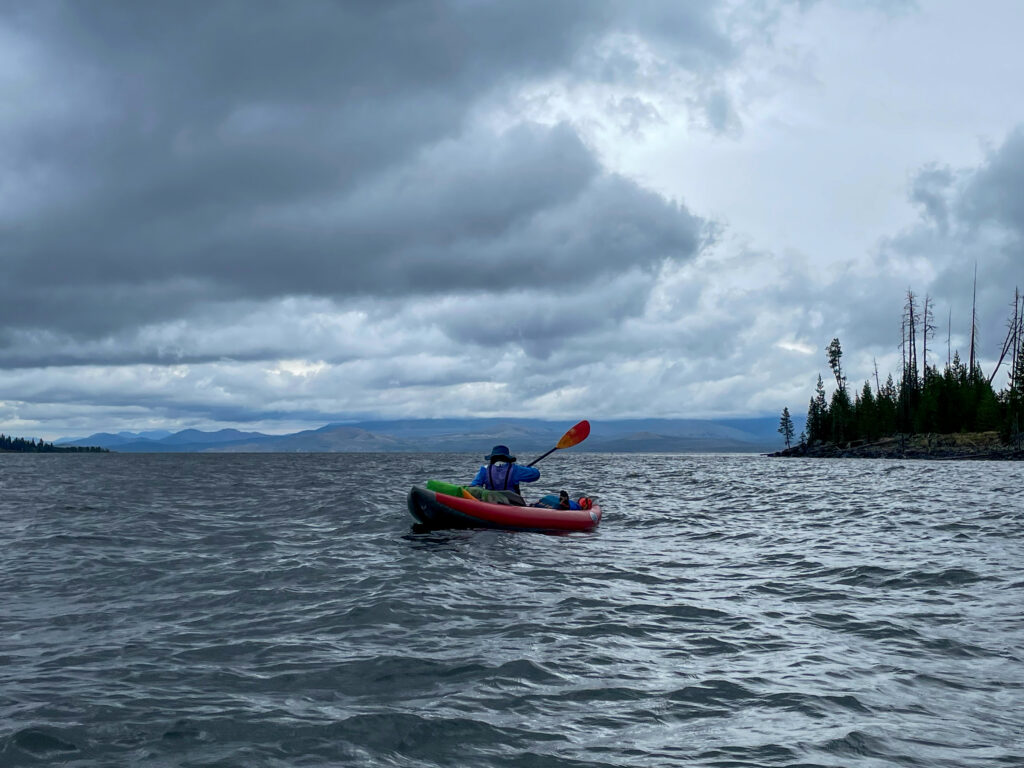
On our first day in the kayaks, we launched later than we intended. Around 10 a.m., we were on the water. That meant we were on the water later than planned and encountered rain and wind.
A simple rule: reach your campsite by noon. Thunderstorms often pop up later in the day, which can make paddling difficult.
Going directly into it means you fight the headwind. If you have a tailwind, you still contend with the wind twisting your kayak.
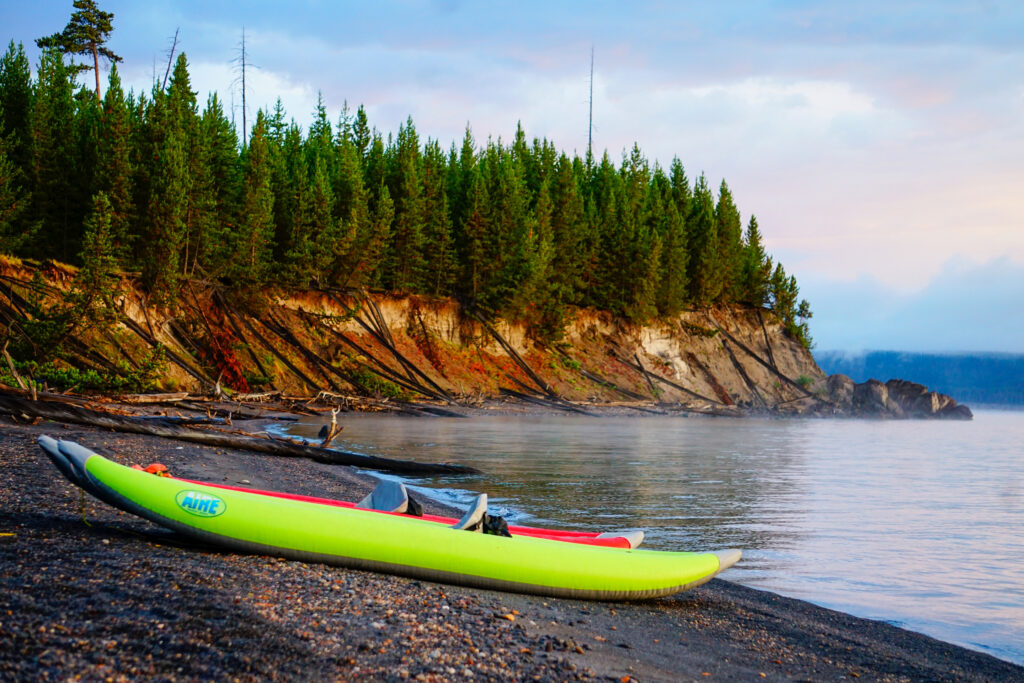
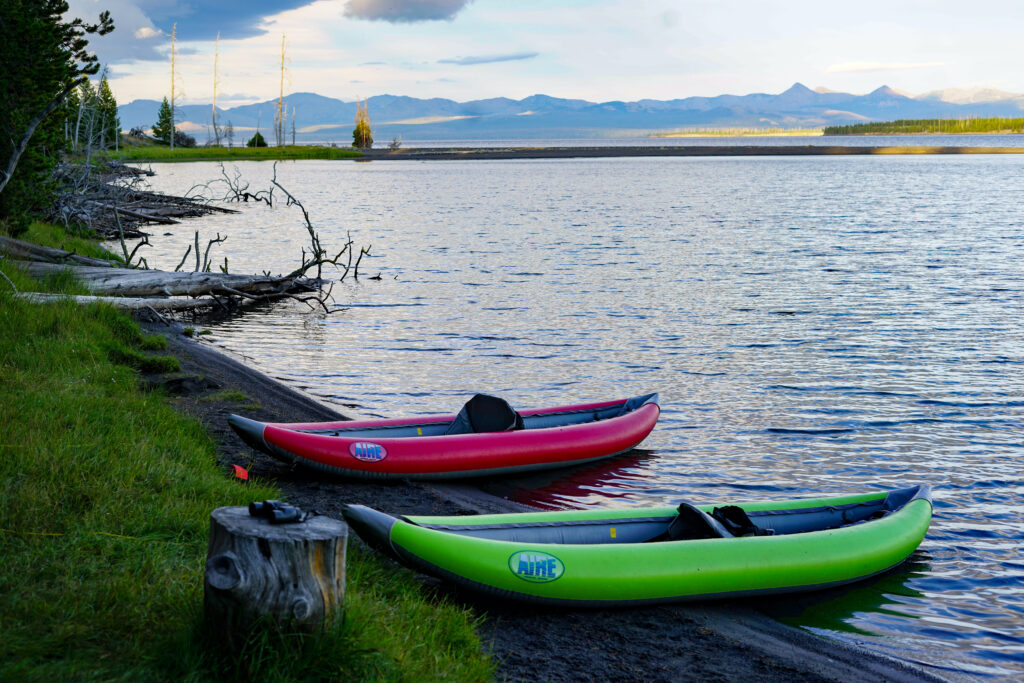
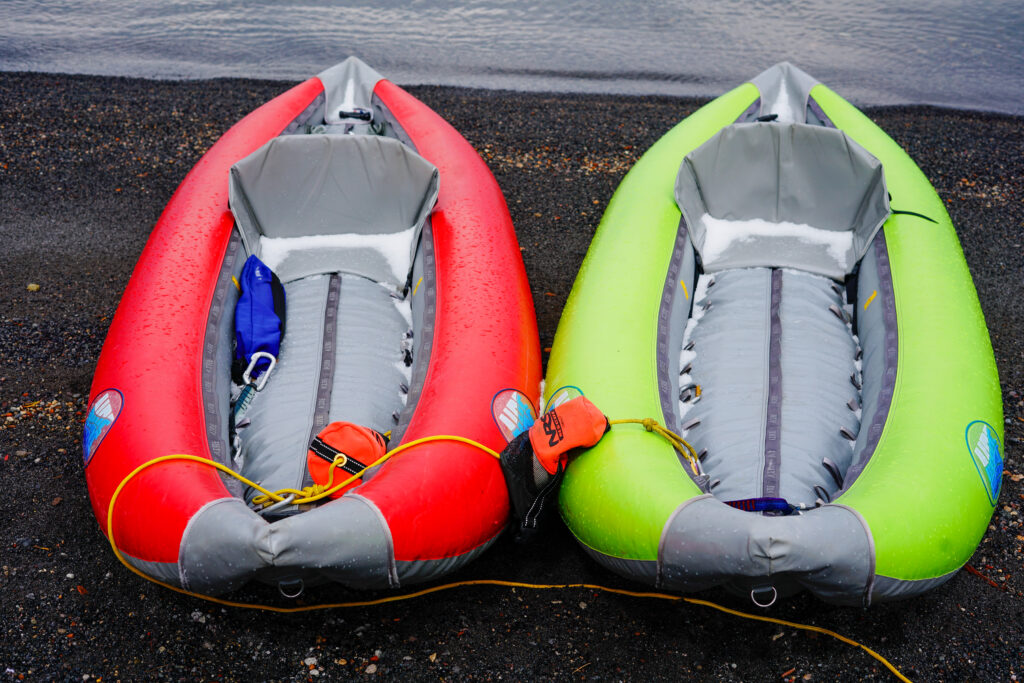
We have Aire Lynx II inflatable kayaks. They’re excellent, but not as aerodynamic as some touring kayaks that sit lower in the water and have rudders.
I remember late in the first day the rain pelting us, the waves rocking our kayaks.
Wind kicked up the waves to whitecaps.
We launched from the Grant Village marina parking lot and made it to first campsite (7L1) by 2 p.m.
Beaching the boats in a heavy rain.
But it seemed as soon as we had the boats tied off, the rain stopped.
The sun came out.
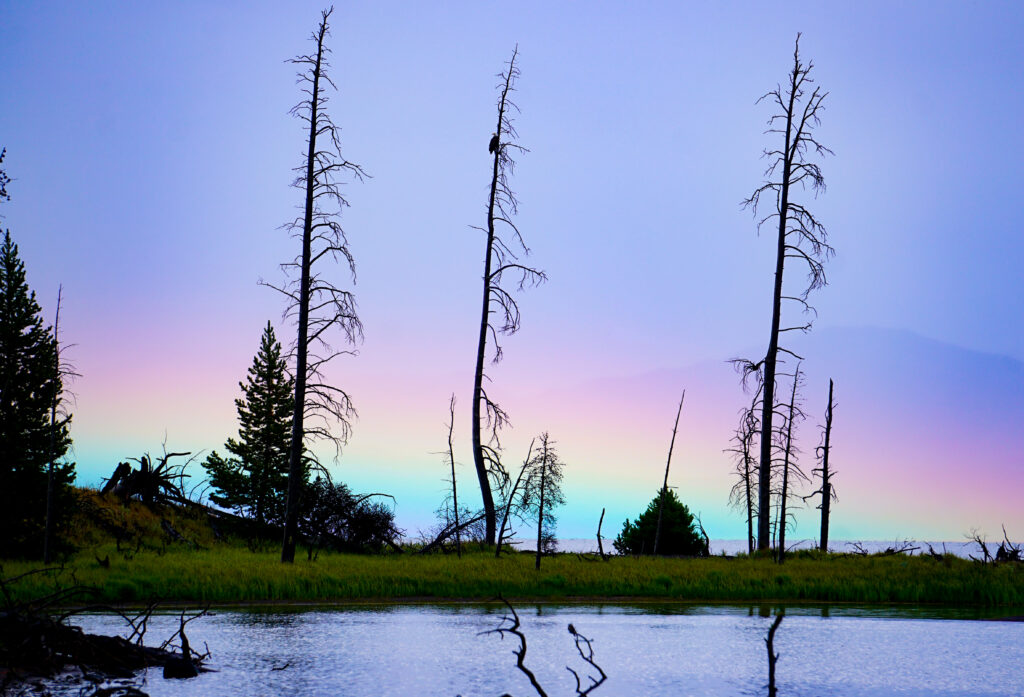
On the lake behind us a cloud rainbow settled over the water.
In the trees near the shoreline perched bald eagles.
With a respite from the rain, we quickly put up the tent and camp. We didn’t need to rush.
Now that we’ve spent about two weeks paddling Yellowstone and Shoshone Lakes, we’ve learned afternoon thunderstorms are normal in summer. Moreover, they usually fizzle out fairly quickly, including in September when we went to Shoshone Lake last year. On that trip, August 2024, we had storms every day but the last. We had a wicked headwind bedeviling us on our return paddle.
We actually liked the storms, the dramatic skies, the lightning and thunder. They brought cool air and freshness with the rain.
At one particular camp the thunderstorm was practically biblical. Lightning blasting all around us, very close to our tent. But the worst effect was puddles because the rain fell so hard and fast it didn’t have time to soak in the ground. I’m always impressed how our good lightweight tent can keep us dry and safe no matter the storm, even when it gets flattened by wind, which happened at one alpine lake campsite in Colorado.
A word about Bears: Whenever you think Yellowstone backcountry, it’s natural to consider the grizzly danger. I must confess to thinking about the bear danger more so before the trip than during. Once you’re out in the backwoods and aren’t finding a bear behind every pine you kind of forget about the danger. We saw grizzly tracks on the shoreline but that’s it. My best wildlife encounter was meeting a frisky Pine Marten on a log staring at me. I’d always heard of them but never saw one in person until that moment. They’re cute little things that eat rabbits, scamper quite quickly, and have furry, rounded ears. They seem a little like a small fox or a cross between a fox and a ground squirrel.
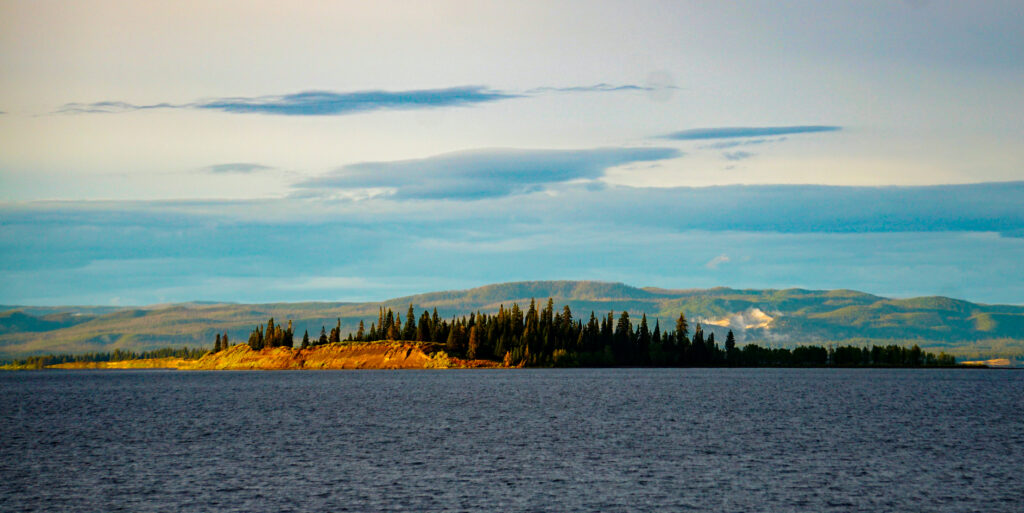
The other wildlife moment was a birder’s treat: At dusk we were eating dinner on our perch above the lake and I started shining a flashlight into the sky to attract moths and bats, then was surprised to see a good-sized bird swooping and flapping wildly in the beam of light. Turns out it was a Short-Eared Owl, our first siting ever of one, which are known to swoop and flit wildly while eating insects. From the south shore of the lake we had great views of Frank’s Island, below.
It’s a cliche that the Yellowstone plateau creates its own weather. And it’s true. Our trip was mid-August and on the last two days we had ice on our kayaks in the morning, same as we did when we paddled Shoshone Lake the next year in September. Once I backpacked to Heart Like in late July and woke the first morning to find snow on Mt. Sheridan.
The worst day of our trip was the last: As we paddled back through the West Thumb area we chose to head directly toward the put-in/takeout near the marina. At first it was fine paddling, blue skies and calm winds, but quickly the wind picked up until it was a wicked grind. Clouds blotted out the sun and I was chilled from the wind and waves. Same thing happened the next year on Shoshone Lake. But eventually we made it to the marina and all was well. A beautiful trip in a wild corner of the world.
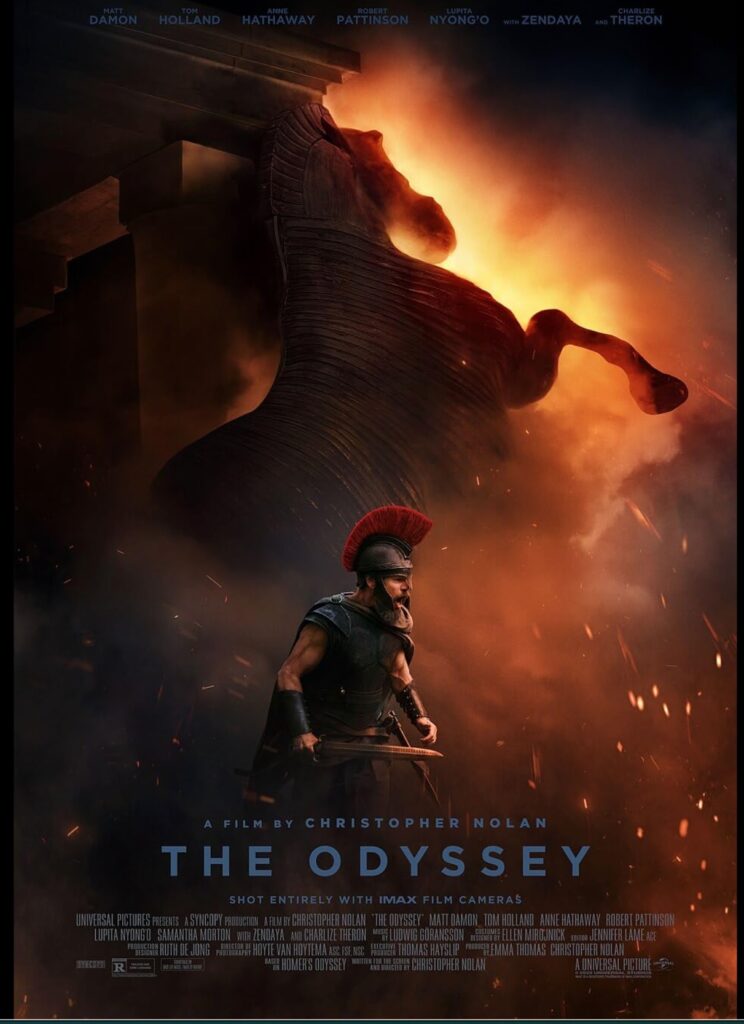
So like everyone who reads the news I’ve heard the hoopla about Christopher Nolan’s adaptation of the Homeric epic The Odyssey, and was actually in the audience at my local theater to watch its Thursday-night debut. The place was packed. A group behind us were wearing togas (that looked like bed sheets “repurposed”). Excitement in the air! The crowd was not disappointed: At the movie’s close there was an ovation, though I always think that’s a bit silly, since the performers aren’t there to hear it.
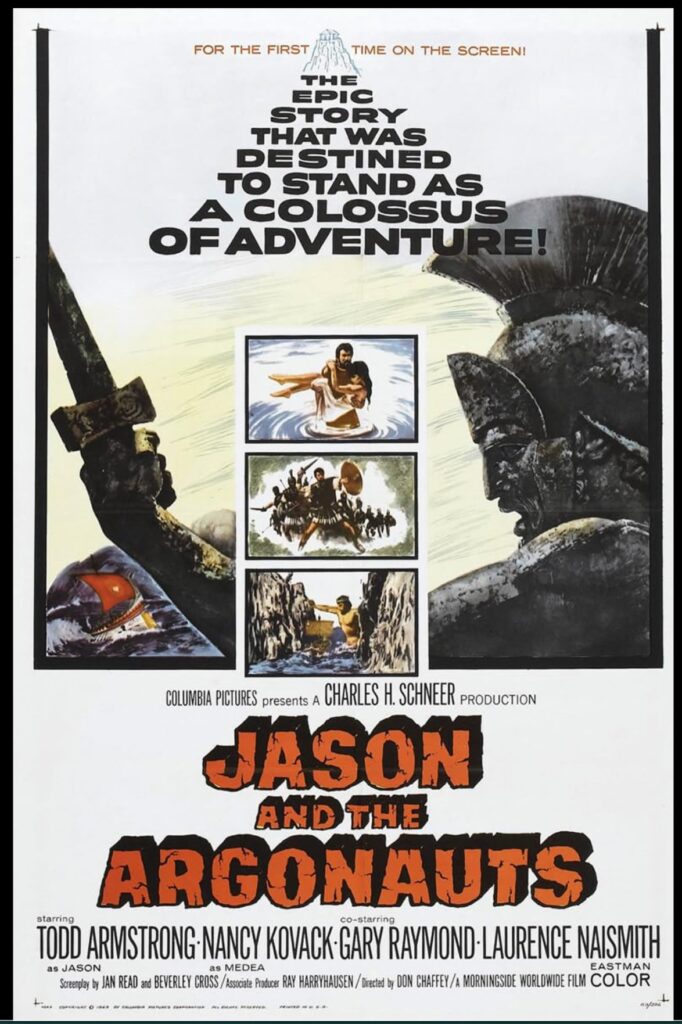
An easy reaction: It’s like a really well done homage to the 1960s classic Jason and the Argonauts (1963). I’m sure Christopher Nolan fans will find that cheeky. He makes great films if they do require some patience. In this case it’s an epic serving of eye-candy. The scenes are iconic and often awesome, such as when the Cyclops traps them in his cave, or when Odysseus is pining away on the beach with Calypso. As with Jason, there’s also a scene in which dead soldiers rise from the sandy beach. (My favorite scene in Jason and the Argonauts was the skeleton battle.)
It’s good filmmaking, though I still rate Backrooms as more of an iconic hit of the summer, with its scary techno-world reality.
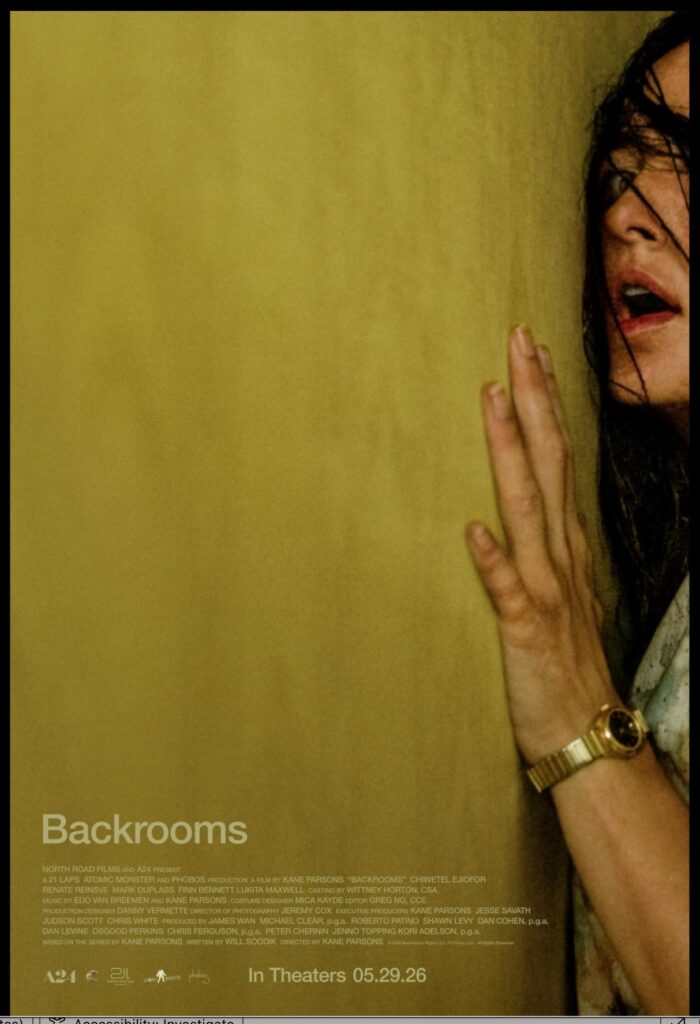
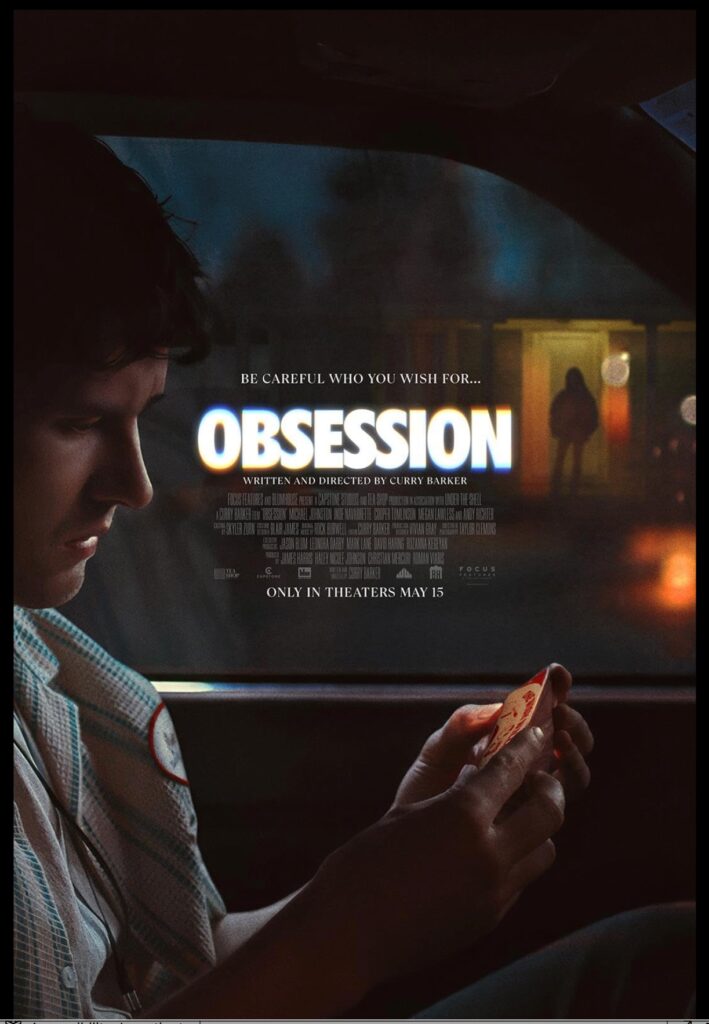
So I’ve heard the buzz about the new film Backrooms for a while, along with Obsession, the two breakout hits of the summer movie crop. I studiously avoided reading much about it, including reviews, so as not to be corrupted by other opinions. Now that I’ve seen it I do recommend that approach, as surprises are part of the fun. Or more particularly: The Mystery. In Backrooms the filmmakers do a good job of dropping hints and clues about what’s going on, without fully explaining it. If you’re a fan of psycho/surreal horror, you’ll love it.
I’ll do my best not to give much away. My perception of the movie, from the online buzz, was that it was this year’s Blair Witch Project (1999). Wrong. (Blair Witch had its makeshift charms, anonymous, inexperienced actors and limited plot: I remember seeing it at the theater and wondering, when it ended, “Is that it?”) No, Backrooms is professional and polished, despite its director being only twenty years old (and the movie’s “found footage” origins from a YouTube video). One thing I quickly discovered: It has knockout performances from the two main A-list actors: Chiwetel Ejiofor as Clark, the man who sets the plot in motion, and Renate Reinsve as Mary, who acts as something of a narrator and psycho-spiritual guide. (She was up for Best Actress in last year’s Sentimental Value.)
The best summer hits capture the nation’s zeitgeist, so in this way maybe Backrooms is this summer’s Jaws (1975), or better yet, Alien (1979). It’s a snapshot of what we fear: In this case, technology run amok. I read it as a metaphor for A.I., or A.S.I. (Artificial Superintelligence), although A.I. is never mentioned in any way. Various A.I. researchers and pundits have noted that even its creators don’t know exactly how A.I. works, how it “learns” and “grows,” exactly. Some have argued that’s cause for great alarm—the folly of creating a super-powerful technology that we don’t understand and can’t necessarily control completely. Backrooms, however, is no jeremiad. In a nutshell, it’s freaky. Great visuals of empty rooms and insular creepiness. Supposedly it’s a play on “liminal spaces” and there is a not-exactly-here element to its reality: It’s something in between our world and the world to come. I’ll classify it as Psycho-Surreal Horror. Now to Obsession, a horse of a different color.
Obsession is more conventional. Its tagline captures that: “Be careful who you wish for.” It’s essentially a Love Story or a Love-Gone-Wrong Story. I’ve heard it’s interpreted by some as a metaphor for (romantic/sexual) “consent.” Maybe. But it doesn’t beat you over the head with that idea. Unlike Backrooms, the danger is not a technological one, but it shares a fear of the unknown product we can purchase that will change our lives in ways we don’t anticipate or understand. Michael Johnston plays Bear, the lovestruck lead, who pines for his “friend” Nikki (played by Inde Navarrette). Despite his bruin’s name, Bear is a nebbishy guy who can’t confess his feelings or pretty much act in his best interests . . . without some supernatural or divine intervention. Which goes terribly wrong. It’s another version of the classic Monkey’s Paw idea: Fulfilled wishes usually come with strings—or thorns—attached.
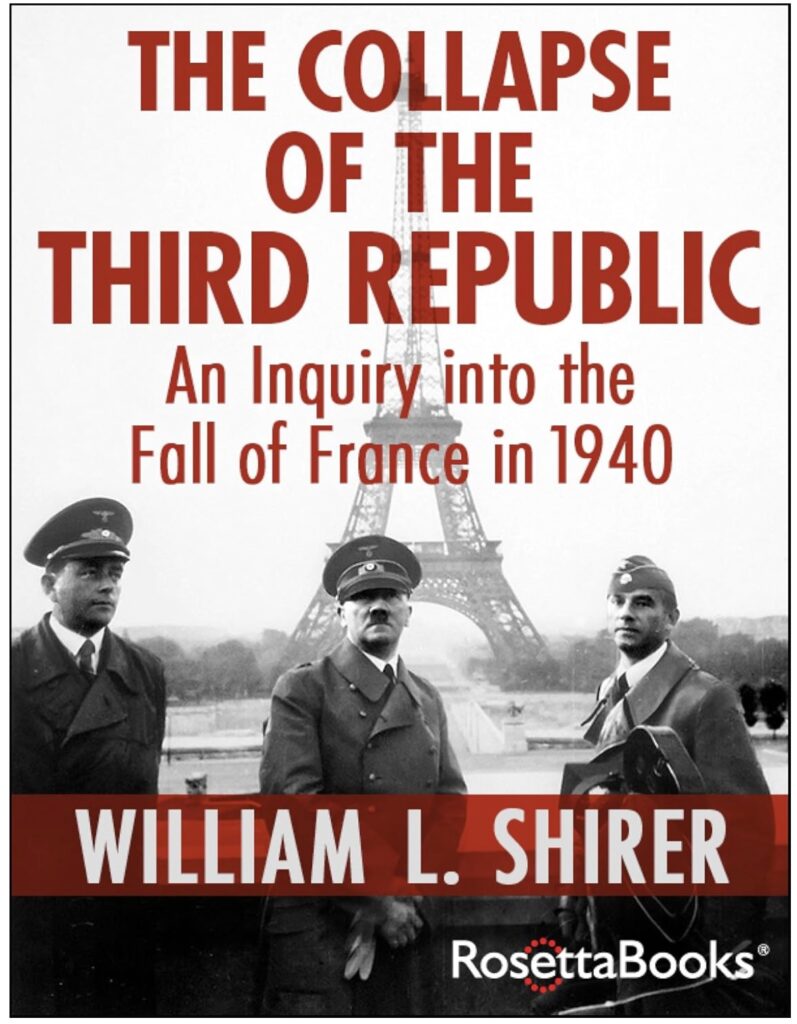
So one of the best books about WWII is William Shirer’s epic The Rise and Fall of the Third Reich (1961). Shirer is a fascinating narrator in part because he was there. (He’s also an excellent stylist, with a fluid, straightforward narrative flow.) He describes being at rallies in Berlin, about seeing Adolf Hitler and Herman Goring up close and personal: He was an America journalist stationed in Berlin during the 1930s (and has multiple bona fides about being a foreign correspondent in Europe, circa the 1920s-30s). The Rise and Fall of the Third Reich is phenomenal book. It changed my thinking and perspective on how brutal and cruel the Nazi regime was, and how foolish, in its own macabre way.
Now I’m tackling Shirer’s additional tome meant to explain and understand WWII, Collapse of the Third Republic (1969). In a nutshell Collapse tries to explain the complex history of early 20th-century France and how it could result in the demoralizing and catastrophic surrender of French forces and government in only one month at the outbreak of WWII in 1940. Shirer describes the tumultuous 1930s, including the riots of 1934 that weakened the French government (The Third Republic), from an eyewitness standpoint. He was there in Paris when many of the riots occurred.
The book is not an “easy read.” Although it’s very readable and lucid, it’s also 2000 pages, more or less, in my ebook version. I’m around page 500 so I’m a quarter of the way in, and still so much to go. But I like long books. If they’re worth it. And in this case, I think the answer is Yes.
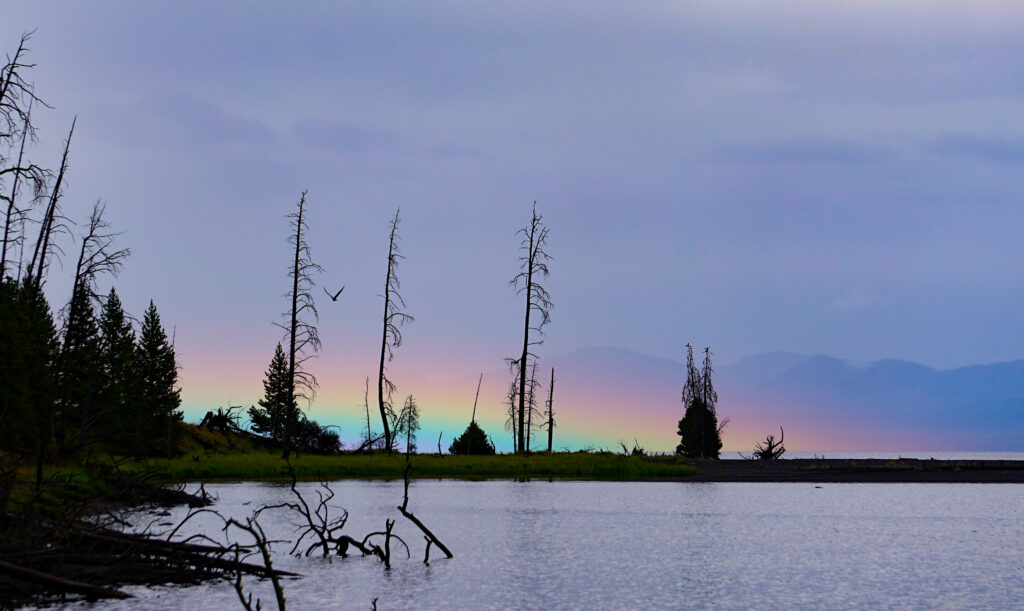
So one of my favorite places in the U.S. and the world is Yellowstone. While Old Faithful and the geyser basins accessible by car are all fine and dandy, the real charm of our greatest National Park is its backcountry. Here’s a photo taken while kayaking on the southern shore of Yellowstone Lake in 2024, a fabulous trip full of wind and rain and glorious lake. Our first day it rained while we paddled and the waves rocked our kayaks, but the sun came out as soon as we got to our campsite. Behind us the lake was filled with fog and mist and a cloud rainbow. If you look closely you can see a bald eagle flying between a couple of those snags.
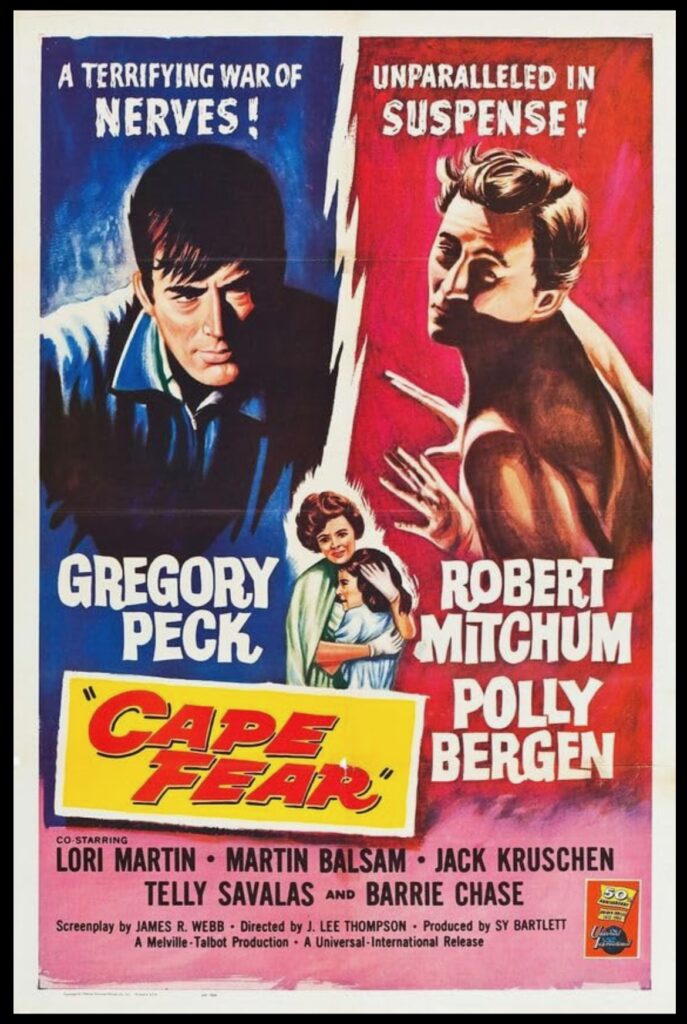
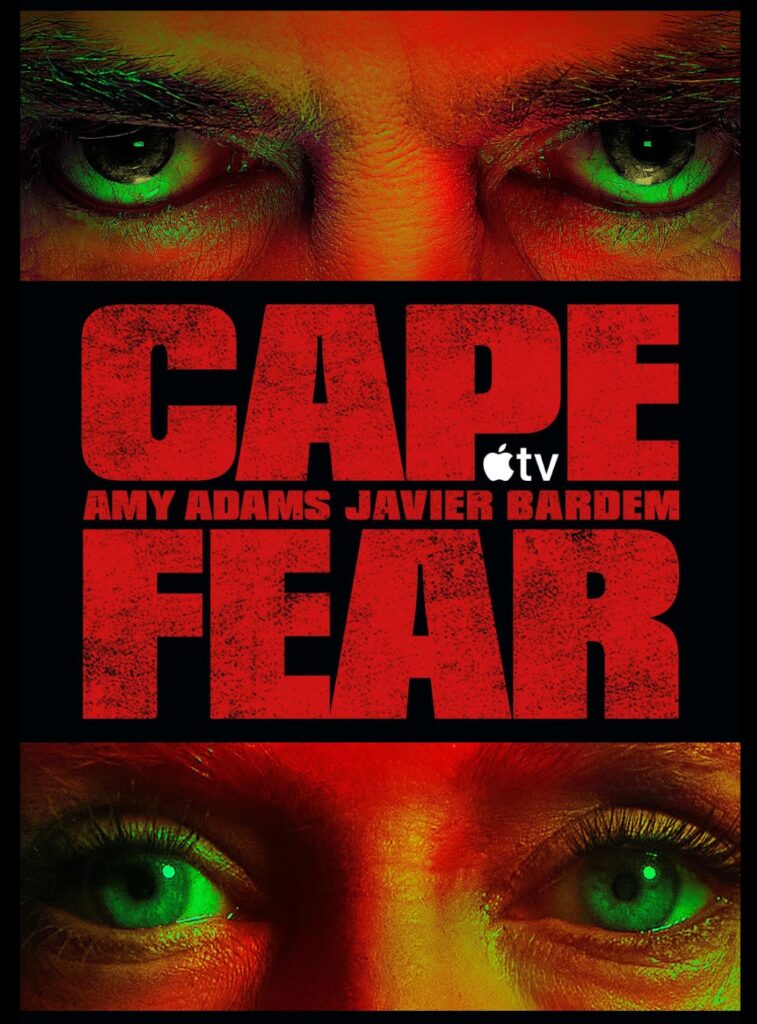
So when I first learned that there would be another Cape Fear remake, I was dismissive: The first two were good. For those who don’t know, the original starred Gregory Peck and Robert Mitchum, circa 1962, and is a noir classic. Then Martin Scorsese remade it in 1991 with Nick Nolte and Robert DeNiro, also quite good. Why another? Now that I’m watching the Apple TV series (big change from a feature-length movie) I see what they’ve done with it and have to say . . . it works. It’s even weirder than the first two gruesome versions.
The longer format of a series apparently led to the creation of numerous minor characters and major adjustments to the main characters. The nominal star of this remake is Amy Adams as Anna Bowden. Adams does a terrific job playing the lawyer whose fishy behavior led to Max Cady’s (Javier Bardem) imprisonment for 17 years. She’s cocky but vulnerable and a tad unhinged, guilty of the sin of hubris—or as my Catholic-school nun teachers would argue, the sin of Pride, the worst of the Seven Deadlies. She’s guilty of lawyerly misconduct because she believed her client, Cady, was guilty of the murder for which he was being prosecuted—by none other than her soon-to-be lawyer husband and former prosecutor of the murder case (Tom Bowden, played by Patrick Wilson). Seventeen years later, Max Cady gets released from prison and is out for revenge.
The differences between the earlier feature-length films and this series are too numerous to list, and the main reason why it seems like its own beast, not just another paint-by-numbers remake. For one thing, in the first two films the lawyer couple upon which Max wreaked his vengeance had one teenage daughter, who at some point Max comes to threaten. In the series, they have a teenage daughter, Natalie (played by Lily Collias, who looks more like her early 20s) and a teenage son Zach (played by Joe Anders, who does a good job of being moody). At first Zach is the one in trouble, presumably targeted by Max Cady as part of his revenge plot when he comes home missing a toe. It’s updated to include the role of technology in this Revenge Tale: Zach is wooed online by the sexy Nevaeh Valentine (played by Malia Pyles), Max’s mysterious and possibly homicidal daughter. Zach is a gamer who has shared nudes of his ex-girlfriend with other high-school classmates and is in purgatory for that sin.
But the real action crackles between Amy Adams and Javier Bardem. Bardem plays the role like a charming devil. He’s not as typecast as the first two films, not simply The Bad Guy. In this version he’s been wronged and may well be as murderous and evil as the lawyers think he is, but he’s also clever enough to milk the circumstances to appear the victim. Meanwhile Adams seems to react badly to one outrage after another, and is busy digging her own grave. It’s up to episode 6 by now, and one of its surprising charms is that you can’t really guess what happens next. Maybe Max gets his revenge and maybe he doesn’t. More likely the revenge he effects is more complex and nuanced than the violent end of both earlier films. Not that I don’t expect a violent ending, but it’s not the only option for the varied storylines. I’m enjoying it—even though, at the outset, I didn’t even want to watch it.