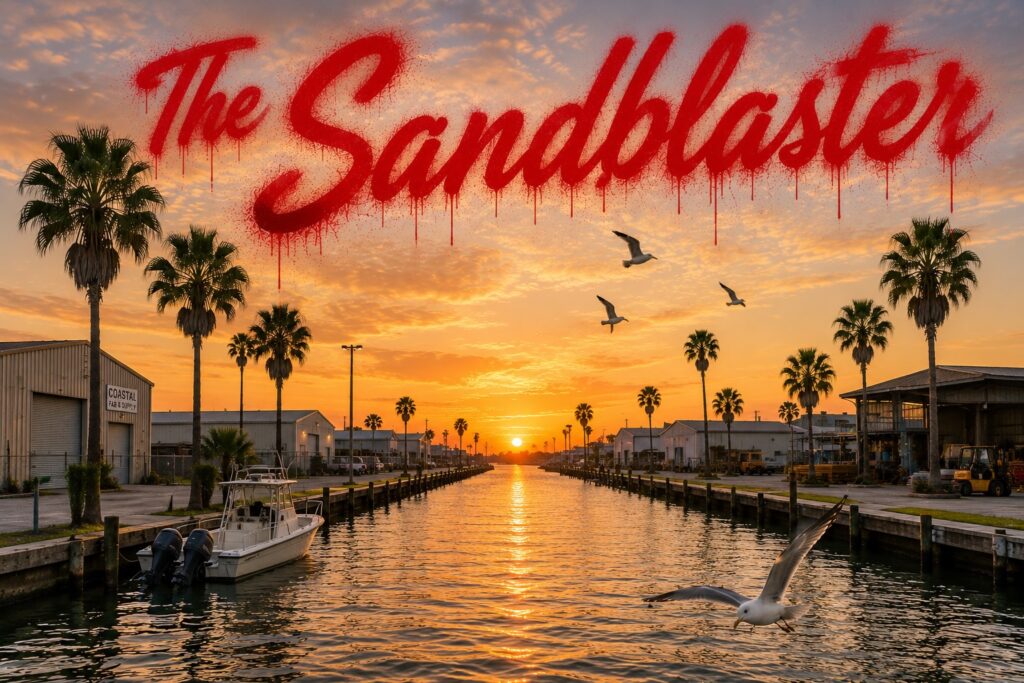
I was working as a sandblaster on the coast of Texas, at an industrial park right off the Intracoastal Canal. A wasteland of bulldozers and cranes. Stacks of rusty metal pipes. A few scraggly palm trees, no grass, house or town within miles. That’s where I saw her. Odd to come upon any people in that zone: We were like twenty miles from the beach on Mustang Island but there weren’t any bikinis or daiquiris to be found. Just miles of flat sandy windswept Nowheresville. Everything smelled like beached fish cooked in diesel fuel. Seagulls wheeled and squealed in the sky. They perched in lines on the concrete seawall and the pier railings.
We worked on a rusty barge moored in the canal. Our job was to sandblast the rust off the metal then paint it with rust-coating. We walked a bouncy plank bridge to get on board every day. Stagnant water beside the barge littered with yellow rubber gloves like a school of severed-hand fish. Summertime, ninety-five degrees in the shade, wind blowing twenty to thirty mph every day, flags popping on the big cranes used to lift shit.
And then, through a curtain of gliding seagulls against the bright summer sky, we see this gal walking in the wasteland. Took one look to know whatever is going on, it’s not good.
We is me and my painter boss, Pete, a crusty old drill sergeant of a guy with a handlebar mustache and eyes perpetually squinting in the sun, deep wrinkles on his face. He looked like a shrunken Marlboro Man. I was near six feet and he was a good step down from that—maybe five eight, nine. Classic Short Man’s Complex. Not a bully but grouchy and hard-bitten.
I was a newbie on the sandblaster/painter crew, young and naïve, got the job after talking with one of the painters while getting gas at a convenience store, told him I was looking for a summer job. He said, “Come on, Cowboy,” and that was that. After a few weeks I had a reputation for being easy to get along with. Pete wasn’t.
The other painters considered Pete a dick but we got along just fine. He was stern and grouchy but never really snapped at me as long as I did my job without loafing. Learned that my first day. The barge so hot I was just kind of standing there in the glare and heat willies rising off the baking sand. I took off my shirt and could practically feel my skin burning and shriveling up. At one point I felt dizzy and was leaning against the generator, trying not to faint. Pete growled, “Well don’t just stand there with your finger up your butt.”
After a few weeks on the job I knew his quirks. He was never a pussycat but he could be alright. I called him Mr. Grumpus one time and he almost smiled. Grouchy he was, sure, but I was never afraid of him. Pete reminded me of an old movie I saw once, with the actor Robert Duvall, The Great Santini. About a former fighter pilot who was a tough father. Once when I was finished cleaning all the paint equipment I said, “Okay, Santini. Let’s roll.”
When I first got the job, I told my friends, “Yeah, I’m a Sandblaster, no big deal.” I said it like I was some kind of Superhero: The Sandblaster. He’ll strip the flesh off your bones. Most people didn’t even know what it was. I didn’t, before I got the job. Cleaning rust off metal crap, that’s what it is.
Another reason the other painters didn’t want to work with him: He wouldn’t take breaks and generally ran a tight ship. As his assistant mainly I mixed the paints and cleaned all the equipment when we were finished, ran the compressors, and tried to keep the hoses from coming loose and twisting around like a rattlesnake, smashing you in the head with their hard metal couplings.
But that day Pete saw me watching this tiny girl in blue jean cutoffs and a halter top slinking along the stacks of concrete pipe over by the crane. I was about to call out and ask if she needed any help, but she was still too far and wouldn’t hear me. So I kept watching and ignored Pete giving me the stink-eye. “Get back to work,” he finally said.
I said it was kinda strange, wasn’t it? A girl walking alone out here? Then as we watched a pickup truck with two Mexican guys came driving across the wasteland, heading in her direction. “None of our business,” said Pete. “You want to stay healthy, keep your head down and pay no mind to that bullshit.”
I didn’t say anything. Rinsed out the sprayer and decoupled the compressor, covered the cans so the paint wouldn’t get stiff and thick. Like I was paid to do. But the whole time I’m watching. Mexican guys headed across the sandy flats and cut the gal off before she could get far. She saw them coming and ran behind the stack of pipes. They got out and each went in the opposite direction around pipes, and after a little bit here they come, dragging the girl along. Pushed her into the pickup cab and took off. But instead of leaving out the main road in they circled around to another rusty barge a ways down the canal, far enough that you couldn’t tell shit. But a half hour later they were gone.
The next day lunch time I took my cheeseburger and root beer and walked the seawall along the canal, toward the barge. Pete saw what I was doing and didn’t say anything. He was my boss but not the boss of me. We’d had a few words about the ICE deportations. He thought the “wetbacks” were getting what they deserved. I didn’t. Keeping my opinions to myself was part of the job.
Seagulls scattered before me as I made my way down the concrete seawall covered with bird shit. A blue heron five feet tall perched on leg and watched until I got close enough then it flew off slow and big like a baby pterodactyl. I got close enough to see that people were living there. A square cabin and wheelhouse toward the bow and a porta-potty perched aft, near the stern. A clothesline strung between the cabin roof and the railing. Women’s clothes on the line. Like our barge, this one had a wobbly jerry-rigged bridge of two-by-twelve planks held together every few feet with braces. I was thinking maybe I should step on board, ask if they needed anything. Then I saw him.
Skinny teenage Mexican guy, maybe my age or a little older, sitting in the shade on one side of the cabin, under the awning of a blue tarp stretched above him with yellow cord. Holding a rifle by the barrel, stock on the barge floor. Watching me. His face in shadow so I couldn’t see his expression.
I acted like I didn’t see him, kept walking along the concrete seawall. Made a show of looking into the water, like I’d lost something and was searching for it. Felt that gun aimed at my neck when I turned around and headed back. At our barge Pete was waiting, finished with lunch. He just looked at me and shook his head. “No, you ain’t doing that. So just forget about it.”
Quitting time we went home, getting munchies on the way. Pete bought me a cold beer and I drank it. Truth is I don’t even like beer, but I know you don’t turn one down. On the way back to the office, where my car was parked, we passed several ICE trucks with people pulled over on the shoulder of the road. Trash blowing in the wind. Palm trees waving in the gusts, people arguing, pleading, people with their legs spread and hands on the hoods of white ICE pickups. We’re used to it by now.
The Texas coast is pretty much Mexico with better roads and less diesel exhaust. Shrimp boats in the Gulf sometimes pick up extra cash by smuggling drugs off-loaded from others. Corpus Christi used to be known as a popular stop for illegals getting jobs and apartments. Now the Border Patrol is chasing down people everywhere and they’re all hiding. As we’re getting our beer white ICE pickups with green stripes surround a local bus and hold it up, drag two guys off and arrest them. The ICE cops wear black masks and have their pistols in side holsters, like wannabe gunslingers. I called them assholes and Pete said they were just doing their jobs.
Pete wears a gray hardhat shaped like a cowboy hat. It’s kind of cool, actually. I wouldn’t wear one. I couldn’t pull it off. But with Pete’s grizzled face and that handlebar mustache, he rocks it. Doubles as a political statement.
“They might be just doing their jobs,” I say, “but they’re still assholes.”
I still live with my parents, summer before college starts. I can’t stand my stepfather and we hardly say anything. But my best friend lives right down the street and I don’t have to pay rent. Don’t buy the cow when the milks free. After work I mainly hang out with high school buddies and get high, watch the moon on the water. My best friend likes to water ski but I never really thought much about being dragged behind a boat. I’m a working-class rat and skiing always seemed a rich kid thing, like those assholes who go snow skiing in Colorado at Christmas break and come home with broken arms or legs.
My mom said I was too negative. That I should learn to ski, to mingle with “quality” peeps. She suggested I enlist in the army. “Mom?” I said. “That’s for losers.”
Nonsense, she said. “You need some discipline,” she added.
She was big on inspirational quotes. Liked to embroider little pillows with sayings and tuck them all over the house. One pillow on our sofa proclaimed, “To succeed in life, you need three things: a wishbone, a backbone, and a funny bone.” Success and sweetness on wooden plaques hung on nails around our house: “Live, Laugh, Love.” The wag in me wanted to rewrite it as “Die, Frown, Hate.” But I couldn’t do that. She pasted that shit on my bathroom walls and my bedroom door. Here’s one of my favorites, on my bedroom door: “Try to be a rainbow in someone’s cloud.”
The next couple days I tried to tow the company line: Heed Pete’s advice: Ignore the trouble. Let sleeping dogs lie. Don’t stick your neck out. We were almost done with the barge job. I was itching to get out of there. Warm wind stinking of dead jellyfish. I’d stare out the window on the drive to the site. Flat horizon, hard-baked sand, tidal marshes and ditches with alligators. At first there were power lines with sneakers tied at the shoestrings and thrown over the lines to dangle. Hundreds of them. It was a high school thing. Some people did it when they got out. Like I’m free. Others when they dropped out. Like fuck it. If you hooked your sneakers over the first throw you had good luck for life. After the sneaker lines, nothing but a few scraggly palm trees at the industrial park entrance. Oil spills on the dirt road. Brown pelicans in groups of three flying over the ditches, hovering in the wind.
Sometimes I’d turn around and notice Pete watching me. He’d be bleached by the bright sun, mopping his neck with a red bandanna, cowboy hardhat practically gleaming. Every day there the sun seemed to keep getting hotter. I stood baking in the heat, wearing a floppy hat like vets wore in Iraq, zinc oxide on my nose, my shoulders sunburned when I got too hot and stood around without a shirt. The other barge was a couple hundred yards away at least. Mainly just a dark structure down the canal. Now and then I could see movement but too far to tell who or what was going on.
At the end of day I was cleaning all the pain buckets and resealing the cans and putting all the gear into the bed of Pete’s pickup truck when I noticed something move under the ratty blue tarp back there. I lifted a corner. A pair of bare feet retracted and then something squirmed and I came to be looking into the brown eyes of a teenage girl, staring back at me, her head covered in shadow, only her eyes visible in the murk. “Please,” she whispered. “Let me just stay here, okay?”
I gave her a long look back. Rock and a hard place. Standing there with my hands on the tailgate, heat radiating off the metal. The pickup bed messy with paint cans and trays, tarps and crap. She was tucked into the back right corner, using a spare tire to make the tarp like a little blue tent. I said nothing. If Pete glanced over and saw me talking to someone he’d put a stop to it quick. Without trying to be obvious I wandered over to our water cooler sitting in the shadow of the compressor and filled up my one-liter bottle, then nonchalantly dropped it beside her blue tarp, where a hand darted out and grabbed it.
Come quitting time a trio of military choppers fly low over the canal and we stop and watch. You can feel the whump-whump-whump as they chop the air. The sky has turned violet by then and the air is cooling off. I ask Pete if they’re Chinooks just to distract him. He slams the tailgate of his pickup and doesn’t say anything, suddenly stops and lifts the corner of the blue tarp. Sighs and shakes his head. “You know,” he stares at me hard, “there’ll be hell to pay.”
I shrug.
Driving the dirt road to the gate of the industrial zone, we don’t say a word. I keep an eye on the distant barge to see if there’s any action. Nothing stirs. Expecting a lecture or worse from Pete but he keeps his yap shut. I’m bone tired and sunburned and sleepy and when I rub my eyes they sting from all the crusted salt. As usual we stop at 7-Eleven, passing an ICE van on the highway. The store is on the edge of Aransas Pass, a ratty town that’s the gateway to Mustang Island and Port Aransas, just this side of the ferry landing. I get a Big Gulp of root beer and take my place in line behind two giggling blondes in bikinis, barefoot and still soggy from the beach. One of them asks if she cut in line and I tell her No, she was there first. She thanks me and points out a sign near the door to her friend, one that says, “No shoes, no shirt, no service.” They make oopsy faces and smile back at me.
When we return to Pete’s pickup, the blue tarp is bunched up and pushed into the corner. Pete pulls it out of the bed and fold it up roughly, weighs it down with spray paint rig. On the way out, he drinks his beer and I suck down my root beer until my belly’s full. The only thing he says is, “Looks like you got lucky.”
After the girl disappeared I had the sense Pete wanted to get this job done asap. We still had a week of blasting and painting left but he told me to show up at five a.m. the next morning to get an early start. We worked till sunset. I was so tired and sweaty by quitting time I was standing at the compressor and yawning, my vision blurry, my lower back burning. By then it was almost dark in the wasteland, the western sky red as fire. We’re shutting down everything and cleaning up the equipment when we see headlights heading our way, against that blood-red backdrop. My heart started beating hard but I tried not to act worried. We never got visitors.
Pete stopped what he was doing and stood there, straight as a ramrod, almost glowing in the headlights. He disconnected the blaster hose from the sand tank and plopped the end of it in the space between his pickup and the compressor trailer. He lifted his cowboy hardhat and smoothed his hair, put it back in place, came over to where I was cleaning the paint sprayer. “Listen,” he said. “If this is about that girl, you don’t know nothin’, you understand.”
I nodded.
“Nothing,” he added. “Not a thing. And let me do the talking.”
“Got it,” I said.
A sandblaster is a pretty simple contraption: First you need a diesel-powered portable compressor, on wheels, with a trailer hitch. You park that somewhere close to what you’ll be blasting. Some old rusty thing. My main job was running the compressor: Fueling it, connecting all the hoses, turning it on, being ready to turn it off at the drop of a hat. If the compressor is on and the hoses aren’t all connected, the air shooting through the hose turns it into a dangerous snake whipping back and forth, with a heavy metal coupling at its tip. The compressor makes a racket. We’d already shut it off but Pete walked away from me and flipped it back on as the pickup pulled up close and the headlights blinded us. The only thing keeping the hose in place now was no air in the lines: There was another lever you turned to open the air feed to the hose. Pete gave me a look, turning his attention from the pickup to me, then pointed at the hose end, raising his eyebrows.
A skinny Mexican got out of the pickup slow-like and moved toward us. Pete paid him no mind. He was carrying the paint cylinder to the back of his pickup, and loudly told me to bring the tarps off the barge. The Mexican looked at us both. “Donde va?” he asked.
Pete was passing the compressor and the kid was just the other side of it. Pete almost ran into him, growling, “Coming this way,” as he got close. The kid stepped aside. Pete dropped the paint cylinder on the tailgate of his pickup with a loud clang, then scooted it back into the bed.
The Mexican stared at me. “Where’s the girl?” he asked me.
Before I could answer Pete moved between me and the guy. “What can I do ya for, amigo?” he asked. “We’re about to leave and this is a private job site, so you ain’t stayin’ either.”
The Mexican made a face, walked to his truck and opened the door. He told us to turn off the compressor, that he couldn’t hear anything. We kept packing but in a second he was back, holding the semi-automatic. “I asked you, Mr. Gringo, to kill that fucking noise.”
Pete nodded. He shouted, “Sorry gotta let it run to clear out the lines.”
The Mexican stared at the two of us. The whole time that compressor noise blasted over all three of us. He squinted. “Where’s the girl?” he shouted.
“What?” shouted Pete. “I didn’t catch that.”
The Mex said, “The girl.”
Pete shook his head. “It’s been a long day, amigo. You go ahead and look for your girl. Ain’t none of our business.” He came up beside me and clapped me on the shoulder, like we were best buddies. Something he’d never done before. “Us two are going for a beer.” Then he kind of pushed me toward his pickup. “Adios, muchacho.”
The Mexican pointed his gun at Pete. “Turn off that fucking noise, Gringo.”
Pete stopped and nodded, keeping his hand on me. “One sec,” he shouted. He turned to me and gave me a death stare. “Get ready to run,” he hissed. Then he reached toward the air release lever. The one you never flip if the compressor is running and the hoses not connected. He made sure I saw.
Then flipped it.
It always takes a couple seconds for the air to fill the hose. It’s a thick rubber hose about two, three inches in diameter, and starts to bulge and bend as the air fills it, then shoot sideways. We rush behind the compressor as the metal coupling bashes the Mex’s pickup grill with a hard smack. Like a giant rattlesnake it snapped and coiled and whipped, smashing into things until it hit something with a thud and the Mex let off a round of bullets. We’re huddling behind the compressor, where the hose can’t reach. The shooting stops. The compressor keeps roaring and the coupling smashing into things.
Pete edges forward and peeks around the compressor. “Jesus fucking Christ,” he says. He inches around till he can reach over and kill the compressor engine. Suddenly, silence. The sound of seagulls squawking. The Mex on the ground, head bloodied, crawling toward his gun. I’m on my feet by then and not sure what to do. Pete watches him for a minute, pulling on a pair of workgloves, and when it seems the Mex is getting close, Pete steps over and picks up the gun. He stares down at the kid and shakes his head. “Some people don’t know when to take a hint.”
He points the gun at the Mex and lets rip a burst of bullets. The blast echoes flat against the barge. Pete tosses the gun on the dead guy. “You keep that, amigo. Seeing as how it’s done you so much good now hasn’t it.”
I was shaking and had to pee something fierce.
In the movies when they shoot people it’s full of suspense and drama. You know it’s going to happen before it does. Usually. Not the way it was: Pete just pointed the gun and popped him. And people in movies always get shot between the eyes or in the middle of the forehead. Pete got him in the neck. He scrabbled in the sand as his throat gurgled and spurted. For a second it looked like he was trying to rise up. Then he head fell back and he went limp.
I saw it all and thought: Now what.
Pete told me to hang loose. He had some calls to make. I was trembling and dizzy, my legs wobbly. My mouth dry and goosebumps on my skin. Almost dark by then and the wind whipping off the canal cooled me to the bone. Pete dragged the tarp out of the pickup bed and covered up the dead Mexican with it. Same one that the girl had hid beneath.
I sat on the tailgate and watched the industrial park road we used to access the barge site. No action at first, then headlights bouncing along the dips, heading our way. Pete appeared at my side and told me to let him do the talking.
The county sheriff pulled up to us slow and careful like, got out and settled his official cowboy hat in place. We all shook hands and he asked my name, wrote it down. He obviously knew Pete. They walked over by the compressor and stood there talking for a while. I couldn’t hear what Pete was saying but I could guess. He was gesturing this way and that, and at one point lifted the compressor hose and acted like it was swinging around. The sheriff put on gloves and picked up the semi-automatic weapon, carried it to his car. Brushed his hands off after he put it in the back seat.
He shook hands with Pete, came over and patted me on the back. “I think we can have all this cleared up by Monday,” he said. Then he drove off.
That night, when I got home I found Mom had embroidered a new fancy-looking round pillow and placed it at the top of my bed. In big black-and-red letters, it read, “Act as if what you do makes a difference.”
We had a couple days left on the barge job. Other than being a little rainy, everything was mostly the same. The barge down the canal was dead calm. The clothesline gone. Never heard anything about the girl. Soon after I quit to go off to college. On my last day, Pete shook my hand and said, “Stay out of trouble.” That was it. Later I heard they practically gave him a fucking medal of valor. I’m cool with it. The path of the righteous man and all that crap. Plus, you know, the wicked.