On Nathaniel Philbrick's "Mayflower" & Evan S. Connell's "Son of the Morning Star"

Nathaniel Philbrick is on a roll: Several years ago he won the National Book Award for In the Heart of the Sea (2000), about the wreck of the whaling ship Essex, which was staved in by a whale in the 1830s and became the impetus for Melville’s Moby Dick. (Melville is believed to have actually met the captain, Owen Chase, who survived the shipwreck and impossible long journey in a small boat to shore, a saga marked by the sailors having to cannibalize the dead, and even kill the living, to survive.) A couple years back Philbrick’s Mayflower came out and didn’t get quite the attention of In the Heart of the Sea, but it’s an outstanding book of early American history, especially the history of European immigrants clashing with Native Americans. The main focus of the book is King Phillip’s War, its causes, events, and aftermath, which is essentially the first volley in three centuries of Indian Wars. Mayflower makes a great bookend for Evan S. Connell’s Son of the Morning Star (1984), which is nominally about George Armstrong Custer and the Battle of the Little Bighorn. But Son encompasses most of the Plains Indian Wars of the late 19th century. Both books have a rhetorical angle that suggest ‘it didn’t have to happen this way,’ and both books are good at setting the events in historical context. Evan S. Connell is also a knockout novelist, most famous for Mr. & Mrs. Bridge, novels that seemed well ahead of their time. 
There’s an eerie symmetry to the timing of King Phillip’s War (1676) and the Battle of the Little Bighorn (1876), with the Revolutionary War (1776) sandwiched between: Flash forward to the end of the Vietnam War (1976). It makes you wonder what 2076 will bring: The end of the Chinese War?
From a 21st century perspective, the gruesome violence of 17th century Massachusetts is shocking. It seems that beheading was a common occurrence. There’s always someone getting his head chopped off and placed on a pike. At the end of the war, King Phillip, a Pokanoket (Indian tribe close to Plymouth) sachem or leader, is killed, his head chopped off, and placed on the gates of Plymouth, where it stood for twenty years. It seems pretty common for the unlucky in this conflict to be burned alive, torn apart by dogs, drawn and quartered, or tortured. 
This horrific violence puts me in mind of Cormac McCarthy’s Blood Meridian and The Road: When I first read Blood I thought it offered an exaggerated, over-the-top vision of the Texas/Mexico border violence of the 19th century. I later learned that McCarthy did a good deal of research about the Glanton gang. This is lifted from Wikipedia: “Much of the book is based on Glanton gang member Samuel Chamberlain‘s My Confession, which has been criticized as unreliable, but Blood Meridian is historically accurate in general, and includes numerous references to contemporary occurrences.” I now think it’s more accurate than not, as brutal as it is. When I first read The Road I thought it had that similar outrageousness, projected onto a future apocalypse. Considered through the lens of 17th century violence, perhaps The Road is also more “accurate” than we would like to believe.
Posted in Uncategorized | Leave a comment

Review of Stephen Graham Jones' "The Fast Red Road," from the Vaults

I’m glad to see that my comments on Stephen Graham Jones’ Ledfeather have drawn much attention on the site, and next on my reading list is his (other) new novel, The Long Trial of Nolan Dugatti. (He also just told me he’s recently finished another novel. Slow down, Buddy. You’re making the rest of us look bad.) Plus, in the spirit of the customer-is-always-right, I’m posting my review of Stephen’s first novel, The Fast Red Road. It’s still one of my favorites. I claim Stephen as a protege, as he was my student years ago, although he’s such a talent that I’m sure all I did was point him in the right direction, which is what professors often do, I think. It makes us feel warm and fuzzy when our former charges do well: see my recent reference to Alita Putnam’s knockout essay in Narrative. Here goes: The following review appeared in The Houston Chronicle’s Zest Magazine, 24 June 2001, pp 20, 23.

THE FAST RED ROAD: A PLAINSONG/By Stephen Graham Jones/FC2; 326 pages; $13.95

The Real Thing

With the disarming title of “The Fast Red Road: A Plainsong,” Stephen Graham Jones’ first novel roars onto the literary landscape like a Seventies muscle car hellbent on nothing less than genius. Its subtitle echoes Kent Haruf’s critically acclaimed “Plainsong,” and both novels stake out similar high plains territory. But the comparisons end there. While Haruf offers a reserved, sober evocation of a town forty years past its heyday, Jones’ novel looses a rebel yell about a Native American culture a thousand years old and utterly of the moment. It’s a hallucinatory, beguiling ride through a world both painfully real and utterly hypnotic.

The refrain of Marty Robbins’ classic country-western hit “El Paso” functions as both motif and Rosetta stone for the convoluted and juxtaposed workings of the plot. One of the seminal events takes place at a hip hootenanny gone wrong: “There was more that Birdfinger wasn’t telling him. A lone Goliard standing squat and misshapen at the edge of the floodlights once, unspeaking the world, pulling Cline from his paranoid salesman life back in time to WWI—Willie and Waylon and the boys—letting him remember how it was before Marina died, when they were postal thieves, the hammer thumbed back every minute of every day, the ’69 Ford faster than radio. . . . There was the graven image of his dad as seen from a shelter, holding the leopard woman’s forehead to his limited-series commemorative beltbuckle, both of them framed by the trailer window, backlit by Gunsmoke” (38).

That passage introduces two motifs: the importance of names and the unriddling of songs. The names in this novel are original, quirky, and mysterious. It’s as if Thomas Pynchon’s patterns from “V.”  have finally been updated and one-upped. The principal characters are brothers Pidgin del Gato and Birdfinger. The interment of their father, Cline Stob, jump-starts the action of the story, even though Cline died some eleven years prior to the moment of his burying/mock funeral, which, for various woolly reasons, Pidgin fails to attend. Marina is their mother, and died mysteriously some years before all of the present action, but her fate ricochets through her grown sons in psychic ripples.

Yet the main characters are only half the fun. Secondary characters with shape-shifting identities and handles abound, complete with thumbnail biographies and razorblade-sharp descriptions. For instance, there’s Vanetta, a some-time love of Birdfinger’s and shamanesque Gal Friday: “Birdfinger had told her once that her red hair was why he chose her out of all the others in the first place, that it was opposite enough from his long-gone Marina that it didn’t remind him of her so much. Vanetta had just looked around and said ‘What others, Bird?’ then went on, that night, to prove to him that her hair was just dyed red, faux fox. Midafternoon he woke to her watching him. She was smoking a miles-long aftersex camel, her nails witchblack, no make-up. She laughed and said, ‘You’re a hornbrowed, unclever man, Bird,’ to which Birdfinger added he was a little long in the tooth to boot, but who was counting?” (68). There’s also the weird configurations of the Leopard Woman, and a nurse who dispenses painkillers, Anodiana. When late in the novel a character pops up named Patience Patience, you just have to love the invention.

Once you puzzle through what exactly happens at WWII (the second Willie and Waylon concert), you’ll eureka outloud, having unraveled a mystery that reads like a hybrid of Stephen Hawking’s“A Brief History of Time” and the gunslinger bios of Billy the Kid. Suffused in the strata of story is a challenging and post-eclectic philosophical stance. At one point Pidgin struggles to come to grips with a suitcase that may or may not contain a dead dog: “Pidgin sat . . . watching the suitcase for signs of life, knowing it was pointless: the dog would be neither dead nor alive until seen, realized, labeled. Until then it was in quantum limbo. That was the way things were. He’d had it drilled into his head before he was ten, by Sally, with her ergodic theory flashcards and her nicotine lectures on Schrodingerian paradox and Poincarean recurrence” (36). That’s a mouthful. But if you puzzle through the ideas and the lingo, it makes perfect, cut-to-the-quick sense.

Although this is a novel “about” Native American culture, it’s much wilder and more profane than the digestible visions of Louise Ehrdrich or Sherman Alexie. It’s more like Leslie Marmon Silko on drugs. Does it matter that Jones is Native American himself, a Blackfeet? Yes. There’s an utter credibility, a sureness to the writing, a confidence to parody Native American stereotypes in everything from “Gunsmoke” to  John Ford Westerns to porno flicks. And does it matter that Jones grew up in Lubbock, got a PhD from Florida State, and is now teaching at Texas Tech? That he’s only twenty-nine years old? Perhaps it should. It’s a book by not only a Native American, but a Native Texan, that deserves lavish praise. It’s the real thing.

April 2009 Update: Stephen now teaches at the University of Colorado at Boulder. He’s older, too.

Posted in Uncategorized | Leave a comment

Bobcats & Turkeys, Dust Storms in the Snow

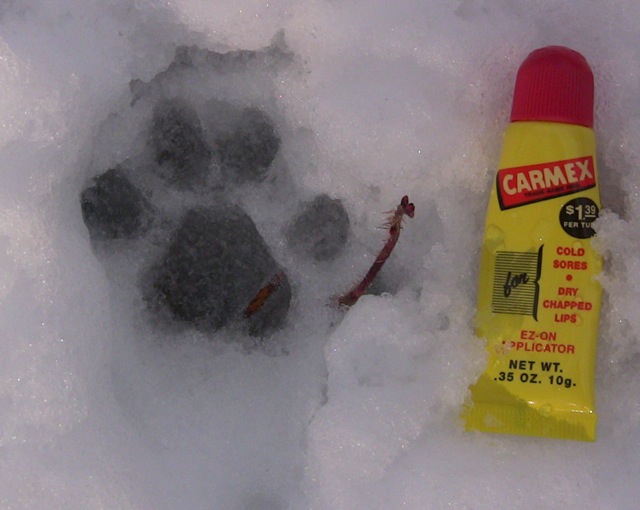
So there’s an article in the Washington Post today (I found it here: http://www.msnbc.msn.com/id/30360872/) about dust storms becoming more common in the West, with threats of a new Dust Bowl by mid-century, which fits my new novel, The Bird Savior, which opens with a dust storm. About a couple weeks ago our deck was covered with red dust after a snow storm. People don’t realize just how dry it can be out here. At my level of the mountains, though, we still have plenty of snow in the yard, if it is finally melting. It makes for good tracking, and we’ve had bobcat and turkeys in our yard lately. Here’s the bobcat track:
bobcatsnow1
The carmex tube (only thing in my pocket) used for scale is 3 1/4 inches long. Here’s the turkey track, even bigger:
turkeytrack
The turkeys look prehistoric, or atavistic, a throwback to the first Thanksgiving. (I’m reading Nathaneal Philbrick’s Mayflower right now, which takes me back.) We have them in the yard every day lately. They strut and fan their tails.
As an added bonus, click here (https://narrativemagazine.com/issues/winter-2009/fisherman’s-daughter) for an excellent essay about growing up in Alaska, by the one and only Alita Putnam, lately of Penn State.

Posted in Uncategorized | Leave a comment

Albino Crows & Thunder Snow

You always hear how the past haunts the present, like Faulkner’s oft-quoted adage about the South, “The past is not dead. In fact, it’s not even past.” Here in backwoods Colorado the past haunts the West, partially in the frontier hardiness, where you stand side-by-side with ranchers at the supermarket and coffee shop, or in the ruins of a frontier-era cabin in my front yard, a 12×12 foot square home to an aspen now. But the haunted West reveals its ghosts also in the landscape: This morning we saw an albino crow in the springsnow mud along the aptly named Muddy Lane, and yesterday we heard thundersnow during this storm that dropped as much as two feet of snow on our valley. It’s a wildness of the landscape not yet overrun by people, perhaps never to be. On our return from Texas we passed through unpopulated Huerfano County, and saw a herd of some 200 buffalo, 50-60 pronghorn antelope, and over a dozen elk. Our ponds are filled with geese, and the roadside busy with killdeer, meadowlarks, magpies, kestrels, redwing blackbirds. The other morning of flock of over twenty wild turkeys marched past our front windows and across our yard, the tom spreading his tail wings like he was showing off. With black bear and mountain lion in our yard regularly, along with mule deer, raccoon, badger, and pine marten, we’re close to the animal world, to those energetic claws.

Posted in Uncategorized | Leave a comment

On Fawn Brodie's "No Man Knows My History" & the Polygs in My Backyard

So I recently finished Fawn Brodie’s biography of Mormon prophet Joseph Smith, No Man Knows My History, and I rank it as one of the best biographies of an historical American figure I’ve ever read, although T.J. Stiles’s Jesse James: Last Rebel of the Civil War is a close second. Both feature frightening depictions of Independence, Missouri in the pre-Civil War era. The Haun’s Mill Massacre episode and its aftermath—when the Mormons were expelled from Far West, Missouri—should be a movie, and shows the violent and shocking side of frontier life.
What’s most impressive about Fawn Brodie’s explanation and explication of Joseph Smith: She makes the wacky ways of the early Mormons—the gold plates, the seer stones, the invented history of the Native Americans and Jesus in the New World, and polygamy—make total sense. In the East this seems like a quaint, odd corner of American history. In the West it’s part of our daily life. The other day the playground where my daughter slides and swings was full of girls in prairie dresses. Some of them might be Amish or Mennonite, as we have a community of both in Custer County, but we also have a FLDS community here, too, newly formed and growing. One of their 80-acre plots of land is only a couple miles from my house.
The story of how polygamy developed in the Mormon church is odd and rather unremarkable, save for the ego and energy of Joe Smith, and the fact that it has lived on, even after the U.S. government made the Mormons give it up. I’m a fan of HBO’s Big Love, which recently wrapped up its third season. It seems fairly realistic but for the main family of Bill Paxton, Chloe Sevigny, Jeanne Tripplehorn, et al. They seem a bit too glamorous for that world.

Posted in Uncategorized | Leave a comment

Abandoned America Redux

Driving west-northwest across Texas from the Gulf Coast is like viewing landscape-as-economic-chart. First you pass through the lively, jumping hives of San Antonio and Austin, where the Depression doesn’t seem evident, the freeways full of pickups and new cars driven by people hustling to work. If you then head toward the Panhandle, things veer down the Dilapidated Way. After (and before) Abilene a wide expanse of ranchland where plastic bags impaled on cactus and barb wire fences is a common sight. Weedy sidewalks, bleached storefronts, rusted cars in rocky fields. Few houses and few people. Most of the businesses seem abandoned, as do the once-mighty town squares of all the little towns between Abilene and the border at Texline (northwest Panhandle). I noticed this years ago, how the small towns were dwindling and the cities swelling, and wanted to title my last novel “Abandoned America,” until I heard about a book of photography with that title. (Plus I squirm at books with ‘America’ in the title, unless it fits.) Here’s a sign I saw in the abandoned zone closer to the coast, near the town of Sinton:
Wife Needed

Posted in Uncategorized | Leave a comment

Live from Mustang Island: "Burn After Reading"

So here on the Texas coast of Mustang Island, where I misspent my highschool years and where the wind blows like a hurricane on any given day, which is today, naturally, we’re chasing two-year-old Lili around the pool area. It was a minor miracle that we managed to get her to build sand castles. I remember the old coffee commercial from the Seventies where some irritable guy says, “But it’s so windy at the beach!” This landscape is also the setting of Goodnight, Texas. Right now I’m watching the Coen Brothers latest film, Burn After Reading, the first one to follow No Country for Old Men. (Last Saturday we spent the night at the Hotel Paisano, in Marfa, Texas, where the cast/crew of Giant stayed while filming, a cool old hotel with a gorgeous ballroom, classic tile floors, and a fountain in the courtyard, where people congregated to have afternoon drinks. Some of the scenes of No Country were filmed in the Marfa area.) Burn isn’t one of the best Coen Bros movies, not in the same league as, say, Miller’s Crossing or The Big Lebowski, but it has its zany moments: the divorce lawyer and the plastic surgeon are razor send-ups of the devious professionals. Frances McDormand and George Clooney have great moments, both fast-talking, nervous types in the tradition of the madcap comedies of the Thirties and Forties. Brad Pitt is high energy but he seems to be trying too hard. It’s a perfect Coen Bros moment when the Asian girl says, about an online dating service, “Both of my friends got hooked up that way. With really special guys.” It echoes a similar moment in Fargo, but doesn’t feel like it’s stealing or self-plagiarism.

Posted in Uncategorized | Leave a comment

UFO Sighting & Blizzard of March '09

On The Day After of the Great Blizzard of March ’09 (The Weather Channel is calling it an Epic Storm. We got 13″ of snow. Nice but I don’t know about ‘epic’), I’m thinking aliens and such: A few nights ago I awoke in the middle of the night and looked out the French doors to my balcony and saw a strange glow in the sky. It was an orange-colored cloud and flashing lights in the northeast. From my balcony I can see a good forty miles or so (the house is on a hillside), northeast to Lake DeWeese and the Royal Gorge area. The lights and clouds, close encounters via Spielberg, were much closer, probably five miles or so. It could have been headlights somehow shining on a snowcloud. There was a bit of cloud in the sky, but this ‘shining’ was much lower than that. And there are a few roads in the valley there, but not many. I tossed it off as nothing more than that.
Until the next night on the local Colorado Springs news they reported a rash of cattle mutilations, the first of which occurred in Westcliffe. They’ve occurred all over the area of Southern Colorado, in wildly disparate locales. About a dozen or so. Now I don’t know. I’ve always wanted to see a UFO. . . . That said, I’m definitely a ufo skeptic. I probably wouldn’t believe unless I was abducted.

Posted in Uncategorized | Leave a comment

On Eugene Linden's "The Future in Plain Sight" and Other Looming Disasters

Back in 2006 I stumbled upon a book by Eugene Linden titled The Future in Plain Sight, which is a little gem of foresight. Published in 1998, it predicted our present financial collapse, the rise of religious extremism and terrorism, and a host of other ills, most of which have already come true. (One of which is looming: global pandemic. I’m not at all convinced of the certainty of a bird flu epidemic, which is sometimes put forward in popular magazine articles, but there are a host of other viruses that could break out. Richard Preston’s Hot Zone is the scariest book in this category, nonfiction, too, about an airbone ebola epidemic that surfaced near Washington, D.C.) Linden also wrote The Winds of Change, about global warming. He’s had an influence on my new novel, The Bird Savior, with his clear-eyed focus on the troubles ahead. Both books are excellent reads, and make a good campion to, say, E.O. Wilson’s The Future of Life. In this category the best of all, I think, is still Jared Diamond’s Collapse. (I like his especially because the first chapter, set in a valley in Montana, south of Missoula, is much like my home in Westcliffe, Colorado.) Ultimately his perhaps is the most hopeful, as well, from a logical sense: We should be smarter than the Easter Island culture. Even if it seems sometimes we’re not.

Posted in Uncategorized | Leave a comment

On Donald Barthelme's "Sixty Stories" & Mary Robison's "The Dictionary in the Laundry Chute"

Back in 1988 it was and none other than Donald Barthelme called my one-bedroom flat in Jersey City and asked to speak with me. This was close to God giving you a call and wanting to chat. I’d been a fan of D. Barthelme ever since I started college and began to read good fiction. (His wasn’t the only mindblowing fiction I discovered early in college: I remember buying a paperback of Nabokov’s Bend Sinister at a Goodwill store, so naive that I had never even heard of Lolita: Before too long I had read all the Nabokov I could get my hands on, and though I don’t read him much anymore, he’s still one of my favorites.) Barthelme was calling to invite me to join the writing program at the University of Houston, which he directed at the time. (Now, all these years later, I’m directing the writing program at Penn State. Which seems a case of What Goes Around.) Today’s NY Times reviews a biography of Donald Barthelme by Tracy Daugherty, a good fellow and former student of his, an excellent fiction writer too. Barthelme passed away too young and too soon, and I ended up studying with Mary Robison at the University of Houston all those years ago: it was by studying Barthelme’s and Robison’s fiction that I mastered the art of using third-person narration. Back then I noticed most of my peers wrote first person stories, and many of them sounded the same. So I decided to master third-person, and have since found that as my mainstay. I was amazed at how fast Mary Robison could create a world in third-person, and in her best stories, like “The Dictionary in the Laundry Chute,” evoke a powerful emotional punch through seemingly ‘everyday’ details. She’s a good person, too, soft-spoken, humble, disarming. I learned from her that you don’t have to be an obnoxious monster to be a successful writer. Barthelme is flashier and more fantastic, with stories like “The School” and “I Bought a Little City” being some of my favorites. To this day when I see a big moonrise and am out walking with my wife, I’ll say, “See the moon? It hates us.” Lines from a great Donald Barthelme story in Sixty Stories.

Posted in Uncategorized | Leave a comment