
So I think at this point we’ve accepted that technology is going to kill us all one way or another. It’s like we’re playing an elaborate mind-game about which exact glitch will lead to our demise. After the much-deserved success of Backrooms (2026) along comes The Reality Experiment (2026), cut from the same techno-cloth. Plot setup: A kooky-haired British “researcher” named Jeremy hires a group of college students to be his guinea pigs for his eponymous project. They meet in a nondescript office park of some sort, sit in a circle, and each of them has a small white ball with a buzzer atop it: At Jeremy’s command they will all push the buzzer at the same time, receive a small electrical shock, and all of their “realities” will be altered or transformed into . . . what, exactly, is unclear.
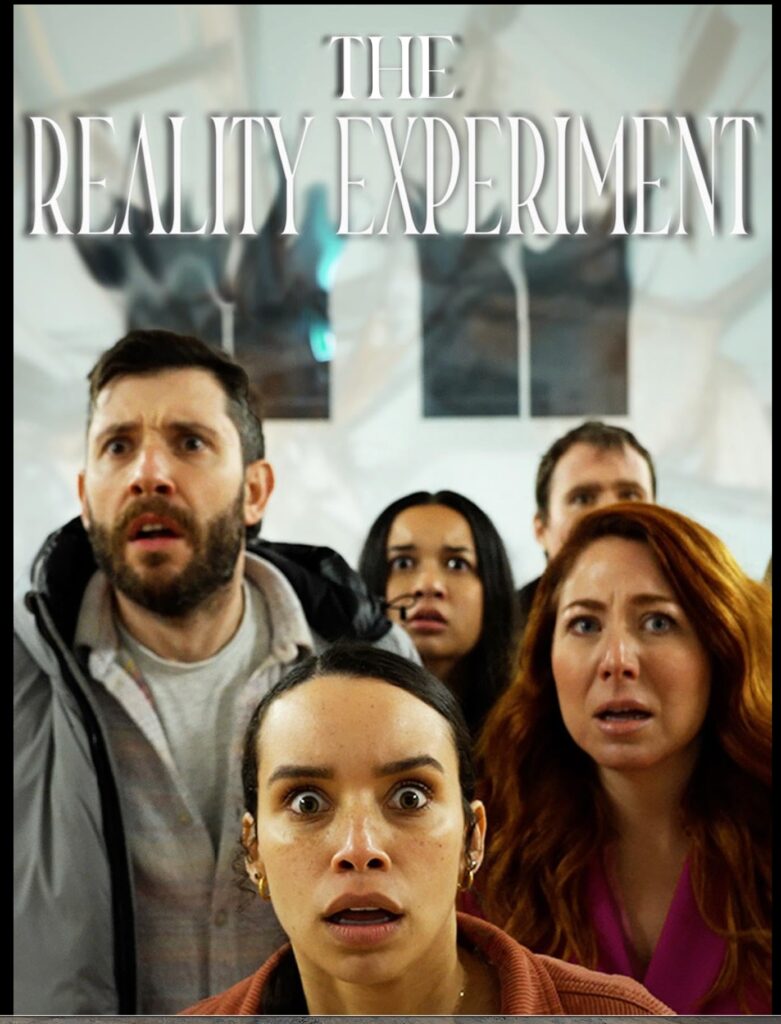
No spoiler alert here: I won’t give it all away. Jeremy—a research psychologist I guess you could call him—is rather feckless and scatter-brained. Seaton Kay-Smith plays Jeremy and does a good job of investing him with personality, even when he seems a bit cliché as the somewhat-ridiculous academic with extremely messy hair. The students are a mix of male and female, with the young woman Kelly (Livia Hendricks) emerging eventually as the Main Character. They push their buzzers simultaneously and voila, the world is not the same as it was before. One woman has a new iphone (yay). Another doesn’t recognize the people in her Facebook page. The worst is Paul—a rather hangdog chap—who seems to have lost his wife and kids in this new reality. From that initial setup the rest of the film unfolds, and answers, various mysteries and subplots. It’s all a bit like Backrooms.

As in Backrooms, the altered reality of their experiment takes a sinister turn. Once they change realities they can’t get back to their original selves. They keep fiddling with the buzzer device (powered somewhat comically by two AA batteries) and rewarping reality to disastrous effect. Although it’s as highly improbable as Backrooms it does hold together well: After being skeptical of the film’s quality in the first five minutes or so, I kept watching and was hooked by the mystery. Roughly three-quarters into it the story starts to weaken. When a giant duck appears and seems to eat one of the characters, it most resembles Backrooms. But, as they say, “All is not what it seems.” Is it a good movie? Kinda. I was hooked. The ending didn’t quite make it for me, but there’s a sly nod to what the power of consciousness can achieve.