
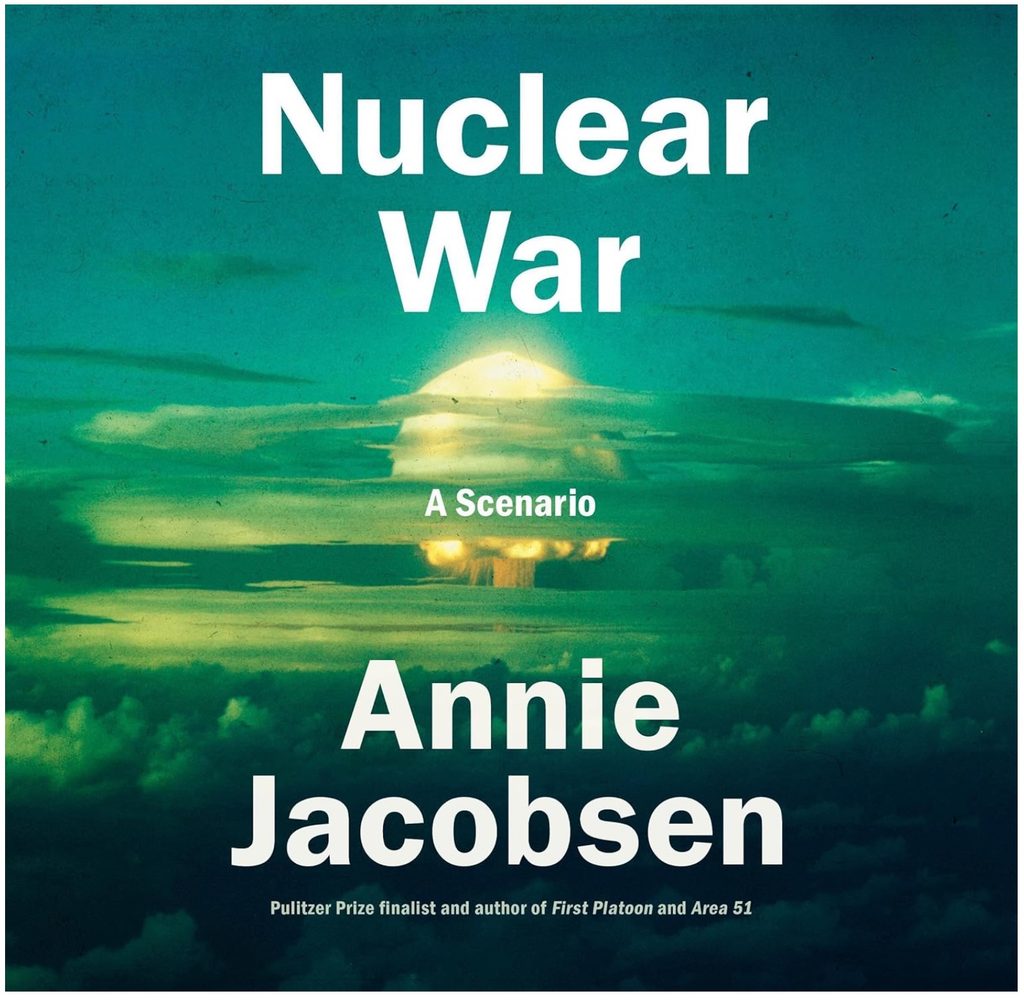
So like most people (I assume), I don’t dwell on the threat of nuclear war too much. Yes, it’s a Sword of Damocles hanging over our head. But it has been for some 81 years, right? Surely it will continue this stasis that preserves . . . gulp . . . our shared civilization and very existence? Well after reading Annie Jacobsen’s Nuclear War: A Scenario (2025) I’m not so sure. This may be the scariest book I’ve ever read. Perhaps more accurately: This is a lucid book about the frightening and fragile reality in which we all live.
First off, the obvious: There’s no shortage of doomsday scenarios floating and bubbling in our culture and news at the moment. A.I. could kill us all! (Maybe but nobody knows.) Bioterror attacks engineered by A.I. could kill us all! (One of the scarier possibilities.) Nanotechnology will kill us all! (See the doomsday-danger speech in Season Three of Silo.) Climate change will doom our planet! (Data driven warning.) But climate change is slow and inexorable, and more a matter of adverse climatological consequences over time than an immediate menace.
So let’s talk speed: Nuclear war would be ungodly fast. As Jacobsen notes, President Reagan in the Eighties famously lamented that any American president would have approximately six minutes to respond to the threat of an incoming nuclear missile. Six minutes. And that only reflects how long he/she would have to access the famous “Nuclear football.” Then the missiles start flying. As more than one quote in Jacobsen’s book warns, “The world could be over in two hours.”
Nuclear War: A Scenario has essentially two parts: The scariest part, in my opinion, is the careful description of the various technological systems in place to enable, facilitate and control the danger of nuclear war. The recent Netflix film A House of Dynamite (2025) also highlights the absurdity of this danger. It stars Rebecca Ferguson, who also stars in the Apple TV series Silo, as the main character Juliette Nichols. She’s a doomsday bookend of sorts: House of Dynamite builds up to a nuclear Armageddon and Silo imagines a post-apocalyptic world in which survivors live in fifty large silos underground, and have been doing so for four centuries. (Ferguson is excellent in both roles.) And the scariest part is how fast of all it would happen. In her scenario, we have about a half-hour from the moment the first missiles are launched before they start landing and other missiles launch in retaliation—all over the world.
The second part of the book is the “scenario.” It’s fictional, and for that reason I find it less terrifying. It involves the North Koreans, Russians, and Americans making decisions to launch many nuclear-warhead missiles (and bombers), totally destroying the world as we know it—at least the northern hemisphere. She doesn’t mention Africa or South America. Or China for that matter. I can quibble with whether the North Koreans would start such a futile war, whether the Russians would then exacerbate it, and whether the U.S. would launch a massive strike in retaliation. One of Jacobsen’s rhetorical arguments is MAD (Mutually Assured Destruction) does not work as a peace policy. All it takes is one bad actor to violate it, and we’re in a world full of falling nuclear missiles. (As this scenario goes, at least.)
The unnerving speed to ultimate disaster: The book is framed by time, beginning with a quick history of the buildup of the world’s nuclear arsenal from 1945 to the present. Jacobsen then relates the SIOP (Single Integrated Operational Plan for General Nuclear War), which details how the U.S. would respond to potential nuclear scenarios, including a First Strike. Then Part II unfolds the nuclear scenario: the first chapter in that Part has the subhead Four-Tenths of a Second After Launch, which is referring to the first launch of a North Korean nuclear missile toward the continental United States. The rest of the chapters follow that pattern, followed by 1 to 3 Seconds After Launch followed by 4 Seconds etc. All of the events described in her scenario happen way too fast. One thing that strains credibility is how quickly Jacobsen imagines our forces respond. If the POTUS has only six minutes to respond to an attack, what makes us think he’ll be available in those six minutes? What if he’s too busy posting angry screeds on his own Truth Social media platform?
Brief aside: The “scenario” involving the U.S. President is the only thing that approaches humor in Nuclear War. I think it’s inadvertent: The fictional POTUS doesn’t even seem to know what his role in a nuclear war is. The generals get frustrated when he won’t supply the attack codes. But it’s clear from Jacobsen’s description of our nuclear systems: The U.S. President has the ultimate—and only—power to launch. Now that’s beyond scary. In such an apocalyptic scenario, do we really trust Trump to do the right thing?
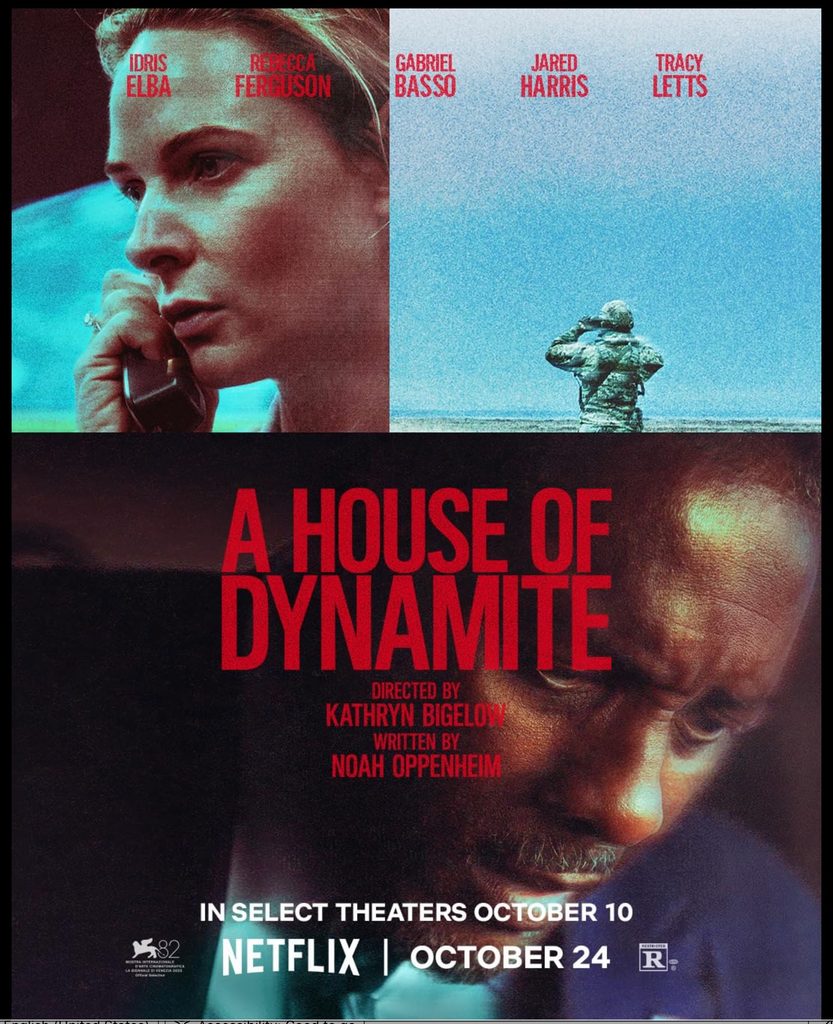
To be clear, Jacobsen doesn’t imagine the POTUS as being Trump, or any other recognizable politician. He doesn’t come across as a fool, either. He doesn’t want to retaliate, or even make the decision of whether to launch nuclear missiles or not. (He also ends up dead.) House of Dynamite stars Idris Elba as the fictional POTUS, as well as a terrific Jared Harris as the Secretary of State. This fictional POTUS is not unlike his counterpart in Nuclear War: A Scenario. Neither of them wants the decision. Jacobsen notes that many past presidents have been woefully naïve about their role, and that some of them seem not to want to know. I don’t blame them. But if push comes to shove (nuclearly speaking), it might affect the history of our world if our POTUS doesn’t do the right thing. What would that be? Who knows. But launching hundreds if not thousands of thermonuclear-armed missiles never seems it would be the “right thing” to do. Unless you want to kill us all.
Nuclear War: A Scenario is quite rhetorical. And Jacobsen convinced me. Of what, exactly? We shouldn’t even have nuclear weapons. It’s madness. Fueled in part by an irrational belief we can point civilization-ending weapons at each other indefinitely and not expect a dire outcome. Lastly, I suppose I should address this question: Is it a good book? Yes, absolutely. It was a bestseller when it (originally) came out two years ago. I read the 2025 update with its updated Afterword. It’s addictive. Although I didn’t find the fictional “scenario” scary, due to its being fictional, it’s still riveting. You rush through it to the end, which is really The End.
After that we enter the post-apocalyptic reality, which Jacobsen only imagines in a quick summation, but thanks to the folks at Apple TV, we have the series Silo to do that. I confess to joining the Silo fandom rather late, as I didn’t start Season One until Season Three was being advertised. But now I’ve seen all three seasons, and expect a fourth. Spoiler alert: If you don’t want to hear some observations from the Season Three finale, don’t continue.
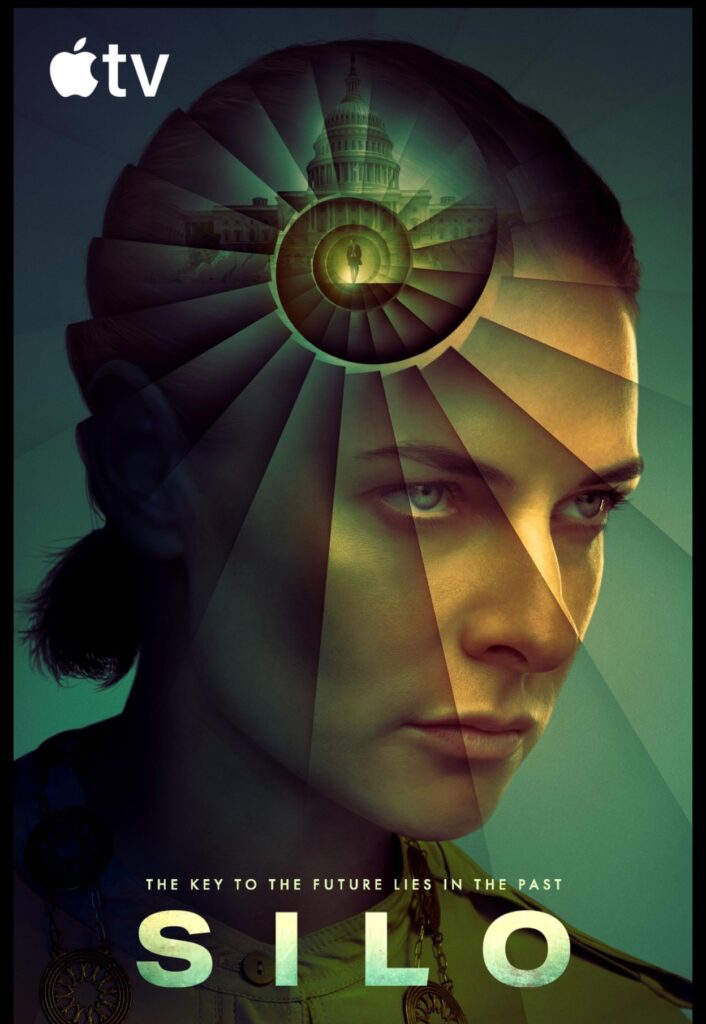
In the first two seasons of Silo the actual cause of whatever apocalyptic catastrophe occurred (which seems to have been four hundred years earlier, more or less) is obscure. It’s hinted at and flirted with, fairly obliquely. This viewer had actually ruled out nuclear apocalypse because there was no mention of radiation. I was wrong: In the finale of Season Three a nuclear weapon explodes (on the horizon somewhere in the distance, beyond the fifty silos). All these silos are the brainchild of a techworld billionaire named Per Stenson, who most resembles an Elon-Musk stand-in. He’s convinced the apocalypse will happen, and has undertaken the gargantuan (and expensive) task of constructing fifty silos (each of which holds around 10,000 people) and populating them, with the intention to save humankind. That all sounds nice and dandy. Except from several clues I suspect Per Stenson actually knew of and maybe even engineered the apocalypse to begin. (The character of Per Stenson is played by Colin Hanks, Tom Hanks’ son, who is quite good in the role.)
What to think of all this nuclear threat? We have to sleep at night, don’t we?
I don’t have any answers for that.
It’s not like we live in a world where we all get along. As of the first of October 2026, a headline in CNN this week: “Putin warns Russia is prepared to use ‘all weapons,’ including nuclear, to protect Kaliningrad.” Or this quote from the NY Times: “Foreign Minister Abbas Araghchi told “Meet the Press” that Iran was fully prepared for a new round of fighting, ‘even if it comes to a doomsday war.’”
These are only a few ominous rumblings from some so-called “leaders.” Trump has threatened to “wipe Iran off the map.” Good god. Tone it down, people. Those threats feed into one of the biggest rational fears to emerge from Nuclear War: A Scenario: Our main hope for stability and safety resides in the people in charge doing the right thing. Lord help us.