On Mud Rains & Wicked Windstorms: Crazy Weather in the Mountains as Backdrop for "The Bird Saviors"

So I’ve noticed the early reviews of The Bird Saviors mention the dust storms and pink snow featured prominently at the beginning of the novel. Although that might seem fantastic, actually crazy weather is common & seemingly growing ever more normal in the West. To give a couple examples:
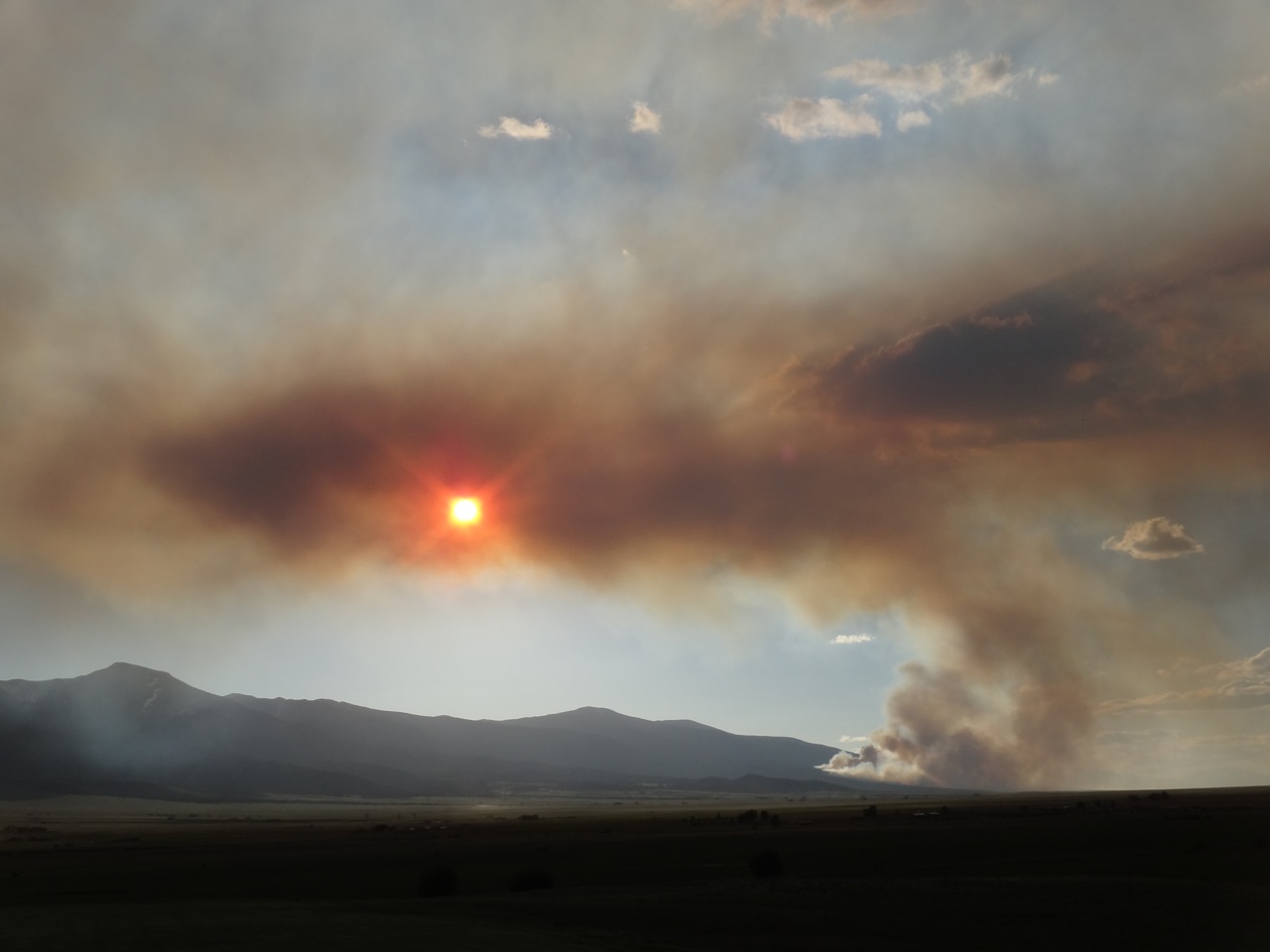
MUD RAINS: Due to the high winds (65-70 mph) over the mountains and the wide San Luis Valley that lies to the west of my home, plus the wildfires in New Mexico, last week we had the weird phenomenon of a “mud rain”: It rained over night, but everything was covered with spots of dust and mud after the rain, because the high amount of dust and dirt in the air. (The sky was hazy brown for several days.) I had to hose off everything—the car, house windows, deck, balcony, the cat.
CATASTROPHIC WINDS: Last November in our area (Custer County, Colorado) there was a wind storm that knocked down thousands and thousands of huge trees. Some of the locals have called it a “250 year” weather event, but I don’t know how one would calculate that. In my yard alone there were 50+ trees knocked down—huge aspens, ponderosa pine, and fir—and I was one of the least hit in my area. Trees fell on two of my neighbors cabins. The forest service cited the figure of 142 mph winds recorded during the storm. Along about a 20 mile swatch it looks like tornado damage in the forest.
Is this affected by Climate Change? I don’t know. Of course both weather people and climatologists would say the standard line that any individual weather event is not necessarily the result of climate change, but the locals here note that the weather here is noticeably different than, say, the Seventies or Eighties—drier, windier, less snow.
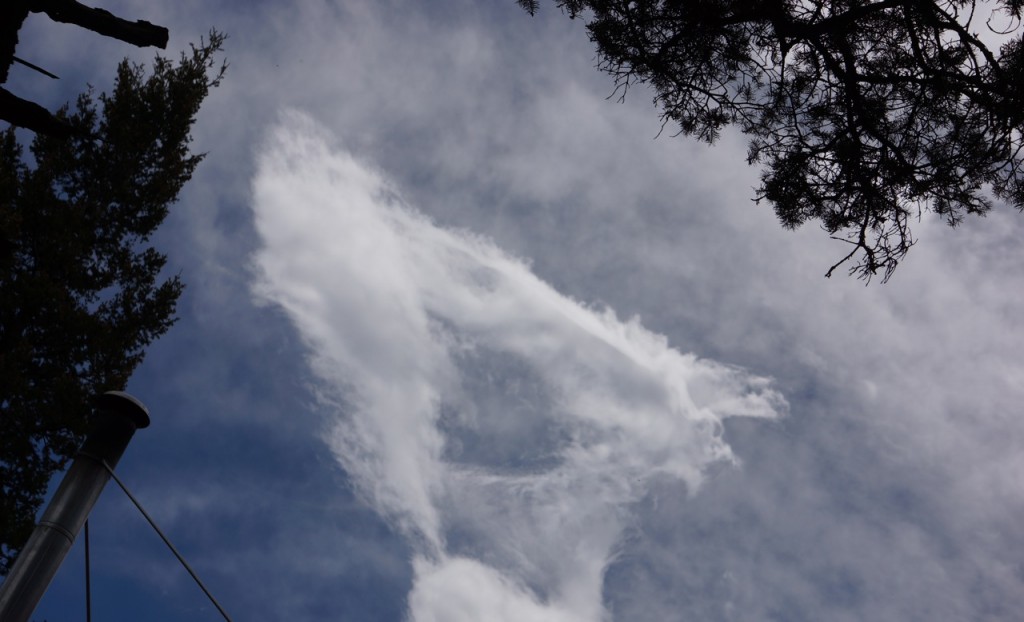
But that doesn’t stop a good parade on Memorial Day Weekend, witnessed below:

Posted in books, Climate Change, Photography, The West, Weird Weather | Leave a comment

"The Bird Saviors" Wins the Green Book Festival Prize in Fiction

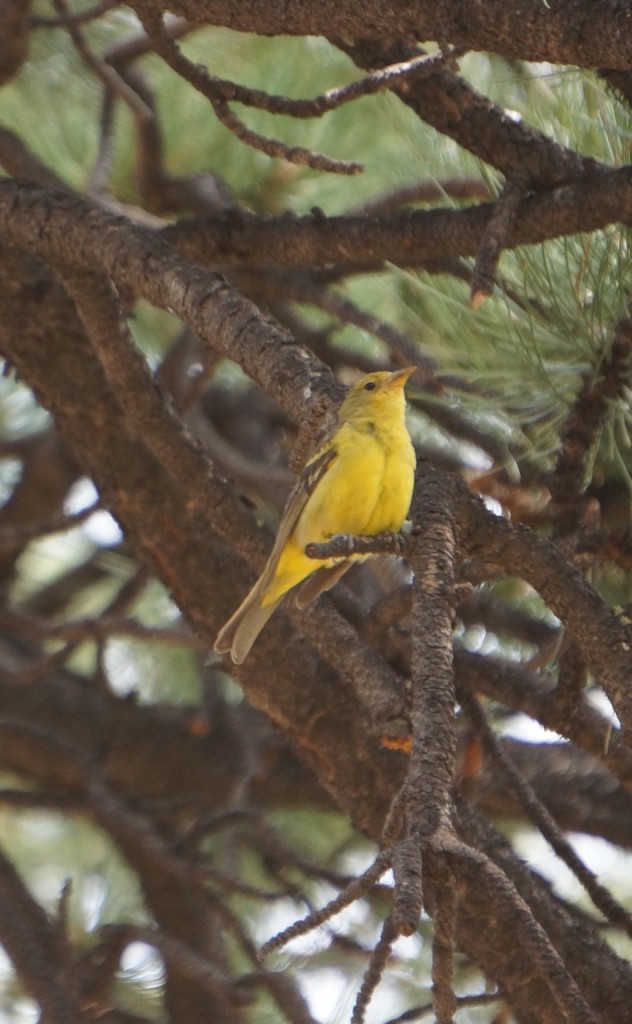
So I admittedly don’t know squat about what the Green Book Festival is, but my publisher entered The Bird Saviors in their contest, and it won the first prize in Fiction, described here. (Take that, Toni Morrison!) And although I don’t know much about the Green Book Festival, I’m glad to be labeled Green. (It’s better than Red, that’s for sure. Or perhaps sooty black, for being on the side of Big Oil or Big Coal.) And here’s a friend of all greenies, a Rose-Breasted Grosbeak who has somehow wandered far astray, into my neck of southern Colorado, when its range extends only to western Kansas:

Posted in Birding, books, Climate Change, The West, writing | Leave a comment

Letter From Westcliffe, Colorado—After a Radio Interview in Denver, With a Shout-out to Richard Brautigan's biography "Jubilee Hitchhiker," Plus a Poke at Nick Reding's "Methland"

So yesterday I was in Denver for a radio interview with Irene Rawlings of the Clear Channel, who couldn’t have been nicer. It was relaxed and easy, and quick. The sound booth/studio (whatever they call that little room) reminded me of episodes of Frasier. I was there promoting my new novel, The Bird Saviors, that debuts next month—which I’m sure I should be hawking and trumpeting even more than I am. I definitely have mixed & queasy feelings about self-promotion. Maybe it’s a Catholic boy thing: I always remember being taught that Pride was the worst of the seven deadly sins. There was a pretty good, if glib, piece about writers being reluctant self-promoters in the NY Times last week. I think it’s certainly true, for some of us. I know certain writers (I won’t name names) who seem to want only to talk about themselves, and I hope never to become that monster. But when you have a book out, you’re supposed to promote it. I mean, obviously I want people to read it. And love it! Still, I feel a bit queasy, urging others to do so. I never want to be the huckster.
But I felt none the huckster when doing the radio interview in Denver, and it was a lovely, pleasant day in the Mile High City, which provided a contrast between where most of the world lives (cities), and where I do, presently (the boonies). Westcliffe, Colorado, should actually be called a “village” or “hamlet’: It’s a ranching town in a valley (now green and pretty, with purple irises just starting to bloom in the hay grass pastures) whose population is only a few thousand souls (around a thousand in the town itself). For four years I lived in Jersey City, NJ, and worked in Manhattan, both places that are ranked as having some of the highest population densities in the nation—Westcliffe is the opposite, one of the lowest. The locals are friendly, the air is clear, & in a given day you often see more animals—deer, elk, antelope, bear—than people. (But who in the world shoots all those holes in the speed limit signs?) Sometimes I feel like Richard Brautigan, who owned a home and wrote in the boonies of Montana, and about whom there is a new biography out right now, Jubilee Hitchhiker, reviewed here. (I’m going to read it soon.) But what strikes me most is the disconnect between how small town America is often perceived and how it actually is. Consider Nick Reding’s book Methland (2009), which I wrote about before, and isn’t a great book or anything, but was interesting for its depiction of small Midwestern towns totally devastated by the meth scourge. That may well be true (I don’t know), but Westcliffe seems more an example of the “bucolic hideout from a chaotic world” than anything else. Last Saturday we attended an Outdoor Buddy event to celebrate Iraq War Vets, with plenty of hunters (I’m not one of them) in attendance, plus a talk from a local rep who saves wolves, and it was way cool. Here’s a photo on that day:

And Mile High City? I’m like, big deal, I live at 9,000 feet, almost two miles high!

Posted in books, The West, writing | Leave a comment

On Alex Prud'homme's "The Ripple Effect": Why I Never Wanted to Read This, and Now Can't Put It Down

So I have to confess of all the environmental issues floating around out there—Climate Change, Peak Oil, Fracking hazards, Overpopulation, Resource depletion, General 21st Century Malaise (okay, I added that one)—I’ve been deliberately avoiding reading (or thinking about) the looming Water Crisis. Why? Maybe it just seemed like one too many things to worry about. We can guess at some point we’ll either run low on recoverable oil or burn so much of it we ruin our climate, but now we have to worry about not having enough clean, tasty water to drink, too? Oy. I think I also classified water worries as something kooks would concern themselves with, and kooks with lots of time on their hands, like the grumpy old guy in HBO’s former good TV series Six Feet Under.
But no more. I’m reading Alex Prud’homme’s The Ripple Effect (2011) and it’s only a slight exaggeration to say I can’t put it down. Why an exaggeration: It’s not a potboiler or page turner like a murder mystery, but it’s full of outrageous factoids that are hard to ignore. To some extent it’s exactly why the Republican “Businss Is Good” attitude is so foolhardy: Leave business in charge and they will make as much money as possible, polluting along the way, and if there’s ever a cleanup needed, hire their best lawyers and spend millions (or even billions) to avoid doing the Right Thing. (Consider the absurd amounts of money already spent on the Republican primaries, and now the money flowing into the Super PACs, whose main agenda is to tell us we shouldn’t vote for President Obama because of his involvement with Rev. Wright, here. Even Romney wants to avoid that approach, knowing it could well backfire. If the rich have that much money to spend to unseat Obama, why not raise their taxes a little to help fix the budget deficit? Oh, no no no. That makes too much sense. They need the money to invest in the latest Hate Campaign!)
Prud’homme began with a focus in the New York area, describing the horrible pollution along the Newtown Creek in Brooklyn, then shifted to Massachusetts and Connecticut, with a description of the ongoing pollution of the Houstonic River: “Don’t drink too much Houstatonic River water. Don’t swin in it for long. Don’t dig your hands into the river’s muddy banks and put your fingers into your mouth, as children like to do. While you are welcome to catch the river’s plentiful fish for sport—brown and rainbow trout, large- and smallmouth bass, northern pike, perch, bluegill, catfish, suckers—don’t eat them. The same goes for the ducks. . . . The Housatonic contains some of the highest levels of PCBs (polychlorinated biphenyls) of any river in America—or in the world” (41).
He describes a lake so polluted that if any birds land on it, they die. And offers quotes about the dire consequences of our negligence with water issues, like this one: “Ismail Serageldin, the World Bank’s leading environmental expert, put it even more bluntly: ‘The wars of the twenty-first century will be fought over water” (26).
I’m at the point where half of me wants to get my water tested, to see how toxic it is, and the other half just doesn’t want to know. That’s my attitude in a nutshell. A looming water crisis is quite likely very real, but also depressing, one worry too many. Maybe that’s why all those people are watching American Idol or some other drivel—we’re up to here with Crises. We need a break.
But I’m still not going to watch American Idol or Dancing With the Stars. Ever.

Posted in books, Climate Change, Politics, The West, Water Crisis, writing | Leave a comment

James Hansen Rants on Obama, and E.O. Wilson Gets Reviewed in the NY Times

So I liked the review in the NY Times this weekend of E.O. Wilson’s The Social Conquest of Earth, which I’m still reading (it’s long), which is here. One thing I’ll note: Although I knew about and recognized his argument for the Group selection over Kin selection argument as the key driving force in evolution, and especially the evolution of eusocial creatures (ants & humans are his main focus), I don’t think that distinction dominates the book. To a laymen, such as myself, it also seems to be splitting hairs a bit: Kin or family units are clustered together in Groups. But I do understand how the distinction becomes important in the span of time, or the big picture.
Also in the NY Times last week was James Hansen’s op-ed about Climate Change and the tar sands issue (the Keystone XL Pipeline debate is in the background of what he’s writing about), although I think he dismisses the enormous political challenges too easily. He takes Obama to task for saying that the Canadians are going to do what they want to do, which seems to me both realistic and pragmatic: The U.S. can’t tell Canada what to do. We might put some pressure on them to do the right thing, but considering the vast amount of money to be made in the tar sands oil business, that pressure will probably be resented, resisted, and dismissed. At times Hansen seems to want Obama to put on a SuperPresident cape and fly about changing the world. That said, I agree he should do more. But could he get the Canadians to halt production of tar sands oil? I doubt it. I’ve blogged about Hansens’ book Storms of My Grandchildren (2009), much of which is about his struggles with the nitwits of the Bush administration. Obviously he’s played a key role in Climate Change information dissemination and research. I also think at this point he’s frustrated. As all of us should be.

Posted in books, Climate Change, Education, Politics, The West, Weird Science | Leave a comment

On Alex Prudhomme's "The Ripple Effect," Plus My Very Own Drinking Problem

So I have a confession to make: I have a drinking problem. But no, it’s not that kind, the James Frey kind (greatly exaggerated, we later learned), the sadsack rehab kind. Like the weepy drunk on the barstool next to you, ranting about his ex-wife, Dora, and how she never appreciated how he took the dog for a walk every night, how he played Scrabble with her brother, who owed him two thousand dollars and did he ever see a penny of that? No. Never! And you know what? He hates Scrabble! And now she has the gall to take out a PFA (Protection From Abuse) on him? She probably doesn’t even know the what the word gall means!
No, I’m not that kind. My drinking problem is the opposite: I don’t drink enough. On my recent travels I had several social occasions in which I was repeatedly offered an alcoholic beverage (“You want a gin-and-tonic?”), and politely declined. No big deal, right? I mean, it’s not like I don’t drink at all. I do. Just not a lot. I guess I’m what you’d call a Light to Moderate Drinker—in the vernacular, a Wimp, Candyass, GirlyMan. Because it seems most all of my good friends drink with great gusto. And great volumes! What’s a couple bottles of wine between friends? Just getting warmed up, as far as I can tell. And the second, third, or fourth time I refuse another drink at one of these social occasions, the eyes narrow at me, and I can see the thoughts behind them: “What? You think you’re better than me? You think I drink too much? Is that it?”
Actually, for health reasons, I drink a lot of water. Which, according to the new book I’m reading right now, Alex Prudhomme’s The Ripple Effect (2011), is in great jeopardy. For the seemingly tame subject of water usage, The Ripple Effect has a great beginning, focusing on the death of a New Jersey water engineer at a midsize water treatment plant. The woman somehow fell into one of the tanks (or was pushed), and was then unable to get out of the tank of (cold) water, and died, then her body was not discovered until almost two days later. Prudhomme uses this dramatic death as entry into the subject, which he sees as an achilles’ heel of the 21st century, or to quote from his material:

“Fresh water will be the defining resource of the 21st Century. Experts call it “the next oil,” and predict water will be the focus of increased tension and great innovation in coming decades.  In response, I set out in 2007 to discover how people across the U.S. and around the world are using and abusing water today – and how they are preparing for what the UN has deemed “the looming water crisis.”

So far I’m enjoying the book. I’m now at my Colorado home, and water issues are front-and-center in the West. Today CNN had a story about the water wars being fought in Tombstone, Arizona (“The Town Too Tough to Die”), here. Here in Colorado, which this winter had a horrible snow drought (caused most likely by a La Nina weather event), we always seem to be waiting for rain. When we get it, we’re happy. When we don’t, we watch the skies for smoke, for wildfires. Here’s to hoping for a wet summer. Me, I’m feeling like Jack Nicholson all over again, trying to solve that water-usage mystery in Chinatown (1974).

Posted in books, books/film, Climate Change, The West | Leave a comment

Super Moon Over St. Louis, With Barred Owl Hooting His Heart Out

So tomorrow we embark on the final leg of our semi-annual migration West, and last night in St. Louis we went out to see the notorious Super Moon, only to be serenaded by a Barred Owl (famous for having a call that sounds like the phrase “who cooks for you!”) in an oak tree above our heads. It was a lovely moment. Where we’re headed (outside Westcliffe, Colorado) often has Flammulated Owls hooting (more of a “boop-boop-boop“) to find their mates this time of year.
Sometimes we hear them calling back and forth to each other. It’s enough to make E. O. Wilson grin. Here’s a photo I snapped of the Super Moon.

Posted in Birding, Owls, The West, writing | Leave a comment

The Heartland Institute's War on Science, Michael Mann's "The Hockey Stick and the Climate Wars," and E.O. Wilson's "The Social Conquest of Earth"

So I’ve been sick the last week with a travel bug, which I suspected I caught in a St. Louis restaurant via an infected cook, a la Gwyneth Paltrow in last year’s bird flu epidemic movie Contagion, but I’m alive enough to be disgusted at the stupidity of the Heartland Institute’s Unabomber billboard attacking climate change scientists (and ordinary people like myself, who actually know enough to take the issue seriously). A description of the brouhaha can be found in the NY Times here. If you read the Heartland Institute’s actual explanation of the removal of the billboard and the defense of the idea, they refer to the issue of Climategate, which Michael Mann dissects completely and illustrates the insidiousness of climate change skeptics (the well-funded kind, at least) in The Hockey Stick and the Climate Wars (2012), which I read recently and found to be an impressive, eye-opening book.
Essentially what has developed now, in the 21st century, is an out-and-out war on science and intellect, centered in the United States. That most of it is funded by hazy fossil-fuel corporate entities only underscores the insidiousness of it: Rich and powerful interests are successfully foisting the nonsense of climate change skeptics into the mainstream media, over and over again. Unfortunately, to keep with that war metaphor, I think they’re actually winning. Why? As long as they can buy off Congress and keep our government from making any tangible progress on the various things we could do, they’re winning. As long as they can make this pseudo-science and pseudo-open-mindedness (I am, for instance, a skeptic on all kinds of issues, and agree that the role of rational skeptics is a valid one) part of the argument, they’re winning. But I don’t think we should despair. Fight back. Read the scientists, read the best books available. Understand the issue. The best books on the issue—like Tim Flannery’s The Weather Makers (2001)—are rational, thoughtful, and not obsessed with doomsday scenarios, as films like The Day After Tomorrow can make them seem, via the pop culture power of mainstream movies.
Since I’ve been sick this week I’ve also been racing through E.O. Wilson’s great new book on evolutionary biology, The Social Conquest of Earth (2012). One of the many things he’s doing in the book is tracing the role of groups in evolution, how groups are central to the rise of human behavior, and how groups naturally compete against each other, and see themselves in opposition to each other. The climate change issue has created many groups, no doubt, but quite obviously those of the scientists trying to warn the world of the possible consequences and the drastic, damaging change that could take place with a hot planet, and the right-wing, conservative Know-Nothings who recognize this as a barrier to making money. Wilson also mentions, now and then, extinction events, usually brought about by climate change, that have occurred in the past, and are now occurring. One of his last books, The Future of Life (2003), described the ongoing extinctions occurring now, and how they will affect our future. He makes the point that humans have been lucky at many moments in history, lucky that our evolutionary lineage did not perish altogether, particularly at a famous point 70,000 years ago. Is that a grain of hope? I don’t know. Let’s hope our luck continues.

Posted in books/film, Climate Change, The West, writing | Leave a comment

Homage to Horace Greeley: "Go West, Young Man"—With a Sony Nex-7 Camera in Hand

So every year about this time I break camp and head west to Colorado, where I hole up to write and enjoy the mountains. That Horace Greeley quote has stayed with me ever since childhood, and I’m always longing for the West if I’m not there, and happy that I am when I am. One version of this (slightly) disputed quote is the one I agree with most: “Go West, young man, go West. There is health in the country, and room away from our crowds of idlers and imbeciles.”
Plus this year I have a spanking new camera, a 24mp Sony Nex-7, which is a cool little gadget, and Popular Photography’s 2011 Camera of the Year no less. It’s something of a hybrid between the bigger (and clunkier, in my opinion) DSLRs that tend to be the top-o-the-line models, and the smaller and more convenient digitals, of which I’ve owned several, but most of them are definitely a couple steps down in image quality. On this trip I’ll take some pictures that capture some charm of the open road, and post them here. It’s about an 1,800 mile drive, so I should see something worthwhile. I’ll be traveling with a five-year-old imp named Lili, who quite likely will be the star of the show. Here she is on the eve of the trip, wondering how many stuffed animals she’s going to collect en route!

Posted in Photography, The West, writing | Leave a comment

Pete Dexter's Great Novel "The Paperboy" Now Coming Out as a Film, Starring Nicole Kidman, No Less, As a Skanky Prison Wife

So I just stumbled across this little gem of good news: Pete Dexter’s knockout novel The Paperboy (1995) has been made into a film, which is about to be shown at the upcoming Cannes Film Festival, starring Nicole Kidman, among others. You can read more news about it in The Daily Mail (you know I’m slumming when I read that), here. I think of Pete Dexter as one of our great contemporary novelists, and somewhat underrated—not totally underrated, as he did win a National Book Award for Paris Trout (1988), but he is something of a cult favorite, a kind of writer’s (popular) writer. As I’ve written before on this blog (I wrote about his novel Spooner when it came out three years ago), his best novels are Deadwood (truly a masterpiece revisionist Western) and Paris Trout. I’d rank The Paperboy as No. 3 in his hierarchy of knockout novels. A few years back I heard that Pedro Almodovar had flirted with directing a movie adaption of it: Now apparently Lee Daniels has directed it, with Almodovar as producer.
It’s also starring Zac Efron, Matthew McConaughey, and John Cusack, but who cares? Once the movie hits theaters, everyone’s going to be talking about Nicole Kidman as the skank. It’s truly a weird story: A woman obsessed with a convicted murderer (Cusack’s character) contacts two newspapermen brothers to try to exonerate him (McConaughey and Efron), flirts with the two, manipulates them with her charm and their sense of justice, and ultimately the killer gets out of jail. I won’t reveal the ending, but the story ends tragically. (Of course Hollywood might change that.) It’s all about sin and redemption and flirting with sexual debauchery/badness, about crossing the line into destruction. My prediction: This may well be Nicole Kidman’s best role since playing the murderous wife in Gus Van Sant’s great film To Die For (1995).

Posted in books, books/film, Film, writing | Leave a comment