
So I’m fascinated by human prehistory and especially the migrations out of Africa and into Europe that took place roughly 50,000 years ago, which also coincides with one of the great Paleo-World mysteries: Around the time humans immigrated to Europe the Neanderthals died out. They had been thriving for 300,000 years and suddenly (in geological time, at least) poof they were gone. (A simplification, of course. Isolated pockets may have survived to 32-35,000 BP. They were part of the Late Pleistocene Megafauna Extinction Event that saw the disappearance of mammoths, mastodons, smilodons, and many others.) But what caused it? A popular theory has been the humans basically pushed them out of their territory and prevailed because they were smarter. Not so, according to Jonathan Kennedy.
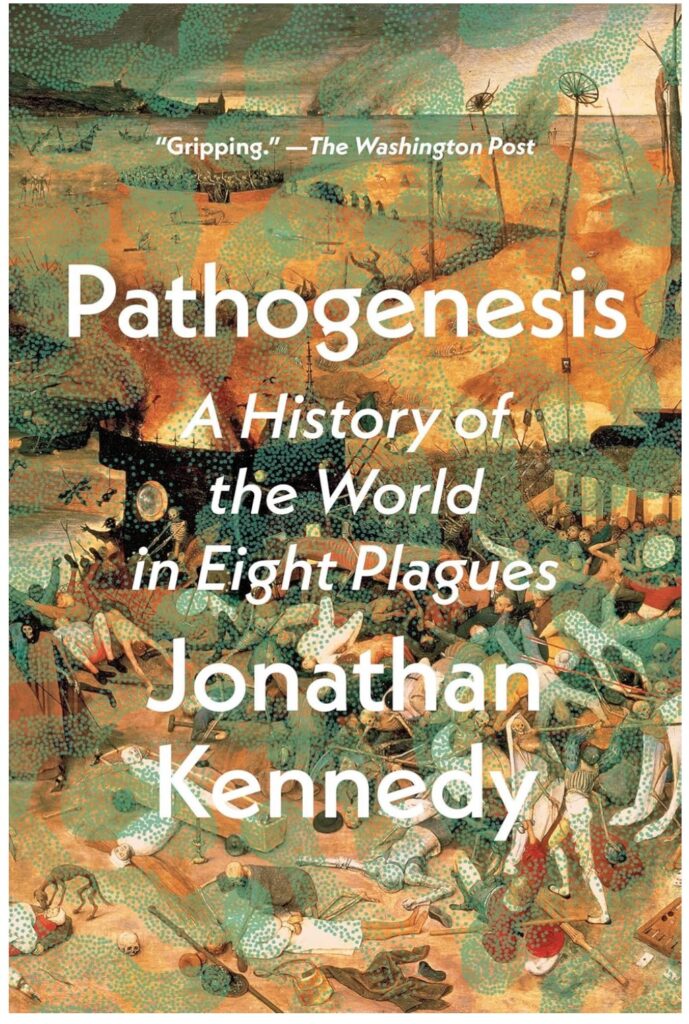
First off he notes the misconceptions about Neandethals: Their brains were actually slightly larger than Homo sapiens. They certainly seem to have mastered their environment and survived for many thousands of years . . . before humans arrived. This is where Kennedy’s subtitle reveals his essential thesis: “A History of the World in Eight Plagues.” He argues that humans had developed antibodies and a history with many more diseases than the Neanderthals. The climate/landscape in Africa is friendlier to pathogens, and thus the human population had their own thousands of years of evolution to adapt. They then arrived in Europe and infected the Neanderthal population, who had no immunities to these pathogens.
It’s an intriguing idea, one that he backs it up with numerous examples of DNA evidence that reveal migrations of different human populations into Europe during the Bronze Age, and how one local population often was supplanted by an immigrant population. It occurred repeatedly in the British Isles, for one example. Although it can’t be proven definitively, it’s an excellent theory.