
So I stumbled upon the film Strange Darling (2023), which has become something of a cult classic. First: I’m not a fan of serial-killer movies. The best of them thrill you with gruesome fantasies such as the “brilliant” serial killer a la Hannibal Lecter, while the worst of them indulge in Rated R torture porn, like the Saw franchise. When I read the description for Strange Darling I was initially put off, thinking, “Oh, just another serial-killer slashfest.” It has a 96% Rotten Tomatoes rating, however. That’s good enough to make me wonder. Spoiler alert: It’s hard to describe/analyze this one without giving away some details.
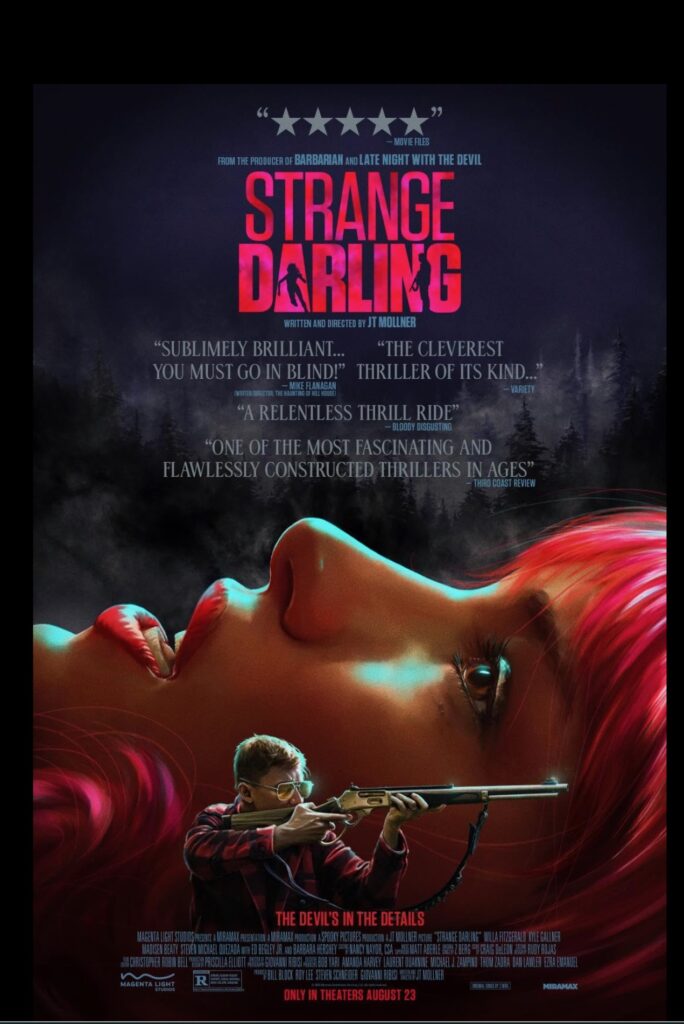
First thing you as audience notice is its nonlinear structure. It’s divided into six chapters (a la Tarantino’s Pulp Fiction or The Hateful Eight). But it begins with Chapter Three, in an action-packed chase scene. From that moment on you begin making judgements about the characters and situations, based on what you’re seeing or being shown. Most of these are wrong, one way or the other. It’s a twist on gender roles: In the initial scenes there are only two characters: a flirtatious young woman (Willa Fitzgerald, terrific) who seems to be playing a dangerous game of Take a Walk on the Wild Side, and a stern-looking suspicious dude (Kyle Gallner, nicely understated) who has a gun in an ankle holster. They’re in his pickup, outside a motel, flirting. One thing leads to another and they end up in the motel room—frisky, handcuffs, the works. Foreplay, as it were. She produces some drugs—ostensibly cocaine—from her purse and announces it’s her birthday. (I didn’t believe that.) From that moment on the action gets ever more complicated. It becomes obvious Things are not what they seem.
As the nonlinear chapters unfold you come to understand that context is everything. It’s not a matter of seeing is believing. It’s a matter of what you see can’t be understood without the linearity of what came before. When there’s no context for the actions we insert our own reasons and logistical frameworks—which, in this story, are likely wrong. I liked how it subverted expectations. You think you know what’s going on and then realize you don’t. The acting and direction are first rate. (See the glowing blurbs on the poster image.) Ed Begly Jr. and Barbara Hershey play wonderful old hippies who don’t deserve their fate. The end is harrowing and poignant. I’ll leave it at that.