A Great Divide: Attitudes About Climate Change Remarkably Different Around the U.S., With Sharp Divide Along East/West

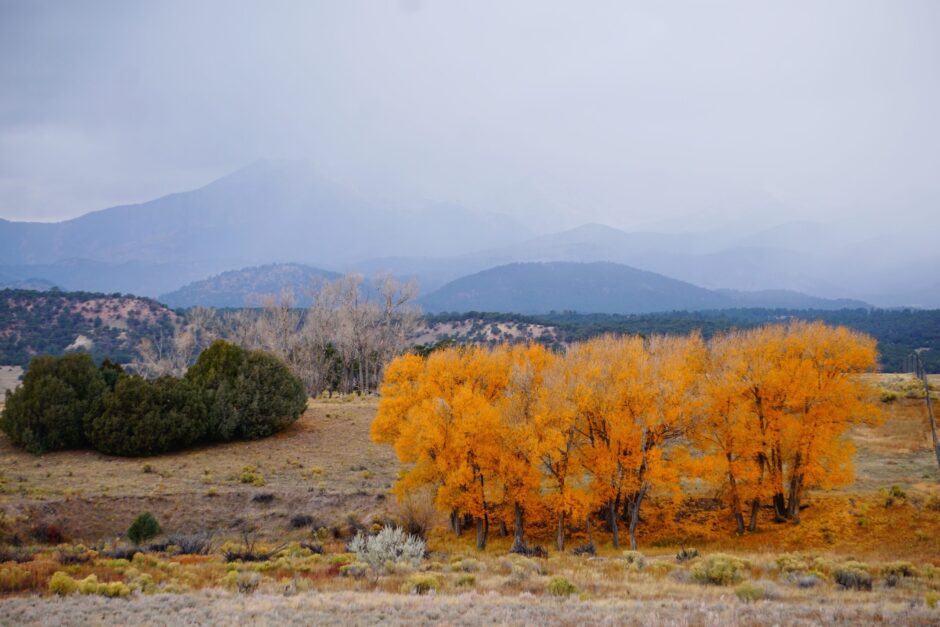
So one thing I’ve noticed the last few years in my peripatetic life of inhabiting both the Eastern and the Western U.S. is a noticeable division in attitudes about Climate Change. In a nutshell, it seems as though the West is much more aware (and fearful of the consequences) of Climate Change, and the East sees it as more theoretical, as something happening elsewhere. There are good reasons for this divide, especially if you’re seeing it through the landscape prism of the Southwest—an area which some climatologists claim has warmed more dramatically than the rest of the country. I’ll leave actual figures for much more data-heavy sites than mine, but the website http://www.realclimate.org/ is a good source for such info. But here’s a bit of anecdotal evidence that says much: My home in Colorado is at the foot of an abandoned ski resort, that flourished briefly in the 1980s, which the locals also claim was a turning point in how much winter snow our area receives: In the past the mountains were regularly snow-clad from November to May, and now it’s an iffy proposition. The ski resort closed from lack of enough snow, and lack of enough business.
There’s a piece in today’s NY Times about an initiative in Boulder, Colorado, to switch away from a traditional utility company, and create a ‘greener’ model, here: http://www.nytimes.com/2011/10/30/us/boulder-seeks-to-take-power-from-the-power-company.html?_r=1&hpw
In central Pennsylvania, where I spend eight months of my year, the main energy argument seems to be how fast we can allow natural gas companies to frack the landscape, and of course at what cost: Or at no cost, as our Republican governor, Corbett, has a no-taxation for natural gas industry policy, in the name of encouraging ‘business,’ or rewarding his campaign contributors. (Almost all other states tax natural gas producers.) Although we certainly have our green energy proponents, and experts, such as Penn State faculty member and climate change expert Richard Alley, the general attitude seems to place Climate Change somewhere on the likelihood of being struck by a comet. Certainly it seems an abstract argument, not a practical one, contrary to the way it is increasingly being perceived as an immediate issue in the West.
Posted in Climate Change, The West | Leave a comment

On the Illegal Immigration Debate, Tim Egan's Savvy Op-Ed, and How It Appears in Novels

So Tim Egan has a blistering attack on the scapegoating of Latinos in the latest Republican presidential debates, and the whole issue of illegal immigration and migrant workers, here:

I grew up in a predominantly Latino area of South Texas (San Antonio and just north of Corpus Christi, both places with Latino populations near 50% or above), and from personal experience, I think I understand at least part of the complexity of this topic. It’s not simply Good v. Bad, either way. There certainly are detrimental effects of illegal immigration in some areas, such as the border locales that see much difficult and dangerous crossing, and the human-trade that makes it function—the coyotes who charge high prices to guide people across the border, for instance. But I’ve also worked with illegal immigrants, and know that they are more often than not simply people who are willing to work, going to a country where jobs are more plentiful than in their own. A sound, compassionate policy needs to be articulated—not electrified fences, such as Herman Cain suggests.
And I write about illegals in my new novel, not simply portraying them as one thing or another. Keeping people disenfranchised and downtrodden makes them angry. It creates ugly situations. We as a country should do better. I think most people know that. My new novel is set in Pueblo, Colorado, one of—if not THE—most Latino cities in Colorado. It’s a funky place, with a complicated personality. It’s interesting. That makes for a good place to set a story. I spend much of my life now in a fairly homogenous area of Pennsylvania, and when I visit San Antonio, I’m amazed at the complexity of it. Plus I love the food, la comida mexicana. Life is a lesser thing without it.

Posted in books, Politics, The West | Leave a comment

In Praise of "Boardwalk Empire," Season 2, & Bad Horror Movies on Netflix, Like "The Awakening"

So I’m home sick today, and one of the few pleasures for a working stiff on these sick days is catching up on mindless TV. It beats trying to figure out why in the world so many people are transfixed by a fraud like Herman Cain and his bogus 9-9-9 plan. In the category of not-so-mindless TV, HBO’s Boardwalk Empire is well into its second season now, and is much better than the first. The plot is cookin’. While the first season seemed too one note—especially for Jimmy Darmody (“Jimmy’s been in the war. Jimmy’s seen some things.”), played by Michael Pitt, like a young Marlon Brando—the second season has great, complicated plots, and Jimmy has risen into a major gangster, who might be about to take a fall. Paz de la Huerta is being underutilized, in my humble opinion, but Agent Nelson Van Aldren (played by the up-and-coming Michael Shannon, who had a wicked role in Revolutionary Road) is doing a great job in that plotline. For those not in the know, it’s set in the early Twenties, all about Prohibition, and is like a period-piece Sopranos.
Then there’s the grab-bag of Netflix. Lately I keep trying to watch B-movie horror flicks, and don’t make it through most of them. One in the so-bad-it’s-good category, was The Awakening. It’s so absurd you have to like it: Dorks (somewhat overaged dorks, at that, for a rave) get invited to a rave by a sexy girl, while plucky archeologist uncovers an amulet that (you guessed it!) unleashes an evil Aztec demon god. Mayhem ensues. Much blood and gore, low-budget style. It’s not My Dinner With Andre, that’s for sure.

Posted in Bad TV, Good TV | Leave a comment

On Prophecies in "The Bird Saviors": Dust Storms in Texas

So my forthcoming novel, The Bird Saviors—due out in (what’s left of) bookstores in May/June—opens with a dust storm in southern Colorado, and when I began writing it some five years ago, I imagined it set in a fuzzy ‘near future’ time, when climate change had caused enough drought to cause dust storms similar to the ones of the great Dust Bowl years of the 1930s. Unfortunately, this imagined reality is now coming true. Besides the wicked dust storms of Phoenix that occurred this summer, we’re now seeing dust storms in Texas. This is a quote from the MSNBC article:
“No injuries were reported from the dust cloud reminiscent of those shown in Dust Bowl photos from the late 1930s. The dust cloud was yet another byproduct of the persistent drought in West Texas, Ziebell said. The U.S. Drought Monitor map released Oct. 11 showed much of Texas, including the South Plains, were still experiencing “exceptional drought” — the most severe category. In an Oct. 6 statement, the National Weather Service in Lubbock reported that there was a “high likelihood” that 2011 could be the driest on record across the South Plains.”
You can read the entire article here, which also includes a (shaky) video:
http://www.msnbc.msn.com/id/44939529/ns/weather/#.Tp1w6JxSl3w
Youtube also has more videos, though I saw this one on London’s Daily Mail, which has some funny voiceover from the people shooting the video, including the line spoken by a child, I think: “What’s so good about dust?” Here:
http://www.dailymail.co.uk/news/article-2050475/Texas-dust-storm-video-footage-captures-moment-Lubbock-engulfed-clouds.html
And this is in a time when virtually the entire Republican presidential candidate field rejects global warming, and the Democrats don’t have the guts to stand up for science, and to take a stand for the future.

Posted in books, Climate Change, Politics, The West | Leave a comment

Seven Billion Humans & Jared Diamond's "Collapse"

So various news organizations are reporting that our planet is now home to this mythical number of seven billion humans, mythical in that we don’t know that for sure, but it’s a good guess, and all its implications. I still regard Jared Diamond’s Collapse as one of the best big-picture nonfiction books I’ve read in a long time. He does a great job of analyzing how various cultures overused their resources, which led to their demise: the Mayans, the Easter Island natives, etc. Tim Flannery’s Here on Earth is in that vein as well, though focused on a myriad other topics besides societal collapse. Both are books we should all be reading, and heeding the warnings of. Here’s Jeffrey Sachs on the implications of 7 billion people:
http://www.cnn.com/2011/10/17/opinion/sachs-global-population/index.html?hpt=hp_c1

Posted in books, Climate Change | Leave a comment

Warren Brussee's "The Second Great Depression" & Herman Cain's Nutty Economics

So one of the truisms that is sometimes voiced about our current Great Recession is that “Nobody saw it coming.” Which is nonsense, a myth propagated by dimwit media types who would like to believe this fiction, or who actually don’t read much, so they’re not up on what’s being published, and what some people warned might very well happen. Case in point: Years ago (back in 2007, I believe) I read Warren Brussee’s The Second Great Depression: Starting 2007, Ending 2020 (2005), which is all about debt, personal and governmental (mainly personal, if I remember correctly), and how it would drag down the U.S. and global economy for many years. I wasn’t too impressed with the book, although I did think it offered a cogent vision and argument, rather wonky. It might seem a bit too simplistic at times, a bit too monolithic—the one idea of debt overshadowing all other economic movers and shakers—but there is also virtue in its simplicity.
But in 2011, with the global economies limping along, Brussee seems to be a regular Nostradamus. I hope he’s wrong about how long it takes to emerge from this stagnation. Unfortunately I recently saw an article that seemed to back up his gloomy timeline.
Enter Herman Cain and his motivational speaker economics. Tim Egan in the NY Times, as always, does a good riff on it here:

Posted in books, Politics | Leave a comment

Pete Dexter in the New York Times!

So it’s a good day when you stumble upon a book review of a Jim Harrison novel written by none other than one of our best living novelists, Pete Dexter, here:
http://www.nytimes.com/2011/10/02/books/review/the-great-leader-by-jim-harrison-book-review.html?ref=books&pagewanted=all
My favorite paragraph, about fiction: “Put together, these things serve (to borrow a phrase from “The Great Leader”) to percolate Sunderson’s brain. That is, to entertain it, which is one of the two possible reasons to write, or for that matter read. To enlighten and to entertain: what else is there? And while good books — even so-so books — serve both functions, if you ever have to choose one over the other, keep in mind that a book that entertains without enlightening can still be a guilty pleasure, but a book that enlightens without entertaining is algebra.”
Dexter is a both an entertaining writer and one who burns a scar of recognition across your brain. His best novels are Deadwood (1986) and Paris Trout (1988), while The Paperboy (1995) is underrated. Last year’s Spooner is a sprawling knockout, like three novels in one.

Posted in books, The West, writing | Leave a comment

Reading Daniel Yergin's "The Quest" & a Witty Post About Truthiness

So I’m reading the much-talked-about new tome on energy and the future, Daniel Yergin’s The Quest: Energy, Security, and the Remaking of the Modern World, just published. So far I’m not particularly impressed, especially after Dwight Garner’s rave review in the NY Times, which offers this rather dim-witted/simplistic rebuttal to the “peak oil” theorists:
“He considers the notion of “peak oil” — the idea that the world’s supply is rapidly running out — and mostly dismisses it. Thanks to new technologies, estimates of the world’s total stock keep growing. But there are other reasons to move beyond oil, not all of them ecological.”
Yergin states: “Oil production today is five times greater than it was in 1957” (I’m reading it on Kindle, so don’t have a page number to cite.)
That’s all fine and dandy, and simplistic to the point of being misleading. Sure, production is greater, technologies have advanced, there is plenty of oil and we’re not “running out” soon, which the more analytic and level-headed warnings about peak oil theory acknowledge. But oil is finite, and all the greater technology is simply allowing the oil industry to obtain it from more and more difficult sources, such as the deep-water well that malfunctioned in the Gulf of Mexico. How much higher is the world’s population now than in 1957? (A webpage called About.com-Geography claims the world population was 2.8 billion in 1955, 6.8 billion now.) How much higher is our energy and oil use than in 1957? (Yergin’s book begins with a recounting of how astronomic our energy usage has become.)
Imagine a forest, a wood pile, and a bonfire. The bonfire is our usage, the forest the total oil on Earth, and the wood pile is what we find and produce. The wood pile may grow larger, but the forest has only so many trees in it. Eventually all of them will be cut down, logical thinking suggests. Jared Diamond does a great analysis of this dynamic in his excellent book Collapse, which contains a chapter about the natives of Easter Island, who apparently cut down all their trees to build the rollers for their massive statues, then perished from ecological collapse.
And for some reason, logic seems to get tossed out the window for many in this argument about peak oil, including by some of its proponents. But this is logical: Oil is a finite commodity. We are getting better and better at finding it, and burning it. The last “Super Giant” oil field was discovered decades ago, and we continue to rely on those (mainly in Saudi Arabia) for the bulk of the world’s oil production. It’s not actually “running out,” which is too simplistic. But it will get more and more expensive to obtain. That idea behooves us to change our ways to greater conservation, and efficiency—which is one thing Daniel Yergin does argue in The Quest. And if we find and burn all we have on Earth, we will have wrecked the atmosphere so severely we will be living in an essentially changed, and most likely chaotic, future.
On another subject altogether, although linked to the reality/spin-doctoring that seems to dominate media these days, there’s this witty rebuttal to a dissing of the “knowledge” of fiction:

Being a novelist, sure, I’m biased toward fiction, toward the role that stories play in culture and civilization. It’s a way we tell ourselves what’s important. It’s a way we communicate our visions of the past and future.

Posted in books, Climate Change, The West | Leave a comment

Australian Horror on Netflix: "The Reef," "Arctic Blast," and "Primal"

So I was at first excited by the streaming-video options of Netflix months ago, but the charm actually rather quickly wore off and I agree with some of the popular grouching about it—basically that Netflix has a rather limited list of titles, even if there are zillions of them. I find myself searching around for something weird and offbeat, and lately all those titles have been Austrialian horror/scifi movies. They’re surprisingly better than our similar B-movie offerings, the kind you can often find on the SyFy channel or Chiller: the Australian ones tend to have better acting and plots. They seem to take their cheese more seriously, and it pays off.
The last film I watched in this category was Arctic Blast, which should really be called Ozone Blast. The best part: when hundreds/thousands of people get flash-frozen because a dangerous hole in the ozone layer lets in some cold air (“Close that ozone hole, why don’tcha?”), the hero (a climate scientist) shrugs and says, “We did it to ourselves. We’ve polluted the planet.” (Or something like that.) He’s unflappable to the nth degree. They should have had this tag line for the movie poster: Arctic Blast—”It’s an eco-thriller The Fog without dead pirates!”
Primal is even more fun, for what happens to the sexed-up cutie on a camping trip. You can always tell who’s going to get eaten/stabbed/hacked/infected first in a horror film—the horniest one. But as this girl morphs into a snarling zombie/monster, her boyfriend doesn’t want to hurt her. “But she’s my girlfriend!” he cries (or something like that: I mean, I wasn’t taking notes), after she’s just eaten another person on their camping trip. (Her version of “glorp.”)
And the seriously good one of this trio is The Reef, which is like Open Water only better. It should really be called The Swim, but why quibble. Some holiday yuppies go for a boat ride, it hits a reef and capsizes, then several of them swim for an island far, far away. Guess what? A shark follows, picking off the slowest ones. The end is quite good. Like Arctic Blast, it also features a seriously stoic hero. That must be an Australian thing.

Posted in Film | Leave a comment

"127 Hours" as Big-Budget "I Shouldn't Be Alive," With a Nod to the Great "Touching the Void"

So I finally got around to watching the much-acclaimed/suspect film of Aaron Ralston’s self-amputation, 127 Hours, and actually thought it was pretty good, even if my hotel owner/chef in Green River, Utah held a grudge against Ralston for not paying back the county/state money spent on searching for him. (See previous post months ago: I met the guy at his Riverside Terrace restaurant, which made a killer breakfast.) It’s really a big-budget version of one of my favorite AnimalPlanet TV shows, I Shouldn’t Be Alive, which reenacts true tales of harrowing outdoor horror, some of them quite good. My favorite: the guy who survived for over three months at sea, adrift in a small life raft. The great part of those shows is they feature the actual survivors reliving their stories, and providing some interesting commentary. Ralston only shows up at the end of 127 Hours, in a brief flash, with his wife, and seems likable enough, for that brief moment.
But Ralston’s story, harrowing as it is, pales in comparison to both the book and film of Touching the Void. This first appeared as a nonfiction book in 1988, about Joe Simpson and Simon Yates’s disaster while mountain climbing in Peru, in which Simpson fell and broke several bones, and then Yates tried to lower him down the mountain, only to be forced to cut the rope and let him fall into a crevasse, giving him up for dead. Only he didn’t die. He crawled out of the crevasse, and several miles over glaciers and rocks back to camp, to arrive just in time before Yates and another fellow were about to hike back to civilization. The book was amazing. The film, made in 2003, was excruciating to watch, and is still the greatest I Shouldn’t Be Alive episode ever told.

Posted in books/film, The West | Leave a comment