On Maggie Gylenhaal’s “The Bride”: Bonnie & Clyde in Stitches

So yesterday I caught the phantasmagorical brilliance of Maggie Gylenhaal’s The Bride. First I should note I really wasn’t interested in seeing this movie. Why another Frankenstein? Didn’t they just make one with Oscar Isaac and Jacob Elordi last year? And saying it’s based on Mary Shelly’s Frankenstein (1818) novel isn’t a big draw for me. I’ve read the book and it’s . . . okay, mainly iconic for being one of the Gothic classics that originated in the famous Year Without a Summer of 1816. It’s certainly a great idea, one of those stories that demands attention. But enough already. The only thing worse than Frankenstein remakes are Dracula remakes. (There’s one out right now, too, which at least stars the always-good Christopher Waltz.) Or maybe Wolfman remakes. Which is all to say, after arriving at the theater with low expectations, I’m impressed to have liked The Bride so much.

Screenshot

The Bride is a quite a complicated contraption of plot and character. Mary Shelly appears on screen and gives her two cents. There are multiple plots and narratorial threads—including Penelope Cruz and Peter Sarsgaard as detectives on the case—that seem mystifying in the beginning but somehow all come together nicely by the end. Most obviously, it’s a movie about movies. Set in the 1930s, it’s reanimated in the same era of as James Whale’s Frankenstein (1931), which famously starred Boris Karloff as the Monster. But Gylenhaal nods to the many other Frankenstein iterations, most notably Mel Brooks’s Young Frankenstein (1974), one of my all-time favorite comedies: There’s an elaborate dance number to “Puttin’ on the Ritz,” complete with top hats and canes, reminiscent of the Gene Wilder and Peter Boyle stage-show in that film. The spirited gender-bending hijinks of The Rocky Horror Picture Show (1975) lurk more in spirit than in allusion, while the crime-spree chaos of Natural Born Killers (1994) arises from the cultural popularity of Frank and his Bride. Last but not least, there are numerous echoes of the seminal outlaw-lovers of Bonnie & Clyde (1967). The tagline below works for Frank and his Bride: “They’re young . . . they’re in love . . . and they kill people.”

Screenshot

Critics will no doubt zoom to the feminist message of the film, but that’s a bit reductive. Before I saw it I wondered why Christian Bale would want to play Frankenstein’s Monster (though usually he goes by Frank). He’s great in everything, but my personal favorite is still the classic The Prestige (2006). Now I know why: He gets to cut his chops and chew the scenery in several over-the-top scenes, and makes it all look easy. Jessie Buckley plays the eponymous Bride and does a great job. I liked her performance here better than in Hamnet (2025). It’s audacious, nutty, and way fun—a crazy-good work of art, not simply a story to get a point across. 

Posted in Frankenstein remakes, Horror Movies, Literary Fiction, Movies about movies | Tagged , , , | Leave a comment

On George Saunders’ New Novel “Vigil”: Jumping the Shark Across the Heavens

So George Saunders’ new novel Vigil is out and about and it seems everywhere you look George is staring back, from an interview in the New York Times that labels him a “secular saint” and “guru of goodness” to a new film adaptation (now in production) of his novel Lincoln in the Bardo—starring Tom Hanks as Abe Lincoln no less. (I’m not saying he’s overexposed, but the George Saunders action figures are a bit much. And so pricey! You have to pay extra for the tiny writing desk and lectern.) Disclaimer: I know George and like him, consider him a friend, though it’s not like we go shoot pool together or anything. I was instrumental in bringing him to the Penn State campus for a couple of readings. Both went well. After one of them we had a party at my home and George was supernice to my students. “Secular saint” and “guru of goodness” was hardly what I (or, I imagine, what those students) would have characterized him as. For one event he read his great story “Sea Oak,” about a woman who comes back from the dead to save her nieces and a nephew who works as a male stripper at a Chippendale’s-like nightclub. There’s a funny point in the story in which the dead zombie-aunt screams at her nephew, “Show them your cock!” So before we go warming up the anointing oil and filling the holy water font, let me say George certainly did not come across as some kind of self-righteous do-gooder. I love his stories, especially the books Tenth of December, Pastoralia, andCivilWarLand in Bad Decline. All that said, let’s take a look at his new novel, Vigil.

Screenshot

At times I’ll admit that the shenanigans in Vigil are somewhat difficult to keep track of: The story involves two angels who are playing a rather scrambled version of Clarence in Frank Capra’s It’s a Wonderful Life(1946), shepherding (somewhat) an oil baron in his last moments of mortal existence. At times the action is cartoony: The angels seem to plummet to Earth (from Heaven?) and land with a sharp splat, then dust themselves off and get to work. They bicker a lot. One of them is French, although his vocabulary is so simple even I could translate it. Like Lincoln in the Bardo (2018), there are stories within stories within stories. It creates a curious fabric to the narrative style: Part satire, part realistic histories, part wacky fun. At times I had trouble keeping up with the many shifts in perspective and had to return to an earlier passage to get my bearings. From the NY Times quasi-apotheosis of Saint George I would have expected the book to be preachy: It’s not. The Dwight Garner review of Vigil in the Times was decidedly mixed, and mentioned Richard Bach’s 1970s classic inspirational book Jonathan Livingston Seagull (1972)—which I loved as a kid—and I recognize why: The angels are wise, chippy, and zoom around the mortal realm, much as Jonathan Livingston Seagull zooms around his shorelines and seascapes. At times this zooming feels as if it’s leaping the storyline, performing its own kind of “jumping the shark” maneuver a la the TV sitcom Happy Days. But the shark that’s being jumped is the oil baron on his deathbed, and the overall arc is not toward preachiness and platitudes, but rather toward understanding and transcendence. Of course for anything we read or watch the thorny question ultimately arrives: But is it good? As I’ve admitted, I’m a biased narrator. You be the judge.

Screenshot
Posted in Artistic writing, Literary Fiction, Uncategorized | Tagged , , , , | Leave a comment

On HBO’s New Series “DTF St. Louis”: Charm & Glory of the Mundane

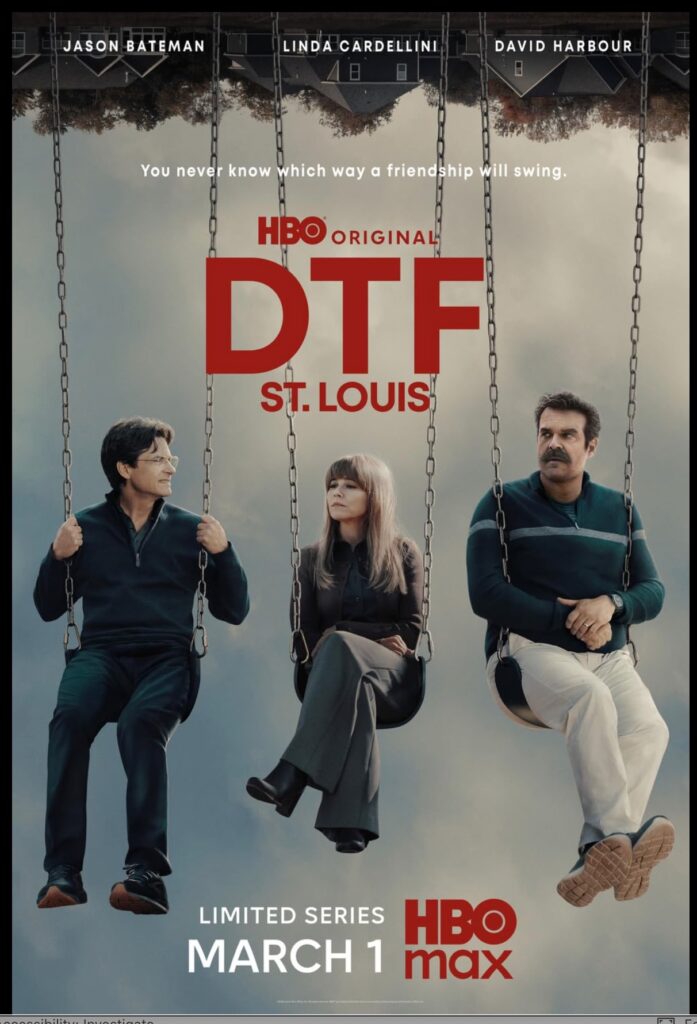
So the best show on TV I’ve seen lately is the new HBO series DTF St. Louis, starring Jason Bateman, Linda Cardellini, and David Harbour. I’d heard a little about it but was pleasantly surprised. For one thing, it’s billed somewhat as a sex comedy, as the title arrives via an eponymous app that’s essentially a hook-up site for horny St. Louisans. That’s mainly played for awkward laughs between the two stars, Jason Bateman and David Harbour, as they negotiate some sexless marriages. But I would have expected several of these dates for comic milking. Wrong. 

The show quickly moves past that hookup-app setup and into the lives of the characters, including a murder. Now in the past I’ve complained how it seems too many TV shows include a murder or unnecessary violence to draw in an audience, but the case here is more in the category of an offbeat Forensic Files than a typical murder mystery. I’ve only seen Episode One (which debuted last Sunday) but I’m already hooked on the mystery: We know who is killed but not exactly how. Several suspects but the most likely is almost surely not the perp. So there’s some zing built for the second episode, as the audience wants to know more to do their own sleuthing. But the real charm of the show is the details: David Harbour is married to Linda Cardellini but sexually turned off by her uniform as a Little League baseball umpire. Jason Bateman rides a recumbent bicycle that makes him look super dorky, including a somewhat oddly shaped bike helmet. David Harbour is the stepfather of a bratty teenager who steals the show each time he appears, often sullenly throwing rocks at houses. 
I actually know St. Louis fairly well: My wife grew up in a suburb on the west side. Does the series look like St. Louis? Not exactly. The street and neighborhood scenes are pretty generic. I can’t say it affected my viewing in the least. Jason Bateman plays a popular TV weatherman and for that reason I suppose St. Louis is a city of the right size/cultural importance to anchor the story. 

So far much is being withheld. Linda Cardellini—a terrific actress whose last big series was the Dead to Me (2019) comedy/action series with Christina Applegate—is a total mystery. I expect we’ll find out more about her shortly. 

Posted in David Harbour, Good TV, HBO series, Jason Bateman, Linda Cardellini | Tagged , , , | Leave a comment

On “Dr. Strangelove” 62 Years Later: General Jack Ripper in Charge Now

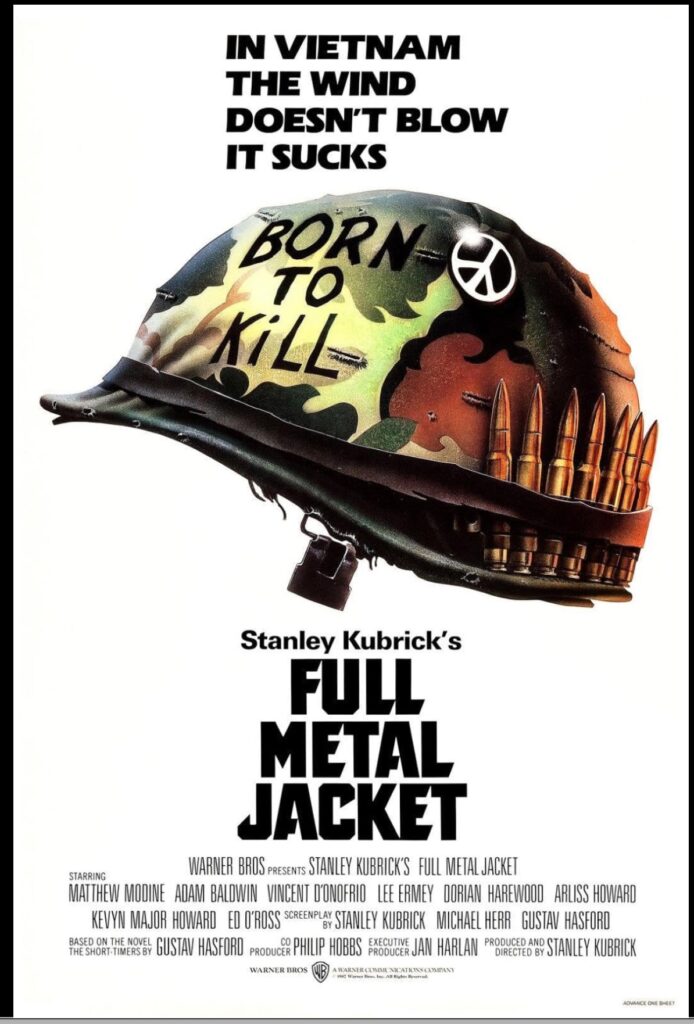
So there’s nothing quite like the genius of Stanley Kubrick to underscore the absurdity of our present Wag-the-Dog war on Iran. In Dr. Strangelove: Or How I Learned to Stop Worrying and Love the Bomb (1964), General Jack Ripper is a lunatic starting WWIII over an issue of foreigners invading our country to steal our “precious bodily fluids.” His monologues sound like an RFK Jr. press release. The IMDB website description is a good beginning to this comparison: “A mentally unstable American general orders a hydrogen bomb attack on the Soviet Union, triggering a path to global nuclear holocaust that a war room full of politicians and generals frantically tries to stop.” We only have to make minor edits to sum up our current international crisis: “A mentally unstable American President orders a missile attack on the Islamic nation of Iran, triggering a path to global holocaust that politicians at a war room in Mar-a-Lago, while noshing on boiled shrimp and cocktails, do everything to encourage.” Their exuberant glee in the destruction of another country and the killing of many “foreigners” is particularly disgusting. Reports are coming out that military officials are telling our troops that Trump has been anointed by Jesus to start Armageddon. (“One combat unit commander reportedly said that the war is ‘part of God’s divine plan’ and that ‘President Trump has been anointed by Jesus to light the signal fire in Iran to cause Armageddon and mark his return to Earth'” (https://www.democracynow.org/2026/3/4/headlines). Our Secretary of War now brags about having “no mercy.” Lord help us.

Screenshot
Posted in Stanley Kubrick films, War on Iran | Tagged , | Leave a comment

On Tom Waits in “Father Mother Sister Brother”: Grifter Like Me

So I came to appreciate the genius of singer/songwriter Tom Waits much later than I should have, even if I did know the Eagles version of his song “Ol’ 55” in early college years. (Waits thought their version was “antiseptic” and wasn’t a fan. I agree. His is so much better.) In fact I thought of him as more of an actor than a singer, having seen him in Jim Jarmusch’s Down by Law (1986) and as Renfield in Bram Stoker’s Dracula (1992) back in the day. Now I have a greater appreciation for his amazing body of work, both as musician and singer/songwriter, that I consider his acting to be a minor side-gig. 

But here it is 40 years after Down by Law and Waits shines in another Jim Jarmusch film, Father Mother Sister Brother (2025). The film is a triptych of sorts, three stories concerned with family, mainly the prickly dynamics between adult children and their aging parents. Waits plays the Father, an old, wiry-haired bespeckled man living in “the boonies,” as his son (Adam Driver) and daughter (Mayim Bialik) put it. He’s estranged from them but they (reluctantly and rather stiffly) come to visit. All is not what it seems. 

There’s a wry humor to their interactions. His messy place in the sticks is actually a lovely home with a gorgeous view. And Waits or Father is not exactly being honest in his dealings with said offspring. Adam Driver does a great job as a somewhat staid and uptight grown-up son, who drives a Range Rover and appears to live a comfortable life in some city (I guessed New York). Driver is a terrific actor and as funny as some of the moments are, he never breaks character and plays it straight, which only makes it funnier. 

As previously mentioned, the film consists of three separate stories. It takes place in three different locations (Upstate New York, Dublin, Paris), with no connection between the characters, but thematic links, motifs, and details connect them: Each features some skateboarders, a Rolex watch, color-coordinated family apparel, and the phrase “Bob’s your Uncle.” The first story is mainly comic, the second sad, and the third sweet. Although the film did get some good reviews, it didn’t even come to my local theater. Father Mother Sister Brother deserves much better, deserves a big audience. Jim Jarmusch is one of our greatest contemporary filmmakers. He made Johnny Depp’s best film, for Chrissakes—the great revisionist Western Dead Man (1995).  While flimsy thrillers like The Housemaid (2025) get much attention a diamond like this gets lost in the shuffle. The world isn’t fair. But we all know that.

Posted in Film, Jim Jarmusch films, Tom Waits' films, Uncategorized | Tagged , , , , | Leave a comment

On “After the Hunt” and “The Tavern at the End of the World”: Land of the Lost Professors

So the lives of professors are fodder for contemporary fiction and film, as evidenced by these two respective gems: the recent Julia Roberts’ film After the Hunt (2025) and Morris Collins’ just-published novel The Tavern at the End of History. Having been a professor for some 35 years I know from my own anecdotal knowledge what many professors’ lives are like—mostly unglamorous and busy, often scrabbling for attention in their respective fields, often juggling students and classes and meetings and administrative work. In After the Hunt overall Julia Roberts makes a convincing professor/administrator. She’s tense and harried throughout the story, check. She doesn’t talk shop with her husband much, check. She mostly seems to keep her students at arms’ length, check.

But there are some stumbles in her depiction: During one party scene both students and faculty are discussing the upcoming chances of two professors going up for tenure. In my experience few students would even know that process was unfolding. Most professors are smart enough not to comment upon such a drama-laden event. (Unless, of course, they aren’t particularly bright or have little Emotional Intelligence, which certainly happens often enough in the professor world.) The students and faculty alike are also boozing at this party, which used to be standard practice for academic events . . . back in the day. Now we all have to be much more careful. And the party scene sets up the most dramatic event in the film—which is why, in real life, we’ve come to avoid parties and drinking in general. They’re not unheard of, but more staid and careful than they were in the past.

One thing I think both novel and film get right: Students can sometimes try to bring down to earth the faculty whom they admire (or whom they simply study with), as an act of maturation, as a way to break free of their mentor’s influence, similar to the way teenagers often rebel to claim their own identities. In Morris Collins’ novel The Tavern at the End of History one of the main characters, Jacob, is essentially fired by his university for bad behavior with a troubled student. It’s not a sexual dalliance. It’s not a cheating scandal or accusations of plagiarism. What exactly leads to his firing? At one point Jacob says, frustrated by said student, “Fuck off, Joshua.” The fact that Joshua attempts suicide soon after this altercation doesn’t help Jacob’s case.

Would that act be enough to cause a professor to be fired? Maybe. The implication here is Jacob is not a tenured professor, but an adjunct or Visiting Professor, which is generally on an annual-contract basis. After Joshua’s failed suicide attempt he launches a complaint against Jacob. Universities, for good reason, don’t want to litigate professor/student squabbles.

On the other hand the “bad behavior” in After the Hunt is more more serious and damaging: There are accusations of sexual assault. The professor vigorously denies these, but subsequent details in the film cloud the picture. Audience assumptions are both scrambled and reinforced. By the film’s end the academic world seems to have been turned upside down, to some extent, with surprising winners and losers. In both stories the professors seem to be lost, in different ways, and emblematic of the fraught relationships common in contemporary universities.

Posted in books/film, Fiction Writing, Film, Julia Roberts films | Tagged , , | Leave a comment

On Morris Collins’s Novel “The Tavern at the End of History” (2026) and the Coen Brothers’ Film “A Serious Man” (2009)

So years ago a good friend of mine had seen the new Coen Brothers’ film A Serious Man before I had and I asked his opinion. He liked it but added, “It’s very Jewish.” Which, now that I know the movie well, is accurate, but at the time I thought it was dismissive. There was an implication that only Jewish audiences would understand all of the film’s underlying meanings and themes. This may well be true. Coming from a mostly Anglo-Irish Catholic ancestry (with a smidge of Jewish forebears) I realize I may not appreciate and understand all the meanings, hidden or not, but I still consider it one of the Coen Brothers’ greatest films—and that’s a rarefied category, rubbing shoulders with Millers Crossing, The Big Lebowski, No Country for Old Men, and Barton Fink. Morris Collins’ new novel The Tavern at the End of History shares that distinction, and pithy summation: Yes, the story it tells is very Jewish. But it’s also a story that transcends ethnic and cultural boundaries. You feel for the people it describes, and follow them wherever they go. Which, oddly enough, is the state of Maine.

The first character we meet is Jacob, a man in trouble. Like Larry Gopnick of A Serious Man, Jacob is a professor—or, more accurately, was a professor. Both Larry and Jacob seem not to have handled their academic careers quite smoothly. In A Serious Man Larry’s tenure is in some doubt due to disparaging letters the tenure committee is receiving, while in The Tavern Jacob is fired for his clumsy dealings with a former student who tried to commit suicide. Both seem earnest, high-minded, and teetering on the brink of . . . something, most likely unpleasant and life-altering. Both have wives who are having affairs. Both have a quest: In The Tavern Jacob travels to an art auction to recover a piece of Jewish art stolen during the Holocaust, while in Serious Man Larry faces a temptation: He’s in financial peril and has a brother who needs an expensive lawyer, and has been offered a thick envelope of cash to fix a student’s failing grade.

About halfway through The Tavern it becomes something of a Country Manor narrative: Most of the novel unfolds on a somewhat-decrepit estate on the coast of Maine called Nod, which evokes the biblical Land of Nod, where Cain was exiled, but also suggests a sleepworld, a dreamworld, as many other references to dreams reinforce. Country Manor or Country House novels have a rich British tradition: Think Agatha Christie’s And Then There Were None (1939), or better yet, Martin Amis’s Dead Babies (1975). At this estate in Maine Jacob and others are all gathered at the island home of Alex Baruch, the philosopher accused of falsifying his Holocaust-survivor memoir. A stranger arrives, Eli. He enters like a Ghost of Christmas Past. When his bad behavior at dinner is rebuked by Baruch, Eli launches into a story/fable (supposedly from the Talmud) about the need to accept strangers in your home and offer them kindness. It made me think of the Invisible Knight anecdote in Sir Thomas Mallory’s Le Morte d’Arthur, in which the quest for the Holy Grail is initiated from an act of violence in a castle: a Knight broke the covenant that a guest should not assault the lord in his own castle. (The Knight was getting revenge on the Invisible Knight, who had killed many.) Which is all to say Collins evokes a classic myth about the role of gratitude and hospitality, thorns and all, which is a recurrent theme. But Eli’s appearance also has striking similarities to the curious epigraph-like beginning of A Serious Man, in which a dybbuk arrives at a righteous man’s home and his wife recognizes him for what he is, rather than what he claims to be. But that intro/epigraph also ends with a mystery: The presumed dybbuk has been stabbed in the chest, but is he actually a dybbuk? Eli performs the function of a dybbuk at times in The Tavern at the End of History, with Baruch more than once insisting he’s a dead man. The novel ends with multiple twists and much fireworks not to be revealed here. It’s a mesmerizing book and a testament to remembering a past that so many others are trying to forget or to claim never existed. It takes place in 2017, during Trump’s first term, around the time of the Charlottesville white-supremacist riots. It’s as relevant in 2026 as it was in 2017 or 1945.

Posted in books, books/film, Coen Brothers films, Morris Collins fiction | Tagged , , , , | Leave a comment

“Song Sung Blue” Makes Kate Hudson Oscar Worthy

So I’ve never given the actress Kate Hudson much thought: She’s Goldie Hawn’s daughter so I’ve probably unconsciously (and unfairly) dismissed her with the ubiquitous “nepo baby” label (see under: Gwyneth Paltrow). I liked her in the unlikely Larry David comedy from years ago, Clear History (2013), starring opposite Jon Hamm, and remember her as the sexy groupie in Almost Famous (2000). And that movie is a good comparison for this moment: 25 years later she just made her best film yet, and for my money, deserves the Best Actress award this year. 

I won’t give much away here: This is a terrific movie and I don’t want to spoil it for others. I’ve seen most of the films up for Best Picture and all but one up for Best Actress and this is my favorite so far. Kate Hudson doesn’t even look like herself. Which makes it more “real.” (As Hollywood movies go, of course.) No doubt the Director (Craig Brewer) deserves some credit. They don’t glamorize her and make her seem too pretty in this “Based on a True Story” (we know how that goes) narrative. She actually looks like a somewhat frowsy “tribute” singer (at first she’s doing Patsy Cline songs) who falls for another tribute singer (Hugh Jackman) and unites to create a Neil Diamond tribute band. It’s funny and touching, and mostly free of indulgent-musician/diva nonsense. Part of the humor is how Do It Yourself their band, publicity, and act is. But there’s plenty of drama and that’s where the touching moments occur. Plus Hugh Jackman gives his signature, over-the-top performance. He must be the greatest ham actor of his era. I think this role as a Neil Diamond impersonator ranks up with his magician role in the knockout Christian-Bale film (2006) The Prestige. Now that is a great movie.

Posted in books/film, Film, Oscar Movies 2026 | Tagged , , | Leave a comment

On Randall K. Wilson’s “A Place Called Yellowstone”: Award-Winning History of Yellowstone National Park

So as a devoted National-Park aficionado I learned of Randall K. Wilson’s A Place Called Yellowstone: The Epic History of the World’s First National Park last Spring when it was announced as winner of the Barbara and David Zalaznick Book Prize for the best work of history of 2024. I’ve read five or six books of Yellowstone lore and this is the best book for the Big Picture of the park. 

It details the park and area’s history from its super-volcanic origins to the present day, from its surprising distinction as the world’s first national park in 1872 to the devastating fires of 1988 and the reintroduction of wolves in 1995 as beyond. It’s full of fun facts, such as Jim Bridger’s early explorations and discovery of the thermal features, that led it to be nicknamed “Bridger’s Hell.” It became a National Park while the Indian Wars were still unfolding and at times pioneers were camping there while Shoshone and Nez Perce still roamed the area. One of my favorite discoveries was that the south shoreline of Yellowstone Lake held a trove of Native American archeological sites. I spent a week kayaking the lake and camped at various locations on the south shore, a gorgeous, isolated lake-scape. 

Fog rainbow on the southern shore of Yellowstone Lake, after rainstorm.

It’s the largest alpine lake in North America and is stunning. As far as wildlife goes we saw wolf tracks along the shore, had a Pine Marten in our camp, and were amused by a Short-eared Owl that swooped and dove above our heads while hunting insects. The campsites were outstanding and scenic: Usually we were perched on a plateau above the lake, as in the photo below.

Every campsite had an impressive bear-pole rigged near camp, where you could hang your food for protection from the grizzlies, but some of them also had the metal bear boxes, which made for great kitchen-organizers.

Metal bear-proof storage boxes.

With most of the campsites perched above the lake we had gorgeous views the whole time.

The paddling can be rigorous: Winds tend to blow from west to east on the lake and our paddle out from the West Thumb boat dock was relatively easy, while our return trip some six days later was a constant fight against the wind. 

The photo above was taken in blue-sky weather, but during our week of paddling we had storms every day, and more than once were caught on the lake in wind and rain. The weather could change quickly. When we woke in the morning the lake would tend to be calm and foggy, and by afternoon the wind would pick up and create waves.

Dawn on the lake.

The storms tended to arrive after noon and before sunset, so the lake would often be calm while we were eating our dinner and enjoying the view.

It was September during our visit. Although there were few aspens on the southern shore of the lake the foliage showed nice Fall color.

And there were still wildflowers blooming.

Lastly I think my favorite moments were the quiet evenings watching the lake. We saw a few other paddlers during our week but not a single one camped close by. We didn’t hear or see Loons on the lake (although I have other times) but there were many geese and ducks.

Sunset looking across the lake to the north and east sides.
Posted in Backpacking Adventures, books, Yellowstone National Park backcountry trips, Yellowstone National Park kayaking, Yellowstone wildlife | Tagged , , | Leave a comment

On Candice Millard’s “River of Doubt” and “River of the Gods”: Bugs, Snakes, and Disease Aplenty

So a couple years back my wife read Candice Millard’s excellent nonfiction book The River of Doubt: Theodore Roosevelt’s Darkest Journey (2005). She raved about it and I put it on my reading list, but somehow or other I ended up reading another more recently published Candace Millard book first, River of the Gods: Genius, Courage, and Betrayal in the Search for the Source of the Nile (2022). 

In our era of satellite GPS coordinates and Google maps it’s hard to imagine the quest to discover the origin of the Nile (and particularly the White Nile) that consumed the Royal Geographical Society and British explorers in the 19th century. Millard’s book focuses on two fascinating men, Richard Burton and John Hanning Speke, who joined forces for a time and helped solve the mystery. (Ultimately it’s revealed that the White Nile originates flowing out from Africa’s Lake Victoria—or in waters of the Kagera River: it’s complicated.) Both men seem brilliant in their own ways and slightly mad for even attempting travel in eastern Africa. Their journey ends up taking several years and both explorers are close to death more than once. They battle disease, bizarre, hostile tribes, tropical heat, snakes and insects and a daunting landscape, all just to identify where the waters first start flowing that eventually become the mighty Nile River. For a somewhat romanticized (and charming) version of the story, see the film Mountains of the Moon (1990), starring Patrick Bergin and Iain Glen, who do a good job of bringing these daring explorers to life. It’s a story of heartbreak and suffering, marred by egos and the acclaim fought over by these 19th century figures. 

If I were to quibble about their exploits I might note that they were so infirm from various diseases and injuries that at times they had to be carried by African porters. The notion of their “discovering” the Nile is a bit suspect, of course, but they did travel—with quite a bit of assistance—to deepest, darkest Africa and trace its source . . . kind of. (They still weren’t quite sure even when they returned to England.) But as difficult as their journey was, Teddy Roosevelt’s expedition of 1912 to map an Amazon tributary known as Rio Duida or “The River of Doubt” matches it at every level, with less assistance and more foolish chutzpah. (An odd note of thematic and historical intersection, their Amazon journey unfolds in 1912-13, soon after Hubert Darrell’s disappearance in far northern Canada, circa 1910-11. See post below.)

As an enthusiastic backcountry paddler (mainly kayaks and inflatable rafts) their preparation for this expedition to the Amazon seems laughable and perilous. The man in charge of organizing it had never been to the Amazon and knew little about float trips. Teddy Roosevelt thought it would be something of a lark. He had recently lost a reelection campaign for President and was looking to distract himself from that sense of failure and disappointment. It wasn’t until they were already in the Amazon that he got the idea to float the River of Doubt from its source to another tributary of the Amazon, where it was known to flow. They quickly and somewhat haphazardly changed their plans and embarked on a tortuous trip into the jungle. The descriptions of their misery are impressive: Insects bothered them constantly, they ran short on food, their boats were left behind due to transportation problems, so they had to rely on dugout canoes. These are fine for flat-water rivers or lakes but the River of Doubt was frenzied with waterfalls and rapids. By the end of their months-long journey Teddy Roosevelt is very near death. Teddy’s son, Kermit, is also a major character in the story. Of the two books I found River of Doubt to be a more enjoyable read. Although I knew bits and pieces of Teddy Roosevelt’s biography, I learned much more about the man, and found him to be fascinating and even inspirational. He’s a pillar of strength, honor, nobility and wisdom compared to the venal creature whom we now call President.

Posted in Amazon River, books/film, Candace Millard books, Teddy Roosevelt | Tagged , , , , | Leave a comment