[Note: This personal essay was originally published in the Superstition Review, Spring 2016 issue. It was a terrific online lit magazine published by Arizona State University. Unfortunately the Superstition Review is no longer with us, so I’m reclaiming the essay, a decade later, and giving it a new life here, by popular request.]
My daughter cohabits with approximately 427 stuffed animals. If this were like the early days of The Book of Genesis and the skies were to open and deluge us with forty days and forty nights of rain, we could repopulate the Earth with our own Noah’s ark of stuffies. Only they wouldn’t be alive, technically.
That’s actually a moot point. For my daughter, these animals are alive. She has an elaborate Invisible World that is populated with stuffed and make-believe beings, friends, and furniture. In this Invisible World, the animals rule. If a Great Flood were to come, she’d be ready, with her entire troupe. I can imagine her drawing up the plans for her animal boat, although she’d want to know exactly what a “cubit” is.
It would be called Lili’s Ark, in honor of its namesake. Names are important. My daughter knows this. She has named each and every one of her stuffies.
Our most recent adoptions include a kangaroo mother with her joey—Rosa Parks and Little Baby Washington. These were rescued from a gift shop at the Smithsonian Natural History Museum in Washington, D.C. We also adopted a Giant Squid (James Earl Faster) and a Honey Badger (Hamilton), who was my choice. One of her dragons (we have several) is Jo-Jo SillyBilly, who makes a strange gargling growl if you squeeze his paw.
I confess my favorite of all is a rather large penguin named Aquatica Mortimer. He’s the handsome fellow in the center of the photo below:
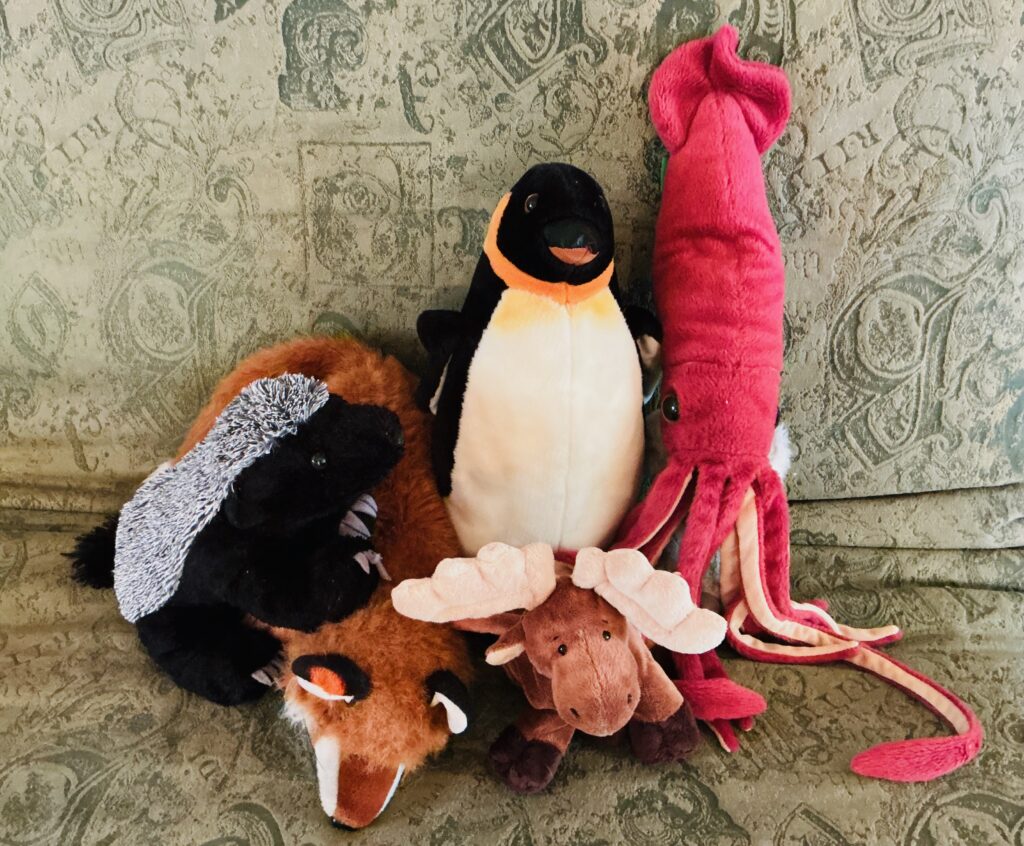
He was adopted into the family at a SeaWorld amusement park in San Antonio, Texas. On the day we visited, as far as I could tell SeaWorld was merely a rather elaborate, land-locked, water-themed, gigantic gift shop. The killer whales—one of the main draws, like lions at a safari park—were on break. We couldn’t see them, but I imagined them in a back room, smoking cigarettes and doing tequila shots. Talking about which trainers they’d like to hold under the water just a little too long.
Lili loved it. Her idea of vacation is an endless stream of gift shops. As long as they are well stocked with stuffed animals. We have visited Yellowstone National Park many times in her eight years of existence (the first time before she was two). She has backpacked there several times, including more than once hiking six miles on her rather short, little-girl legs, doing a good job of keeping up with the grown-ups.
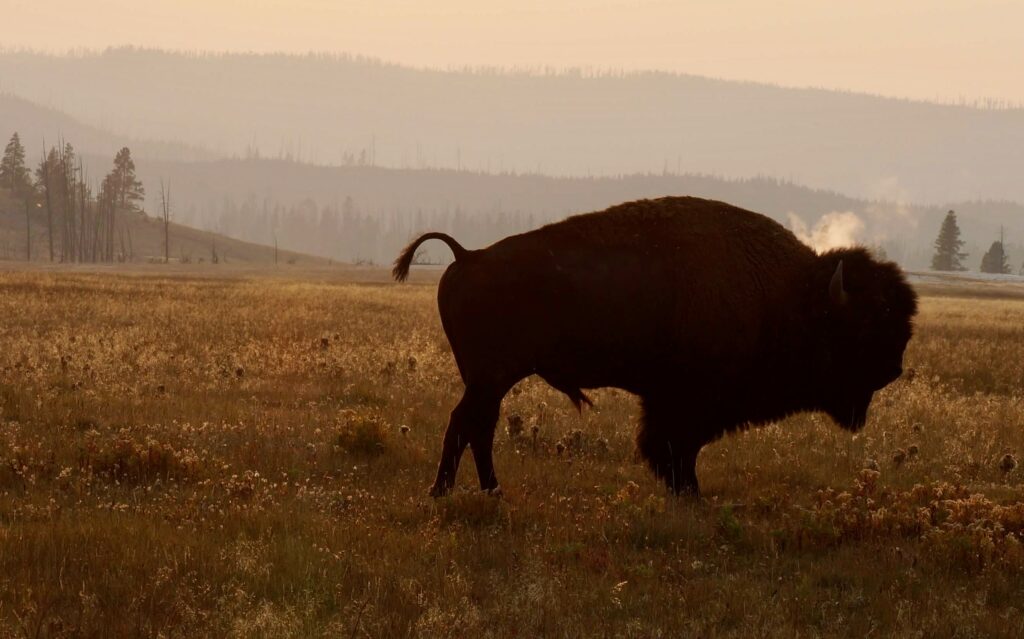
One of her most memorable moments: While we were making dinner around the campfire in the Imperial Geyser Basin, not far from the famous Firehole River, a large Buffalo (or American Bison, okay?) walked right through our camp. It was almost close enough to touch. We didn’t know what to do. We didn’t even see it coming until it was there, upon us. We looked into its eyes and froze. It kept walking.
After it was fifty paces from our camp, it lay on its back and squirmed, scratching its back, like dogs do. Lili was thrilled, and still talks about it to this day. She keeps trying to tell the story the right way, again and again, in various journal entries. Most of them involve some form of the sentence: “A buffalo walked through our camp!” She calls an exclamation point a “gusto mark,” and uses them liberally.
All these gifts shops and stuffed-animal buying come with an emotional cost. Once, in Glacier National Park, at the Two Medicine Lodge (we loved the name) gift shop, Lili clamored for a little stuffed-animal Lynx, which I didn’t want to buy for her. We’d already bought her a number of stuffies on that trip and at the moment I thought it was one too many. She pouted and sulked. It wasn’t expensive—five or eight dollars, I believe—and I gave in. Then I became angry with her for not saying, “Thank you.” On the return to our camp, I pouted and sulked.
I still feel bad about that. Yes, I should not spoil her, in principle. I don’t want her to become another Veruca Salt, that pretty brat from Roald Dahl’s Charlie and the Chocolate Factory—who is, by the way, one of Lili’s favorite characters. But she’s not. She can pout and sulk and get over it within minutes. I can too. But I realize I shouldn’t let anger get the best of me, shouldn’t pout or sulk like an eight-year-old. It’s my role to be mature.
When I’m angry I feel like William Hurt in Altered States (1980)—that Eighties cult film, an adaptation of a Paddy Chayefsky novel (1978). In Altered States Hurt starts as an anthropology professor who messes around with sensory-deprivation tanks and does hallucinogenic drugs (a kind of handsome Carlos Castaneda, as it were), so much that he undergoes a kind of reverse evolution. Eventually he becomes an apelike creature, a Homo erectus perhaps, terrorizing the zoo and one comely graduate assistant in his bed (well, he doesn’t actually terrorize her). He just grunts. That’s what I feel like when I lose my cool, with its commiserate guilt/remorse.
The animals help when I reach this stage of devolution. I confess that I sometimes buy forgiveness with the purchase of stuffed animals. I know this is wrong. But still, I think, it’s not that wrong. If it’s a sin, it’s pretty minor. A venal one at best. I feel remorse for letting anger get the best of me, but seriously (as Lili is wont to say), remorse for buying her another stuffed animal? Not much.
It’s been a constant chore, teaching her to be polite, good manners and all. To say her please and thank yous. Friends and even strangers will remark to us how polite she is, and my wife and I are like, “You don’t know the half of it.” Discipline for us has been an on-going task, fraught with turmoil and guilt and general success. I wish I could say I’ve never raised my voice. I wish.
We don’t spank her, thank god. I can’t even imagine the guilt that would haunt me if I did. Once I asked married-with-children friends of ours if they ever spanked their children and the mother replied, rather haughtily, “We never hitour children.” Touché! And persuasive: Who wants to be the parent who proclaims, “When my child doesn’t do what I ask, I hit her!” So we don’t. Instead we reprimand. We nag. We repeat ourselves. A lot.
Lili is an only child. I don’t really like that term, but it’s accurate, I guess. There’s an implication of being spoiled (probably, in a way), but also of somehow pampered, unrealistic. What is realistic? There are lots of “only children” in the world now. Many if not most of Lili’s friends are also “only children.” Back in the day (say, Kansas during the Dust Bowl years, living in a sod house, covering the faces of the fifteen children with gauze masks to keep out the dust) this was a rarity, when maybe tuberculosis was a common cause of death.
But seeing as she doesn’t have other siblings to spend time with, she’s gravitated to the Animal World. She crawls around the floor daily, impersonating one animal after another. Yesterday she was a wolf pup. “They’re so cute!” she exclaimed. Variously she has assumed the personalities of honey badgers, duck-billed platypuses, and black-footed ferrets. She believes it is wrong to hunt or to kill animals in any way. (We are, after all, animals ourselves, as she likes to point out.) Perhaps she does take this to an extreme degree: She hides flyswatters, won’t even let me use ant powder. Given her druthers, she prefers animals alive, up close and personal.
As she pointed out during our recent trip, the Smithsonian’s Museum of Natural History is really a dead zoo. The Louvre of Lost Animals. That’s where we adopted Rosa Parks and Little Baby Washington, two fine members of our 672 stuffed animals (we’ve purchased some new ones since I started this paragraph).
Thankfully, most of our stuffed animal encounters do not involve reprimanding, feeling guilty, or forgiveness. Mostly they involved cuddling. And sometimes minor heroics. Quests, no less.
Like the time we drove ninety miles to rescue the lost Billy NannyGoat. We were on a road trip, where many of our mishaps occur—passing through Colorado Springs, en route to Wyoming. After visiting an AutoZone, we had a picnic lunch on the grassy knoll beside a busy avenue, under some trees. Is this crazy or what? A picnic lunch beside a busy avenue? Well, the timing was right: We’d already been driving over an hour to get there, and the avenue wasn’t that busy. The sky was blue, the air fresh. We enjoyed ourselves. Lili sat against a tree and at the outset of the picnic, Billy NannyGoat was in her lap. Life was sublime.
An hour later, approaching the outskirts of Denver, Lili burst into tears. What’s wrong? Billy NannyGoat! He’s gone. “I left him on the ground. He’s all alone! He doesn’t know anyone there!”
I’m driving: Interstate 25/speed limit 75. I’m doing 80 no doubt. It’s the Law West of Wherever: Always add five miles an hour to whatever the speed limit, and you’re cool. Lili is weeping inconsolably in the backseat, beside her aunt (my sister), who had given her the stuffy—that day. A brand-new stuffy, left on the roadside, for any thug to come along and steal. An exit appeared. At that speed, I have microseconds to react. “Are you sure he’s there?” I asked. Lili nodded. “I put him behind my back, to keep him warm. Right against the tree.”
Note the particularity—the specificity, if you will—of her memory. I try to teach my writing students this mantra: Be specific. Lili’s specific memory was convincing. I flicked the turn signal. “You’re not doing what I think you’re doing,” said my wife.
The atmosphere in the car was tense. Each of us locked in our own imaginary scenarios. What if we drove all the way back and no Billy NannyGoat? What if someone had stolen him? True, he was a handsome little goat. But kidnappers? Really?
Maybe she had not left him there at all. Maybe we would make it back to the AutoZone and no Billy NannyGoat. His disappearance would become a Mystery. Like Sasquatch or a Chupacabra.
Nobody said a word. Lili quit crying, but she didn’t smile. She sniffled a little, looked worried. “He’s all alone,” she whispered, more than once.
And he was. All alone.
By the time we neared the AutoZone (rhymes with all alone), I was steeling myself to move on, counsel Lili about what we lose in life, how it wasn’t her fault, and so on. It was an hour out of the way on a day of driving that was already close to five hundred miles distance even without this stuffed-animal-rescue detour, but oh well. Traffic was brisk. The AutoZone parking lot was mostly empty. And there, beneath the tree, in clear view out our windows, sat a small stuffed animal, Billy NannyGoat, waiting patiently for the family who had driven off without him. Lili smiled. “There he is. Just like I said.”
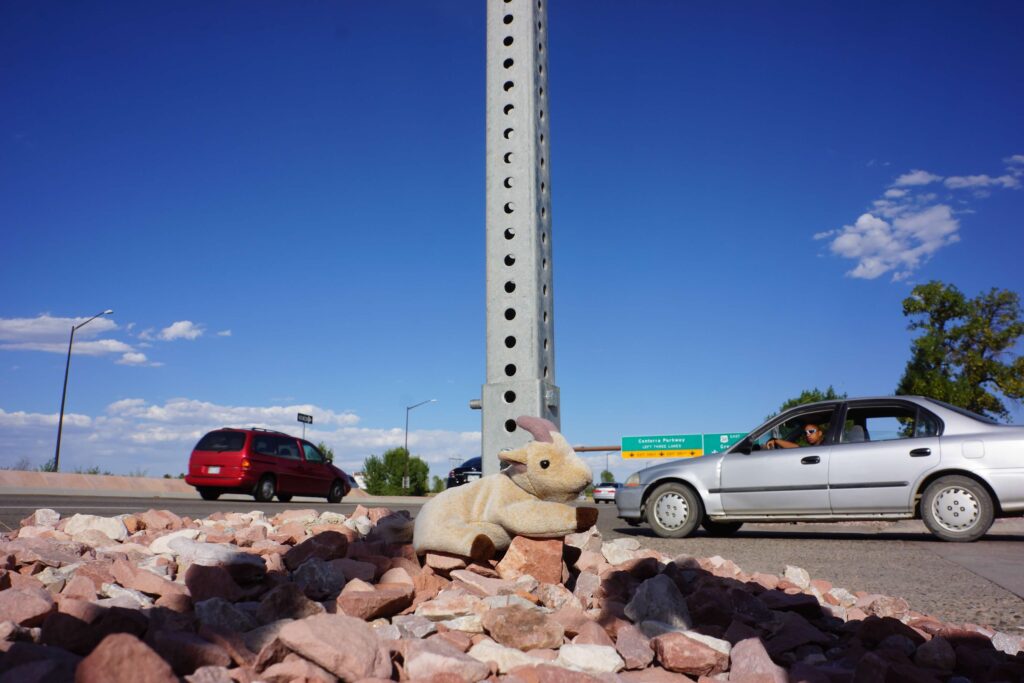
That was the first day of a two-week vacation to Yellowstone and Glacier National Parks—a trip in which almost everything seemed to go well. I like to think we were blessed by Billy’s rescue. That if we had not returned, we would have been cursed. Logically, perhaps, there’s no connection. But what is logic to do about a little girl with fat tears in the backseat, weeping for the goat she left behind?